
TL;DR:
- Choosing the correct exterior colour for Melbourne’s heritage homes requires understanding regulatory restrictions, material considerations, and climate impact. Heritage overlays often necessitate council permits, strict adherence to historical palettes, and tailored paint systems to maintain authentic character and durability. Modern neutral palettes can be approved when integrated into comprehensive restoration plans, balancing heritage respect with contemporary aesthetics.
Choosing an exterior colour for a Victorian or Edwardian home in Melbourne is never as straightforward as picking a shade you like and opening a tin. Heritage overlay zones, council planning permits, historical paint evidence, and Melbourne’s unpredictable weather all shape what is possible and what is wise. Get it right, and your home gains lasting kerb appeal, a higher resale value, and the quiet satisfaction of a beautifully restored façade. Get it wrong, and you may face costly rectification or a compliance headache that stalls your entire project. This guide walks you through the key considerations, leading 2026 colour palettes, and practical steps to achieve a result that honours your home’s character.
Table of Contents
- What to consider before choosing your paint colour
- Heritage-inspired vs modern colour palettes
- Best paint colours for Melbourne’s climate and architecture
- How to pair and test your exterior colours
- Why councils and designers disagree on heritage colours
- Get expert help with your exterior colour project
- Frequently asked questions
Key Takeaways
| Point | Details |
|---|---|
| Check council rules first | Most heritage homes in Melbourne require planning approval for any exterior colour change. |
| Blend old and new | Heritage councils accept modern palettes if they are neutral, recessive, and enhance period features. |
| Prioritise durability | Choose paint systems that are weatherproof and breathable to prevent moisture problems and extend longevity. |
| Test before you commit | Always sample your shortlisted colours outside and check them at different times of day for best results. |
| Get professional help | A specialist painter can navigate permits, historic integrity, and longevity for a simplified process. |
What to consider before choosing your paint colour
Before reviewing a single colour card, it pays to understand the regulatory and practical framework that governs repainting heritage exteriors in Melbourne.
If your property sits within a Heritage Overlay, you will almost certainly need a planning permit before changing the exterior colour. According to permit requirements in Heritage Overlays, councils such as Boroondara assess properties by grading, with Contributory properties subject to stricter controls. That means a colour change, painting a previously unpainted surface, or selecting a modern tone that departs from historical evidence can all require formal approval. Councils typically favour historical replication, backed by Heritage Victoria guidelines or physical paint scrape evidence from the original structure. Invasive preparation techniques such as sandblasting are often prohibited entirely, as they can damage original timber and render.
This is not bureaucracy for its own sake. These rules protect the visual cohesion of heritage streetscapes that define suburbs like Kew, Hawthorn, Camberwell, and Brighton.
Beyond compliance, practical factors shape your colour choice:
- Property orientation: North-facing façades receive strong direct sun, which fades lighter tones and intensifies darker ones. South-facing walls benefit from lighter colours that counteract low-light conditions.
- Existing finishes: Your brick, roof, and timber trims are fixed elements. Any new colour must complement, not compete with, them.
- Surface type: Timber weatherboards, cement render, and face brick each behave differently and may require different paint systems.
- Climate performance: Melbourne’s cycle of hot summers, cold winters, and significant rainfall demands coatings with genuine durability and flexibility.
“Never paint a previously unpainted surface on a heritage property without first seeking council advice. This single action can trigger a permit requirement or, worse, cause irreversible damage to the fabric of the building.”
Pro Tip: Before lodging a planning permit application, consult our Victorian paint guide to understand which colour families are historically appropriate for your property type. It can significantly strengthen your submission.
Reviewing the paint selection factors relevant to heritage homes will also help you build a clear brief before speaking with your council’s heritage officer.
Heritage-inspired vs modern colour palettes
With the regulatory context established, it is worth examining the two broad schools of thought that shape palette decisions for Melbourne’s heritage exteriors today.
Traditional heritage palettes draw directly from the Victorian and Edwardian eras. They feature:
- Warm creams and off-whites, such as colonial cream and aged ivory
- Deep Brunswick greens for doors, trims, and fence details
- Terracotta reds and ochres for rendered wall surfaces
- Rich chocolate browns for timber window frames and verandah posts
These colours reflect the strict historical replication approach that many councils prefer. They are evidence-based, period-appropriate, and carry a very high rate of planning approval.
Modern heritage palettes, by contrast, take a more reductive approach. The 2026 Dulux Colour Forecast highlights an Elemental palette particularly relevant for heritage exteriors. This includes warm neutrals such as Blended Cream and Hog Bristle Quarter, warm greys including Clear Concrete and Reckless Grey, and sophisticated charcoals. These tones suit homeowners who want to honour the architecture without producing an overly period-specific result.
| Palette type | Typical colours | Council reception | Best suited to |
|---|---|---|---|
| Traditional heritage | Colonial cream, Brunswick green, terracotta | Very high approval | Contributory-graded properties |
| Modern heritage neutral | Blended Cream, Clear Concrete, warm grey | Good if recessive | Non-contributory or less strict overlays |
| Contemporary charcoal | Dark charcoal, slate, deep olive | Requires strong justification | Modern extensions or secondary elements |
| Earthy neutral | Hog Bristle Quarter, warm sand, aged clay | Good if paired with period trims | Rendered Edwardian façades |
The key principle is that modern palettes gain council approval when they are recessive in character, meaning they recede visually rather than dominate, and when they are proposed as part of a broader restoration plan rather than a standalone repaint.
Pro Tip: Always review your proposed recommended paint finishes alongside colour selection. A satin finish on a Victorian weatherboard reads very differently from a flat finish, and councils do notice the difference.
Test any shortlisted colour in natural outdoor light before committing. Place a large painted sample board against the façade, then review it at different times of day. Morning and late afternoon light in Melbourne can shift the apparent warmth or coolness of a colour significantly.
Best paint colours for Melbourne’s climate and architecture
Combining the regulatory framework and palette considerations, certain specific colours consistently perform well on Melbourne’s heritage exteriors for both aesthetic and practical reasons.
For north-facing façades with strong sun exposure:
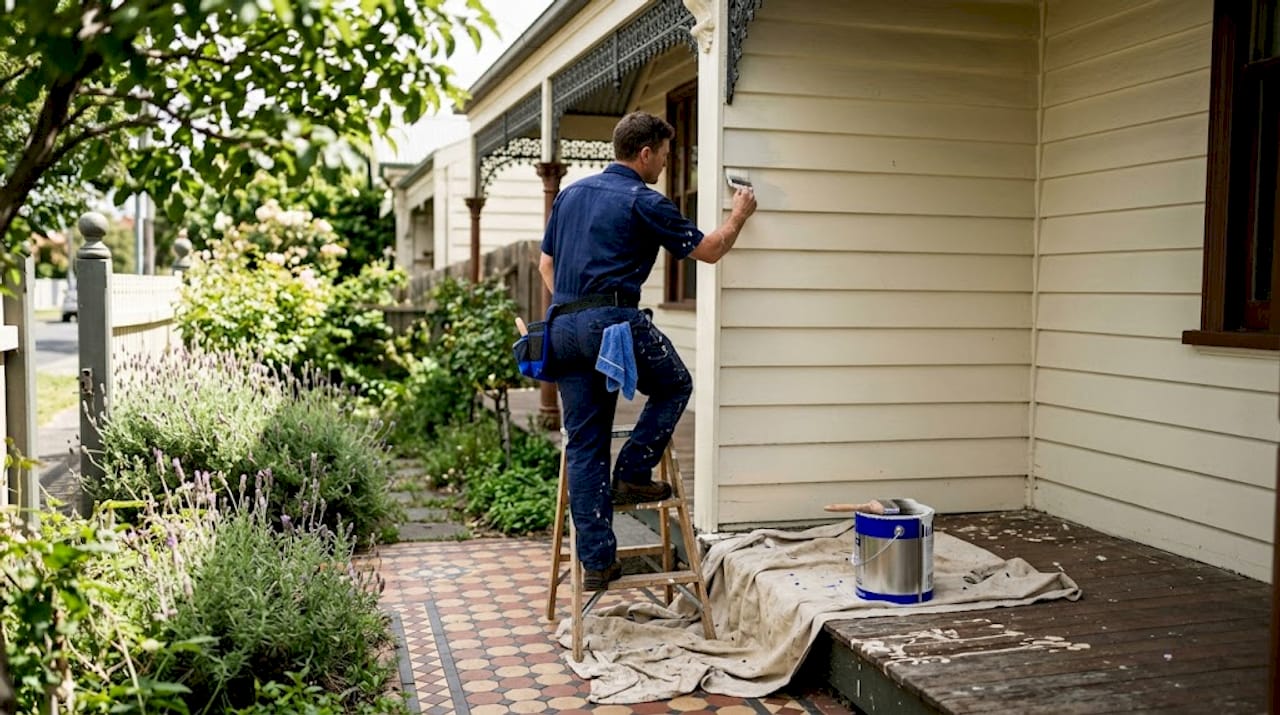
Lighter tones such as Dulux Hog Bristle Quarter or Blended Cream reflect heat and resist UV-related fading better than deeper tones. They also help the ornate timber details of a Victorian verandah read clearly against the wall surface.
For south or east-facing façades with limited direct sunlight:
Warmer off-whites and creams prevent the façade from appearing flat or washed out. A tone like Dulux Natural White or a period cream with a yellow-warm undertone adds life to shaded elevations.
For rendered Edwardian homes:
Warm greys such as Clear Concrete or Reckless Grey work well on smooth or lightly textured render. These tones read as understated and contemporary while still being respectful of the period. Lighter colours enhance the sculptural quality of render mouldings and corbels.
For Victorian weatherboard homes:
A classic three-colour scheme remains the most reliable approach: a recessive main tone for the boards, a mid-depth accent for the fascia and frieze, and a defined contrast colour for window frames, door surrounds, and decorative trims. Traditional combinations pair a warm cream body with a deep green or chocolate trim, while modern interpretations might use a warm grey body with a charcoal trim and a brass or terracotta accent door.
As noted in research on heritage colour in Melbourne, lighter tones work best on shaded areas while darker tones suit sun-exposed walls, and Melbourne weather demands genuinely durable, weatherproof coatings. Breathable systems are particularly important for rendered surfaces, as non-breathable paint can trap moisture behind the render and cause bubbling or cracking.
It is equally important to match your paint type to the substrate. Timber, render, and brick each require a different primer and topcoat system to perform over time. Consult our weatherproof painting advice for a full breakdown of coating systems by substrate type.
For homeowners weighing up paint quality, the premium paint comparison resource outlines why investing in premium coatings delivers measurably longer performance on heritage exteriors. If you are also managing the removal of old paint layers, this safe paint removal guide provides practical 2026 guidance for homeowners.
Summary of colours to consider by architecture type:
- Victorian weatherboard: Colonial cream, warm white, Brunswick green trims
- Edwardian render: Clear Concrete, Blended Cream, Hog Bristle Quarter
- Federation brick: Soft ochre wash, aged cream for render panels, deep red trims
- Late Victorian terrace: Deep charcoal or slate trims, cream or natural white body
How to pair and test your exterior colours
With a shortlist of colours identified, a structured selection process will protect both your aesthetic vision and your planning application.
- Shortlist three to five colours that sit within your chosen palette family. Include at least one traditional tone and one modern neutral for comparison purposes.
- Order large sample pots and paint A4-sized or larger boards with two coats. Do not assess small chips or screen-based previews. Exterior light conditions make these unreliable.
- Place sample boards outdoors against the actual façade surface for a minimum of three days. Review in morning light, at midday, and at dusk. This reveals how the tone shifts across Melbourne’s variable light conditions.
- Pair with fixed elements. Hold each sample board next to the roof, exposed brickwork, and any permanent feature such as stone steps or a rendered column. The colour must read well against all of these simultaneously.
- Seek informal council feedback. Many councils offer a pre-application service where a heritage officer will give preliminary guidance on a proposed colour scheme. This step can save weeks of formal permit processing time.
- Confirm your surface preparation plan. A heritage prep 80/20 rule is commonly applied in practice: roughly 80% of a successful paint outcome depends on preparation quality, and only 20% on the coating itself. Sound preparation is also a factor councils assess when reviewing restoration proposals.
“Period-matched palettes achieve approximately a 90% council approval rate. Choosing colours with strong historical grounding is not just about aesthetics. It is the single most reliable strategy for a smooth planning outcome.”
Pro Tip: Assess your paint longevity expectations before finalising a palette. With quality preparation and premium coatings, an exterior repaint on a Melbourne heritage home should last a full ten to fifteen years without requiring major intervention.
Why councils and designers disagree on heritage colours
Clients frequently ask why council heritage officers are so cautious about colour, particularly when a proposed modern neutral seems entirely respectful of the architecture. The honest answer is that councils and designers are solving different problems, and the tension between their views is worth understanding before you enter the approval process.
Council heritage officers are primarily responsible for protecting the visual character of an entire streetscape, not just your individual property. When they assess a proposed colour scheme, they consider how it will read alongside every neighbouring property, many of which may already carry traditional period tones. A charcoal or deep slate, even when beautifully resolved on your home in isolation, can create a jarring contrast in a street dominated by creams and greens. Their conservatism is not arbitrary. It reflects a genuine responsibility for collective amenity.
Leading designers and architects, on the other hand, work at the scale of a single property. Their brief is to express the architecture clearly and create a refined, contemporary result. They often argue, with good reason, that a strict cream-and-green replication can feel more like a costume than a genuine restoration. Muted charcoals, warm greys, and earthy neutrals can be more sympathetic to the underlying architecture than a forced historical replica.
The real insight here is that modern heritage updates gain council support when they are proposed as part of a thorough restoration plan. A homeowner who is repairing render, restoring original timber windows, and reinstating missing verandah details alongside a colour update is making a much stronger case than someone requesting a colour change in isolation. The colour becomes part of a broader story of care and conservation, and that matters enormously to a heritage officer’s assessment.
The practical takeaway is this: use evidence-based modern neutrals, propose them alongside genuine restoration work, and engage your council early. That combination achieves curb appeal, permit approval, and long-term value. Explore further heritage insights from Sol Shine’s project experience to see how this balance has been achieved on real Melbourne properties.
Get expert help with your exterior colour project
Selecting the right colour for a heritage façade involves regulatory knowledge, materials expertise, and a trained eye for proportion and tone. It is not a decision that should rest on a single paint chip held up in a hardware store.

Sol Shine specialises in Melbourne exterior painting for Victorian and Edwardian homes across Kew, Hawthorn, Camberwell, Brighton, Malvern, and surrounding suburbs. Our heritage painting services cover everything from council permit navigation and paint scrape analysis through to full surface preparation, premium coating application, and heritage timber trim detail work. For homeowners considering a larger scope of work, our team also handles render repair, brickwork restoration, and timber window restoration under one roof. If you want to understand how a well-executed exterior repaint contributes to long-term property value, our restoration value insights provide a clear picture of the return on investment for heritage homes above $2 million.
Frequently asked questions
Do I always need council approval to change heritage exterior colours?
In most Heritage Overlay zones, a planning permit for colour changes is required, even for relatively minor shifts from the existing tone. The level of scrutiny depends on your property’s heritage grading.
What’s the most popular Dulux exterior colour for heritage homes in 2026?
Blended Cream and Clear Concrete from the 2026 Dulux Elemental palette are widely used on Melbourne heritage exteriors for their versatility and council-friendly neutrality.
How long should exterior paint last on a Melbourne heritage home?
With thorough preparation and premium coatings, Dulux exterior paint lasts ten to fifteen years on heritage homes, even in Melbourne’s demanding climate.
Does it matter if I use modern colour tones on a heritage home?
Councils may approve modern neutrals such as warm greys or charcoals if they are recessive and complement heritage features and are submitted as part of a comprehensive restoration plan rather than a standalone colour change.
Are there special types of paint needed for Melbourne’s climate?
Yes. Breathable paint systems for render are essential to prevent moisture becoming trapped behind the surface, and all exterior coatings on heritage homes should be rated for durability in conditions of high UV exposure and significant seasonal rainfall.


