
TL;DR:
- A period home exterior repaint requires careful phases including heritage assessment, surface preparation, and breathable coating application. Proper compliance, high-level surface prep, and hand-brushing techniques ensure longevity and heritage accuracy. Cutting corners in preparation often leads to premature failure and regulatory issues.
A period home exterior repaint workflow is a structured, stage-by-stage process combining heritage-compliant surface preparation, breathable coating systems, and precise hand-application techniques to restore and protect historic façades. Melbourne’s Victorian and Edwardian homes require this level of care because standard residential painting methods actively damage historic substrates. Modern latex paints trap moisture causing damage within 2–5 years on period timber and render. Getting the workflow right from the outset protects both the structural integrity of your home and its heritage character. Sol Shine works exclusively on projects of this scale and complexity, and this guide reflects what that work actually involves.
What does a period home exterior repaint workflow involve?
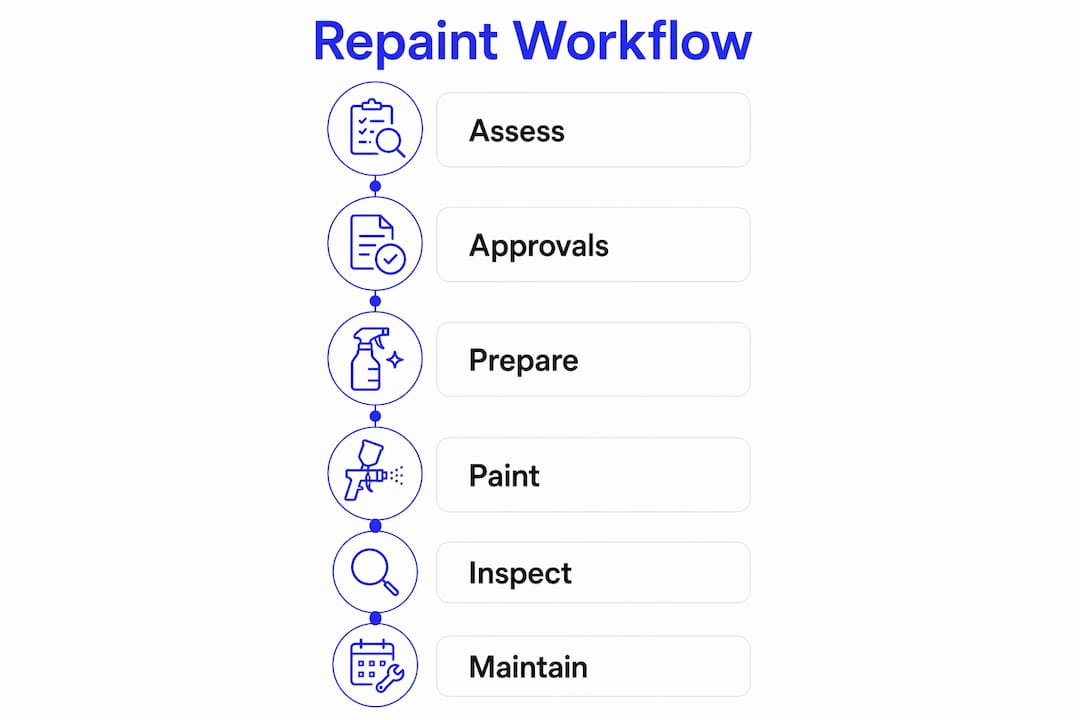
The period home exterior repaint workflow covers six distinct phases: regulatory assessment, planning approvals, surface preparation, material selection, paint application, and post-project maintenance planning. Each phase depends on the one before it. Skipping or compressing any stage is the single most common reason period home repaints fail within a few years.
Heritage conservation requirements in Melbourne vary by suburb and property overlay. Homes in areas like Kew, Hawthorn, Camberwell, and Brighton often sit within Heritage Overlay precincts under the relevant local planning scheme. This means colour changes, render repairs, and even repainting can require council approval before work begins. Consulting your local conservation officer before committing to any scope is the correct first step.
Large-scale heritage exterior repaint projects commonly start above $20,000 due to specialist preparation and materials. That figure reflects the true cost of doing this work properly, not a premium for its own sake.
What planning and approvals do you need before starting?
Regulatory compliance is the foundation of any Victorian or Edwardian home painting project workflow. Conservation area consents require an 8-week determination period as standard, and unlisted buildings may still need formal approvals depending on local planning overlays. Starting work without the correct approvals risks enforcement action, stop-work orders, and costly reinstatement.
Key planning requirements to address before work begins:
- Heritage Overlay check: Confirm whether your property sits within a Heritage Overlay via your local council’s planning portal.
- Colour scheme approval: Some overlays restrict colour palettes to period-accurate ranges. Submit proposed colours with your application.
- Material restrictions: Render type, paint system, and trim materials may all be specified by the overlay conditions.
- Lead-safe work plan: Properties built before 1970 almost certainly contain lead paint. A documented lead-safe work plan is required under safety standards for heritage home painting.
- Scaffolding permits: Scaffolding on public footpaths requires a separate permit from your local council.
| Requirement | Typical timeline | Notes |
|---|---|---|
| Heritage Overlay check | 1–2 days | Via council planning portal |
| Colour scheme approval | 4–8 weeks | Submit with full application |
| Lead-safe work plan | 1 week | Required for pre-1970 homes |
| Scaffolding permit | 2–4 weeks | Required for footpath access |
| Contractor booking | Book by april | Quality practitioners fill quickly |
Pro Tip: Book your heritage painting contractor by april for a summer start. Quality practitioners in Melbourne’s inner east and bayside suburbs fill their schedules months ahead, and rushing this decision leads to poor contractor choices.
Many homeowners overlook the need for approvals for seemingly minor works like paint colour changes. The regulatory risk is real, and the cost of enforcement far exceeds the cost of compliance.
How do you prepare period home exterior surfaces correctly?
Surface preparation accounts for 60–70% of project time on a heritage repaint. That proportion surprises most homeowners, but it explains why properly prepared period homes hold their finish for 10–15 years while poorly prepared ones peel within three.
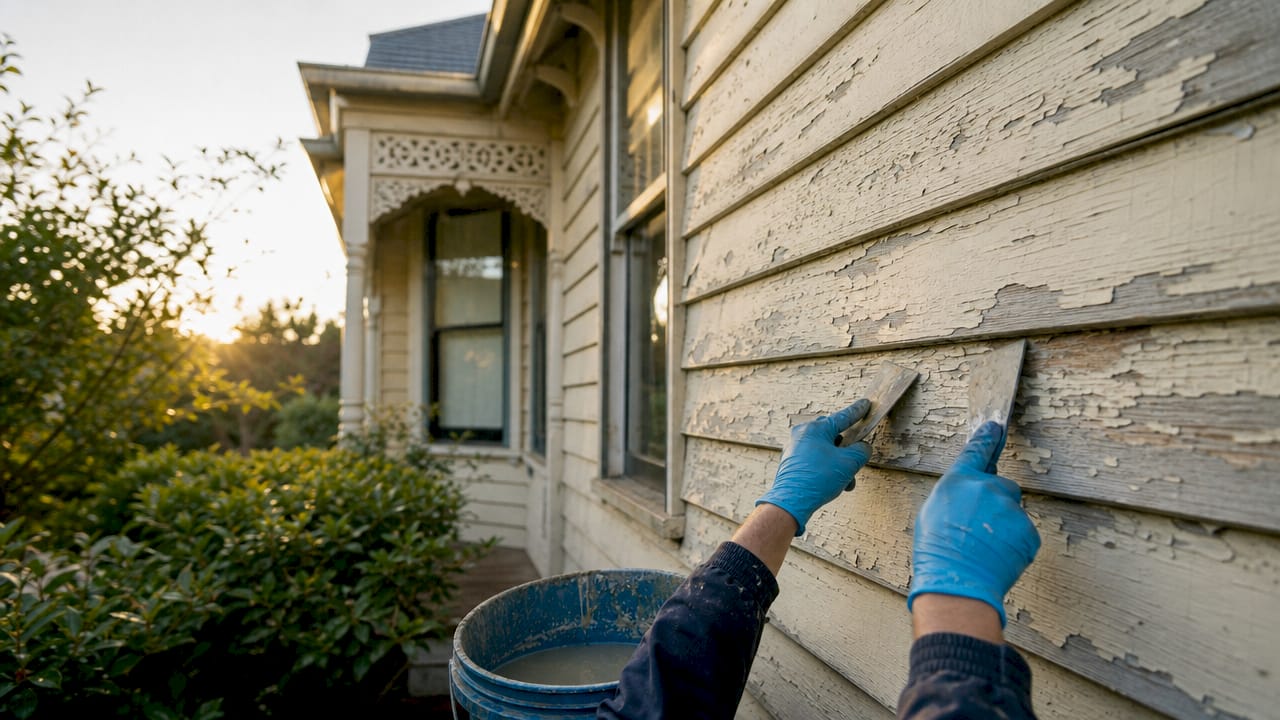
Preparation falls into three tiers, each suited to different substrate conditions:
| Preparation tier | What it involves | Best suited for |
|---|---|---|
| Low | Clean, light sand, spot prime | Sound surfaces with minimal paint failure |
| Medium | Scrape, sand, glaze cracks, full prime | Moderate weathering, some paint loss |
| High | Bare wood scraping, rot repairs, consolidation, full prime | Significant paint failure, rot, or moisture damage |
Period homes in Melbourne almost always require high-level preparation. Weatherboard homes in Fitzroy, Northcote, and Thornbury typically present with multiple paint layers, some containing lead, and varying degrees of timber rot at window sills, fascias, and weatherboard ends.
Lead-safe removal is non-negotiable on pre-1970 homes. This means wet scraping, HEPA vacuum collection, and containment sheeting. Dry sanding or heat-gun removal without containment is illegal and dangerous. Breathable limewash and vapour-permeable primers prevent the freeze-thaw moisture damage that destroys period substrates over time. Primer choice influences coating longevity more than topcoat selection.
Scaffolding for heritage homes can involve 6–8 weeks standing time, which must be factored into your project schedule and budget from the outset.
Pro Tip: Photograph every surface before preparation begins. A thorough photographic record identifies hidden rot, failed glazing, and cracked render that becomes visible only after paint is removed. This documentation also protects you if disputes arise mid-project.
Which paints and materials suit a period home’s exterior?
Paint selection for a historic home painting process is not simply a colour decision. The coating system must be vapour-permeable, compatible with the substrate, and appropriate to the architectural period of the home.
The three main coating systems used on Melbourne period homes are:
- Limewash: Breathable, mineral-based, and historically accurate for rendered masonry. Allows moisture to pass through without trapping it. Requires reapplication every 5–7 years but causes no substrate damage.
- Mineral silicate paint: Bonds chemically with masonry rather than sitting on the surface. Highly breathable and very durable. Suited to rendered Victorian and Edwardian façades.
- Oil-based coatings: Traditional choice for timber surfaces including weatherboards, fascias, and window joinery. Penetrates the timber grain and remains flexible as the timber moves seasonally.
Modern acrylic and latex paints are the wrong choice for period exteriors. They form an impermeable film over the surface, trapping moisture and causing substrate rot and peeling within a few years. The damage is often invisible until it is severe.
Period-accurate colour palettes are available through heritage paint ranges. Sol Shine’s team draws on period home paint options specific to Victorian and Edwardian homes, including historically referenced colour schemes that satisfy council approval requirements. Primer selection must match the topcoat system. An oil-based primer under a mineral topcoat will cause adhesion failure. Matching the full system from primer to finish coat is the correct approach.
How is the exterior repaint actually executed on a period home?
A full exterior heritage repaint for a two-storey period home typically requires 10–18 working days due to intensive hand-preparation, lead-safe practices, and multi-coat finishing. That timeline assumes good weather and no hidden substrate damage discovered during preparation.
The execution sequence follows this order:
- Scaffold erection and site setup. Containment sheeting installed for lead-safe work. All surfaces accessible before preparation begins.
- Lead-safe paint removal. Wet scraping, HEPA collection, and disposal in accordance with EPA Victoria requirements.
- Timber repairs. Rot cut out and replaced with matching timber profiles. Window sills, fascias, and weatherboard ends treated with consolidant where rot is minor.
- Surface sanding and glazing. All surfaces sanded to a consistent profile. Cracks and gaps filled with appropriate flexible glazing compound.
- Priming. Full prime coat applied to all bare and repaired surfaces. Spot priming is not sufficient on period homes with extensive paint removal.
- First finish coat. Applied by hand using natural bristle brushes. The lay on and tip off technique loads paint heavily with one brush, then refines with a fine bristle brush to eliminate brush marks and preserve grain texture.
- Full curing between coats. Minimum 24 hours in Melbourne conditions, longer in cooler or humid weather. Applying the next coat too early causes lifting and wrinkling.
- Second and third finish coats. Heritage finishes typically require two to three topcoats for full opacity and durability.
- Ornamental trim and window sash work. Completed last, with fine brushwork on architraves, column capitals, fretwork, and sash rails.
- Final inspection and touch-up. Full walkround inspection in natural light. Touch-ups completed before scaffold is struck.
Pro Tip: Temperature and humidity directly affect paint adhesion and curing. Do not apply paint when surface temperatures exceed 35°C or drop below 10°C. Melbourne’s autumn months, march through may, offer the most consistent conditions for heritage exterior painting.
Environmental conditions matter as much as technique. Painting in direct summer sun causes the paint to skin over before it penetrates the surface, leading to poor adhesion and early failure.
What are the most common problems during a period home repaint?
The most common failure point in repainting vintage homes is inadequate preparation followed by an incompatible coating system. These two errors together account for the majority of premature paint failures on Melbourne period homes.
Key risks to manage throughout the project:
- Peeling within 2–3 years: Almost always caused by insufficient preparation, moisture trapped under a non-breathable coating, or applying paint over contaminated surfaces.
- Regulatory non-compliance: Changing a colour or repainting render without council approval in a Heritage Overlay area can result in enforcement notices and mandatory reinstatement at your cost.
- Rushed scheduling: Compressing curing times between coats to meet a deadline causes lifting, wrinkling, and adhesion failure across large surface areas.
- Lowball contractor selection: Low-priced contractors cut prep corners, resulting in paint peeling within a few years. Inspect a contractor’s completed projects that are 3–5 years old, not freshly finished work.
- Ignoring ongoing maintenance: Even a correctly executed heritage repaint requires annual inspection of sealants, glazing, and drainage to achieve its full lifespan.
“The proof is in the ageing. Ask any contractor for references on jobs completed three to five years ago, then go and look at them. Fresh work always looks good. Aged work tells the truth.”
Sol Shine’s approach to paint durability for Melbourne heritage homes is built on this principle. Longevity is the measure of quality, not the finish on day one.
Key takeaways
A correctly executed period home exterior repaint workflow depends on regulatory compliance, high-level surface preparation, and breathable coating systems applied in sequence, with each stage directly affecting the longevity of the finish.
| Point | Details |
|---|---|
| Approvals come first | Check Heritage Overlay requirements and secure council consent before any work begins. |
| Preparation is the majority of the work | High-level prep accounts for 60–70% of project time and determines how long the finish lasts. |
| Coating system must breathe | Vapour-permeable primers and period-appropriate topcoats prevent moisture damage and substrate rot. |
| Hand-brushing preserves authenticity | The lay on and tip off technique maintains grain texture and avoids the flat finish of sprayed coatings. |
| Book early and vet contractors carefully | Quality heritage painters book out by april; inspect their aged work, not their fresh work. |
What I have learned after years on Melbourne period homes
The preparation gap is where most projects fail
The single biggest mistake I see on period home repaints is underinvestment in preparation. Homeowners receive three quotes, the middle one looks reasonable, and the contractor spends two days on prep before painting. Six months later, the paint is lifting at every weatherboard end.
High-level preparation on a two-storey Victorian or Edwardian home is a week of work before a brush touches a finish coat. That is not padding the schedule. That is what the substrate requires. When I walk a property and see sound, stable surfaces after prep, I know the finish will last. When I see shortcuts, I know exactly when the phone will ring.
Melbourne’s heritage suburbs add another layer of complexity that generic painting contractors simply do not account for. Conservation officers in Boroondara, Stonnington, and Port Phillip have specific expectations around colour accuracy and material compatibility. Getting that wrong costs far more to fix than getting it right the first time.
The other thing I would tell any homeowner is this: breathable coatings are not optional on period homes. They are the difference between a finish that lasts a decade and one that fails in three years. The substrate of a Victorian weatherboard home needs to breathe seasonally. Seal it with a modern acrylic and you are trapping moisture with nowhere to go.
— Jarrad
Sol Shine’s heritage painting services for Melbourne period homes
Sol Shine specialises in heritage exterior painting for Victorian and Edwardian homes across Melbourne’s inner east and bayside suburbs, including Kew, Hawthorn, Camberwell, Brighton, and Malvern. Every project is managed under one roof, from heritage overlay consultation and scaffolding coordination through to final coat and post-project inspection.
Sol Shine’s craftsmen work exclusively with period-appropriate coating systems, breathable primers, and hand-brushing techniques suited to historic timber and render substrates. Projects typically start at $20,000 and are handled by a single, experienced team rather than subcontracted crews. If you are planning a heritage painting project for your period home, Sol Shine can assess your property, advise on council requirements, and provide a detailed scope before any work begins. Get in touch to arrange a site consultation.
FAQ
How long does a period home exterior repaint take?
A full exterior heritage repaint for a two-storey period home typically requires 10–18 working days. This includes lead-safe preparation, timber repairs, priming, and multiple finish coats with full curing time between each.
Do I need council approval to repaint my period home in Melbourne?
Properties within a Heritage Overlay precinct often require council approval before repainting, particularly for colour changes or render repairs. The standard determination period is 8 weeks, so apply well before your planned start date.
Why can’t I use standard acrylic paint on a period home?
Modern acrylic and latex paints form an impermeable film that traps moisture in historic substrates, causing bubbling, peeling, and timber rot within 2–5 years. Period homes require vapour-permeable coatings that allow the substrate to breathe.
What is the lay on and tip off technique?
Lay on and tip off is a hand-brushing method where paint is loaded heavily with a natural bristle brush, then refined with a fine bristle brush to eliminate brush marks and preserve the grain texture of historic timber surfaces.
How do I choose a reliable heritage painting contractor?
Ask for references on projects completed 3–5 years ago and inspect those properties in person. Fresh work always looks good. Aged work reveals whether the contractor invested in proper preparation and compatible materials.


