
TL;DR:
- Heritage regulations require permits for exterior repainting on Victorian and Edwardian homes in Melbourne.
- Selecting historically appropriate and breathable paints ensures long-lasting and authentic restoration results.
- Proper surface preparation and use of suitable paint types are essential to prevent damage and maintain heritage value.
Selecting paint for a Victorian or Edwardian home in Melbourne is rarely as simple as choosing a colour you love. Many homeowners discover too late that a trending tone from a contemporary palette sits firmly outside what their heritage overlay permits, leaving them facing costly repainting or council notices. The decisions you make around paint type, colour accuracy, surface preparation, and regulatory compliance will determine whether your restoration adds lasting value or creates ongoing problems. This guide walks you through the critical factors every Melbourne heritage homeowner needs to understand before a single brush is lifted.
Table of Contents
- Understanding heritage overlays and permit rules
- Choosing historically appropriate paints and colours
- Technical factors: Paint type, breathability, and durability
- Preparation and application matters: Surfaces, removal, and techniques
- Balancing regulation, history, and liveability
- What most guides miss about paint selection for heritage homes
- Expert heritage painting for Melbourne homes
- Frequently asked questions
Key Takeaways
| Point | Details |
|---|---|
| Check permit requirements | Always verify council overlay rules before starting any exterior heritage painting project. |
| Respect period colours and finishes | Choose paints and shades authentic to your home’s era to enhance heritage value and comply with regulations. |
| Prioritise breathable, durable paints | Opt for materials that preserve old surfaces and prevent common moisture damage. |
| Prepare surfaces carefully | Proper, non-destructive preparation is essential for painting success and surface longevity. |
| Balance history with modern needs | Find practical solutions that satisfy both period style and today’s liveability demands. |
Understanding heritage overlays and permit rules
Melbourne’s Victorian and Edwardian streetscapes are protected through a planning tool called the Heritage Overlay. Applied by local councils across suburbs from Fitzroy to Brighton, this overlay controls what you can and cannot do to the exterior of a heritage-listed or heritage-contributory property. Paint colour, finish, and even the act of repainting itself can fall under these controls.
The key distinction most homeowners miss is the difference between exterior and interior regulations. Interior repainting is almost always exempt from permit requirements. The exterior is where the rules become specific and, at times, complex. Many councils impose what are called external paint controls, which means any change to the exterior colour scheme requires a planning permit before work begins. Permit often required for exterior repainting under Heritage Overlay, even when the change seems minor.
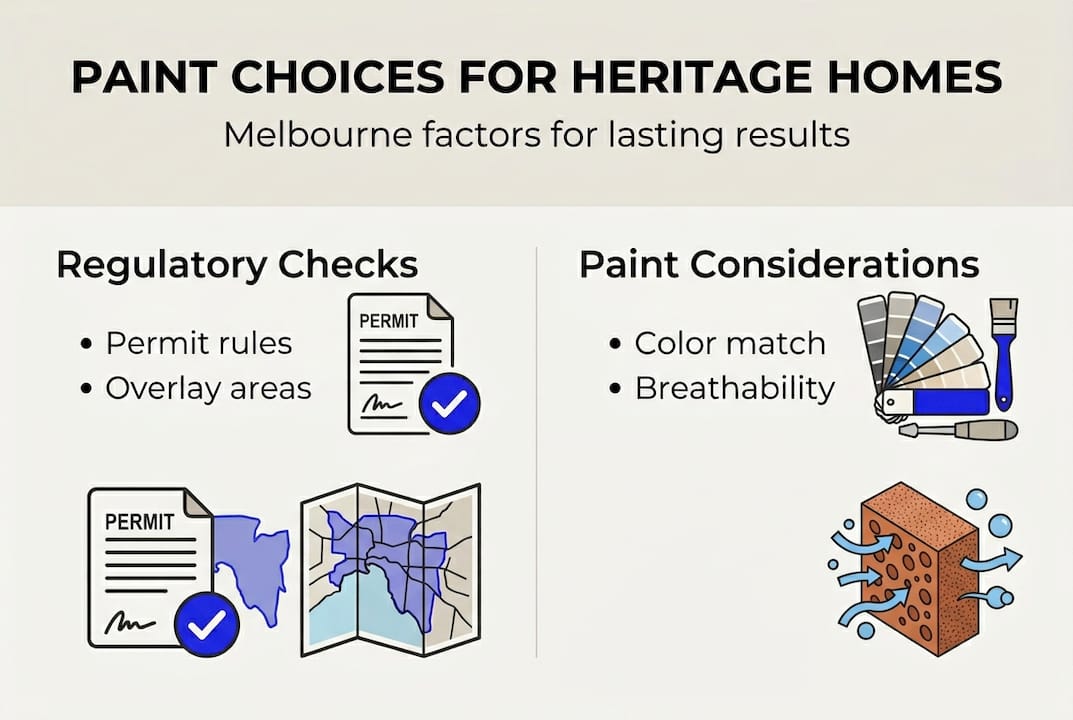
Understanding Victorian and Edwardian repaint rules is essential before you commit to any colour scheme. Some councils allow repainting in the same existing colour without a permit, while others require approval regardless. This varies by council, by overlay schedule, and sometimes by individual property significance.
Here is a practical checklist to help you confirm your overlay requirements before starting:
- Check your property address on your council’s planning portal or VicPlan
- Identify whether a Heritage Overlay applies and note the schedule number
- Confirm whether external paint controls are triggered in that overlay schedule
- Contact your council’s heritage planner for a pre-application meeting
- Engage a heritage consultant if your property is individually significant
For compliant heritage painting, starting with the regulatory framework removes the risk of expensive reversals down the track. A planning permit application for exterior repainting is not necessarily complex, but it does require documentation including a colour schedule and, in some cases, a heritage impact statement. Getting this right from the outset protects both your investment and the heritage character of your home.
Choosing historically appropriate paints and colours
With regulations clearly understood, the next challenge is selecting colours that feel both authentic and considered. Primary factors include regulatory compliance, historical accuracy, and non-destructive method requirements, and colour sits at the intersection of all three.
There are two broad approaches heritage homeowners take. The first is strict historical replication, which means researching the original paint scheme and reproducing it as closely as possible. The second is an interpretive approach, which uses period-accurate tones as a reference but allows for refinement to suit the current home and family.
| Approach | Colour source | Council reception | Best suited to |
|---|---|---|---|
| Strict replication | Paint scraping, historical records | Generally preferred | Individually significant properties |
| Interpretive | Dulux heritage palettes, period references | Acceptable with justification | Contributory or comparable homes |
| Contemporary extension | Contrasting modern tones | Requires strong justification | Non-original additions or extensions |
For researching original colours, there are three reliable methods:
- Paint scraping: A conservator carefully removes layers of paint to reveal the original substrate colour. This is the most historically accurate method.
- Old photographs: Archival images of the streetscape or property can indicate broad tonal families, particularly useful when scraping is not practical.
- Dulux heritage palettes: Dulux produces a curated range of period-appropriate colours used widely across Melbourne’s inner suburbs, offering a credible starting point.
“Colour selection for a heritage property is not simply an aesthetic choice. It is a statement of custodianship, acknowledging the layers of history embedded in every surface.”
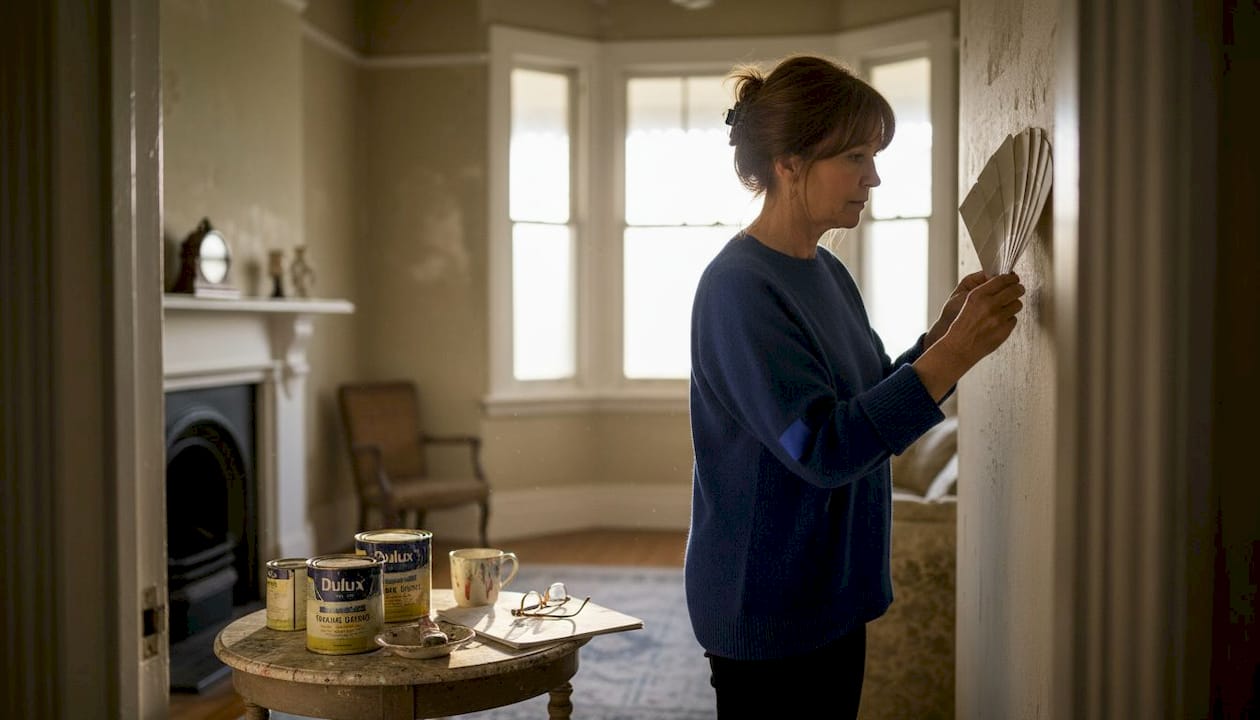
When choosing period-accurate finishes, consider not just the colour but the sheen level. Original Victorian and Edwardian homes typically used oil-based finishes with a mid-sheen on joinery and a flatter tone on render or brick. Matching that hierarchy of finish across your façade creates visual coherence and period authenticity.
Technical factors: Paint type, breathability, and durability
Beyond colour, it is the paint’s technical qualities that determine whether your restoration lasts decades or requires costly attention within a few years. Standard modern paints, while excellent on new substrates, can cause significant damage on heritage surfaces.
The critical issue is breathability. Old solid brick, lime render, and heritage weatherboards all move moisture in and out of the wall system as temperature and humidity shift. Breathable paint types prevent moisture damage, a key concern for heritage homes. When a non-breathable paint is applied to a porous substrate, moisture becomes trapped and drives the paint film from below, causing blistering, peeling, and ultimately penetrating damp.
Here is a comparison of paint types and their suitability across common heritage surfaces:
| Paint type | Breathability | Best surface | Durability |
|---|---|---|---|
| Lime wash | Very high | Brick, lime render | Medium, requires maintenance |
| Mineral silicate | High | Brick, stone, render | High, fuses to substrate |
| Low-VOC acrylic | Medium | Primed timber, weatherboards | High with correct primer |
| Standard acrylic | Low | New substrates only | High on appropriate surfaces |
For best paint materials for heritage substrates, the general principle is to match the paint system to the original material. Lime render should receive lime-compatible or mineral coatings. Solid brick benefits from a breathable masonry paint. Timber weatherboards and joinery perform best with a quality oil-based or acrylic system suited to Melbourne’s variable climate.
Finish type also affects heritage paint durability over time. Flat sheens show more texture and have a period-authentic look but are harder to clean. Low-sheen and semi-gloss finishes on high-traffic areas such as hallways and kitchens offer practical scrubbability without looking out of place in a period interior.
Pro Tip: Ask your supplier or painter to confirm the vapour permeability rating of any paint proposed for solid masonry or lime render. A product with a high moisture vapour transmission rate will serve your heritage walls far better over the long term.
- Always prime bare timber with an oil-based or appropriate primer before topcoating
- Use a tinted primer where possible to improve topcoat opacity and reduce coats needed
- Allow adequate cure time between coats to prevent solvent entrapment
Preparation and application matters: Surfaces, removal, and techniques
The right paint means nothing without correct preparation and care in application. Surface preparation and non-destructive removal methods are essential for period restoration, particularly where original timber mouldings, cornices, and joinery must be preserved.
Follow these steps for preparing common heritage surfaces:
- Inspect thoroughly: Identify all areas of flaking, moisture damage, rot, or previous incompatible coatings before selecting a removal method.
- Remove paint carefully: Use heat guns on low settings for timber, wet scraping for render, and chemical strippers only where absolutely necessary and appropriate to the substrate.
- Repair substrate damage: Address any rot, cracking, or render failures with period-compatible materials before any coating is applied.
- Clean and degrease: Remove all dust, mould, and contamination with appropriate cleaning agents.
- Prime correctly: Apply the right primer for the substrate and topcoat combination before finishing coats begin.
Common mistakes that damage heritage surfaces include:
- Over-sanding fine decorative timber profiles, which removes irreplaceable detail
- Using high-strength chemical strippers on brick or render, which can cause surface spalling
- Filling original timber with modern expanding fillers that move at a different rate and cause paint failure
- Applying coatings before the substrate has fully dried following cleaning or repair
Application technique matters just as much as product choice. Brush application remains the gold standard for fine heritage joinery and decorative timber, as it forces paint into profiles and ensures full coverage. Roller application suits flat wall areas, while airless spray is reserved for experienced painters working with appropriate masking in place.
Pro Tip: If you are unsure whether a surface has been previously coated with lead-based paint, test it before any sanding or heat removal. Lead paint is common in homes built before 1970 and requires safe handling procedures.
For large or complex heritage projects, engaging specialist heritage painters with demonstrated experience in period surfaces is not a luxury. It is a practical safeguard. Pair that with a solid maintenance guide for heritage paintwork to protect your investment between full repaints.
Balancing regulation, history, and liveability
Having covered technical and process factors, it is worth addressing how these intersect with real-life decisions in Melbourne homes. Not everything needs to be a strict restoration. Many homeowners are restoring properties they intend to live in fully, and liveability must be part of the equation.
Modern colours are possible if justified by cultural significance, and high-traffic needs require scrubbable paints. For extensions that are clearly non-original, councils will often accept contrasting contemporary tones provided they do not visually dominate the heritage fabric. This is where a skilled heritage consultant and an experienced painting specialist can guide you through the council negotiation process.
“The goal is not a museum. It is a home that honours its heritage while supporting the life being lived within it.”
Key considerations when balancing heritage and daily living include:
- Sustainability: Low-VOC and water-based paints reduce environmental impact and improve indoor air quality, both priorities for modern households
- Property value: Correctly restored and documented heritage properties consistently attract premium buyers in Melbourne’s inner suburbs
- Protection: Heritage paint systems that suit the substrate protect the building fabric, reducing structural maintenance costs over time
- Council relationship: Proactive engagement with your council’s heritage team builds goodwill and can make future applications smoother
For guidance on sustainable paint choices within a heritage context, there are now a number of premium paint systems that meet both breathability requirements and low-VOC standards. These options allow you to restore authentically without compromising your household’s environmental values.
What most guides miss about paint selection for heritage homes
Most guides focus on the rulebook. Heritage overlays, permit thresholds, colour matching methodologies. These are essential, but they can lead homeowners into a rigid mindset that actually works against a good outcome.
At Sol Shine, the most successful heritage restorations we see are the ones where the homeowner understands the rules well enough to have a confident dialogue with council, their heritage consultant, and their painting team. Strict historical replication is sometimes the right outcome. Other times, an interpretive approach using premium paint for heritage surfaces delivers a result that is more durable, more liveable, and still genuinely respectful of the building’s story.
Every Victorian and Edwardian home has its own layered history. The families who lived in it, the alterations made across generations, and the streetscape it contributes to. Paint selection should reflect that particular history, not a generic template. When you treat colour choice as an ongoing conversation between past and present rather than a compliance exercise, the results are almost always more considered and more lasting.
Expert heritage painting for Melbourne homes
Understanding what is involved in a compliant and well-executed heritage restoration is the first step. Translating that understanding into a result that genuinely enhances your home is where specialist skills matter.
Sol Shine provides heritage painting services across Melbourne’s inner east, bayside, and surrounding suburbs, with expertise in Victorian and Edwardian properties. From colour schedule preparation and council engagement through to surface restoration and final finish, we manage the full scope under one roof. We also offer specialist guidance on heritage window repairs and a complete range of restoration trades for period homes. Contact our team to discuss your project and receive tailored advice for your property.
Frequently asked questions
Do I need council approval to repaint my heritage home’s exterior in Melbourne?
You usually need council approval if your property falls under a Heritage Overlay with external paint controls, but not for interiors or routine maintenance. Permit often required for exterior repainting under Heritage Overlay, so always check with your council before proceeding.
How can I find out the original colours used on my Victorian home?
Paint scraping by a conservator is the most accurate method, but original colours can also be identified through archival photographs and period-specific Dulux heritage colour charts relevant to Melbourne.
What type of paint is best for avoiding moisture issues in heritage homes?
Breathable paints such as lime-based or mineral silicate coatings help avoid moisture entrapment on heritage substrates. Breathable paint types prevent moisture damage and are particularly important for solid brick and lime render walls.
Can I use modern colours in a Victorian or Edwardian heritage home?
Modern colours are possible in certain cases, particularly for extensions or when justified by cultural significance, but council approval is often required. Modern colours possible if justified by significance, so engage your council heritage planner early.
What is the most common mistake in heritage painting projects?
Skipping thorough preparation or applying a paint system that does not suit the substrate’s breathability needs almost always leads to premature flaking and moisture damage. Surface preparation and appropriate paint selection are both critical to a lasting result.


