
TL;DR:
- High-performance commercial-grade paints have higher resin and solids content for durability and UV resistance. Proper surface preparation and correct application are essential for long-lasting heritage preservation. Using the right specifications can extend paint life up to 25 years and reduce maintenance costs.
Not all paints are created equal, and for owners of Victorian and Edwardian homes across Melbourne, that distinction carries real consequences. Many heritage façades fail prematurely, not because of the climate or the age of the timber, but because the paint chosen simply wasn’t built for the job. Products marketed as ‘premium’ at hardware stores often lack the resin content, UV resistance, and film-build required to protect intricate heritage surfaces through Melbourne’s variable seasons. This article explains what commercial-grade paint actually is, how it differs from standard residential options, and why the right specification matters enormously for the long-term condition of your home.
Table of Contents
- Defining commercial-grade paint: What sets it apart?
- Commercial-grade vs residential paint: Side by side
- Durability and performance: Why it matters for Melbourne heritage homes
- Best practices: Applying commercial-grade paint to heritage exteriors
- The Melbourne expert’s view: What most guides miss about commercial-grade paint for heritage homes
- Get heritage results with Melbourne’s commercial-grade specialists
- Frequently asked questions
Key Takeaways
| Point | Details |
|---|---|
| True commercial-grade durability | Commercial-grade paint is engineered for tougher conditions and outlasts standard options, key for heritage homes. |
| Follow Australian standards | Always check paint complies with AS/NZS 2311 and use adapted best-practice prep for older surfaces. |
| Right prep means longer life | Thorough cleaning and priming as per spec makes the difference between a finish that lasts decades and one that peels. |
| Not just for businesses | Low odour, fast-drying commercial paints are ideal for live-in renovations and heritage facades. |
| Get expert advice | Working with specialists ensures correct materials and methods for Melbourne’s unique Victorian and Edwardian homes. |
Defining commercial-grade paint: What sets it apart?
Commercial-grade paint refers to high-performance coatings for non-residential and high-traffic applications, prioritising durability, cleanability, and efficiency over residential aesthetics. That definition, however, only tells part of the story. In practice, these coatings are engineered to perform under sustained stress, whether that means repeated cleaning, prolonged UV exposure, or the expansion and contraction of heritage timber across changing seasons.
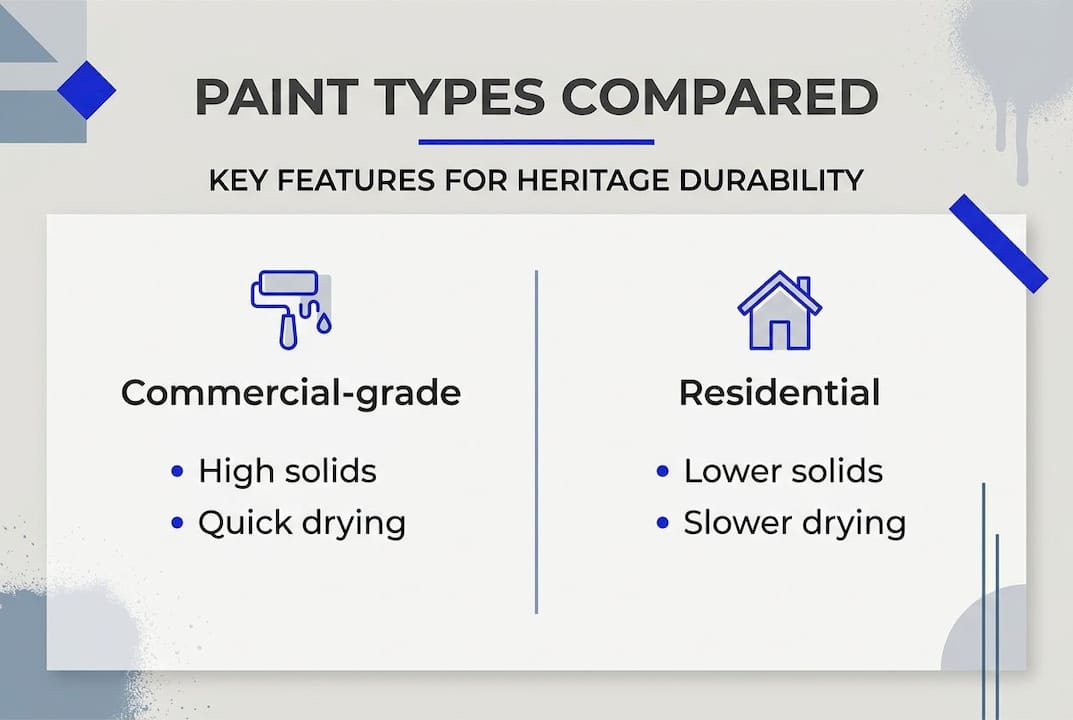
The chemistry is fundamentally different from what you find on a standard hardware shelf. Higher solids and resin content and better pigment quality, with compliance to AS/NZS 2311, are what separate commercial-grade products from their residential counterparts. More solids per litre means a thicker, more protective dry film. Better pigment quality means colour holds longer under UV without chalking or fading.
For heritage homes specifically, these properties matter. Ornate cornices, weatherboard profiles, and heritage timber trim are not flat, simple surfaces. They collect moisture, expand with heat, and demand a coating that flexes and adheres reliably over years, not months. Choosing premium paint materials designed for this level of performance is one of the most important decisions you can make before a brush touches your façade.
Here is a summary of what distinguishes commercial-grade paint at a formulation level:
- Higher resin and solids content for a thicker, more durable dry film
- UV-resistant pigments that retain colour and gloss under extended sun exposure
- Engineered for cleanability, resisting staining and allowing surface washing without film damage
- Compliance with AS/NZS 2311, Australia’s standard for painting of buildings
- Faster application and drying suited to professional-scale projects
“Commercial-grade coatings are not simply more expensive residential paints. They are a different category of product, built to different benchmarks and tested against different performance criteria.”
With this context in mind, next we’ll break down the major differences between commercial-grade and typical residential paint, so you can see what matters for your home.
Commercial-grade vs residential paint: Side by side
Understanding the practical differences between these two categories helps you ask better questions and make more confident decisions. The table below outlines the key distinctions.
| Feature | Commercial-grade paint | Standard residential paint |
|---|---|---|
| Resin and solids content | High | Moderate to low |
| UV and weather resistance | Engineered for extended exposure | Basic protection |
| Washability | Excellent | Variable |
| Dry film thickness | Greater | Thinner |
| Warranty | Up to 25 years (e.g. Dulux Weathershield) | Typically 5-10 years |
| VOC levels | Low in modern formulations | Variable |
| Finish options | Broad range | Broad range |
Australian commercial paints are acrylic-based, low-VOC, quick-drying formulations designed for use in occupied spaces. This is particularly relevant for homeowners who need painting works completed while continuing to live in their property. Products such as Wattyl I.D. Advanced offer low odour and fast recoat times, meaning disruption is minimised without compromising on performance.
For exterior applications, Dulux Weathershield is one of the most specified commercial systems in heritage work across Melbourne. Its formulation is designed to resist peeling, blistering, and colour fade across decades of real-world exposure. When you compare that against a standard retail acrylic, the difference in long-term value becomes clear.
Understanding how premium vs standard paints perform on heritage surfaces helps you avoid costly repaints within five years. It also helps you have a more informed conversation with your painting contractor about specification choices.
Pro Tip: Ask your painter to tint each coat a slightly different shade. This makes it easy to confirm full coverage during application and simplifies touch-up tracking over the life of the paint system.
After comparing the basics, the next step is understanding real-world durability and why it matters for Melbourne homes’ distinctive weather and heritage detail.
Durability and performance: Why it matters for Melbourne heritage homes
Melbourne’s climate is genuinely demanding. Ultraviolet radiation, temperature swings, coastal salt air in bayside suburbs, and periods of heavy rainfall all place sustained stress on exterior coatings. For a Victorian or Edwardian home with intricate timber detailing, the consequences of paint failure are not just cosmetic. Moisture ingress through failed paint film leads to timber rot, render cracking, and expensive structural repairs.

Commercial-grade paints are tested against rigorous durability benchmarks before they reach the market. Exterior gloss retention is tested via QUV-A accelerated weathering, where four to eight weeks of laboratory exposure correlates to years of real-world conditions. Superior resins retain gloss after four months of Los Angeles outdoor exposure testing. Dulux Weathershield carries a 25-year warranty against peeling in commercial applications, which is a meaningful benchmark for any heritage restoration project.
For heritage homes, this translates into practical benefits:
- Fewer repaints over the property’s lifetime, reducing both cost and disruption
- Better adhesion to complex profiles such as cornices, sills, and decorative timber trim
- Resistance to chalking and fading, preserving the refined appearance of heritage colour schemes
- Reduced maintenance burden between scheduled repaints
- Documented performance data that supports insurance and heritage overlay compliance
Choosing premium exterior painting services that specify commercial-grade systems means you are investing in documented performance, not just a brand name. For homeowners managing properties under heritage overlays in suburbs such as Kew, Hawthorn, or Camberwell, having that documented benchmark also supports compliance conversations with local councils.
Reviewing heritage paint longevity data specific to Melbourne conditions gives you a clearer picture of what realistic expectations look like for your property type and location.
Now that you know what makes commercial-grade paint so robust, let’s move to the essential steps for using these coatings correctly, especially on heritage properties.
Best practices: Applying commercial-grade paint to heritage exteriors
Even the best paint system will underperform on poorly prepared surfaces. This is the single most important principle in heritage painting, and it is frequently overlooked when homeowners focus too heavily on product selection alone. Preparation is where the real work happens.
AS/NZS 2311 surface preparation standards specify cleaning, sanding, gap filling, and priming requirements, with SSPC guidelines adapted for Australian conditions. Following these steps correctly determines how long your paint system will actually last.
Here is a recommended preparation and application sequence for heritage exteriors:
- Wash all surfaces thoroughly to remove dirt, mould, and chalking from existing paint
- Sand back any loose, flaking, or peeling paint to a firm edge
- Fill gaps and cracks in timber, render, and joinery using appropriate flexible fillers
- Apply a compatible primer suited to the substrate, whether it is bare timber, previously painted surfaces, or repaired render
- Tint the undercoat a shade slightly different from the topcoat to confirm coverage
- Apply topcoats in the specified number of coats, allowing full drying time between each
- Record batch numbers and colour formulas for future touch-up consistency
Pro Tip: Always retain your paint batch numbers and formulation records after a heritage project. Colour matching years later is far more reliable when you have the original formula, rather than relying on visual matching alone.
For occupied homes, prioritise low-VOC, quick-drying systems to keep living spaces comfortable during works. Thorough surface preparation is the foundation of any lasting result, and quality repainting prep for historical homes requires specific knowledge of older substrates, including lime render, lead paint management, and heritage-grade timber species.
With a firm grasp of specification and process, consider what Melbourne experts wish more homeowners understood about using commercial-grade paint.
The Melbourne expert’s view: What most guides miss about commercial-grade paint for heritage homes
Most articles about commercial-grade paint focus on product selection. Brand, warranty, sheen level. These are relevant, but they are not where most heritage painting projects succeed or fail. In Sol Shine’s experience working across Melbourne’s inner east and bayside suburbs, the gap between a paint job that lasts eight years and one that lasts twenty-five comes down to preparation quality, ongoing inspection, and documentation.
Homeowners sometimes invest in the best available coating and then skip the primer, rush the surface prep, or use a filler that isn’t compatible with the substrate. The coating performs exactly as poorly as the surface beneath it allows.
Touch-up consistency is also underestimated. Over time, minor repairs and spot painting are inevitable. If you don’t have the original batch records, matching the colour and sheen accurately becomes genuinely difficult. That inconsistency accumulates visually over years and undermines the appearance of an otherwise well-maintained façade.
Understanding how paint protects and extends the life of heritage homes reframes the entire conversation. Paint is not decoration. It is a protective system, and it deserves to be treated with the same rigour as any other building element.
Get heritage results with Melbourne’s commercial-grade specialists
If you are planning a significant painting or restoration project on your Victorian or Edwardian home, the specification decisions you make now will shape the outcome for decades. Sol Shine works with Melbourne homeowners on projects that demand both technical precision and genuine respect for heritage character.

Our team brings hands-on experience across heritage painting projects throughout Kew, Hawthorn, Brighton, Camberwell, and surrounding suburbs. From commercial-grade paint specification to full façade restoration, every project is managed under one roof. Explore our exterior painting services or get in touch to discuss your property’s specific requirements. We welcome enquiries from homeowners ready to invest in lasting, quality results.
Frequently asked questions
Can I use commercial-grade paint inside my home?
Yes, many modern commercial-grade paints are now formulated for low odour and low VOCs, making them safe and practical for interior use in occupied homes.
How long does commercial-grade paint typically last on heritage exteriors?
With proper preparation and quality materials, commercial-grade paint can last 10 to 25 years on heritage home exteriors. Dulux Weathershield carries a 25-year warranty against peeling in commercial applications.
What standards should commercial-grade paint comply with in Australia?
Commercial-grade paints should comply with AS/NZS 2311 for Australian performance and application standards, which cover surface preparation, application methods, and film performance.
What’s a common mistake when using commercial-grade paint on heritage homes?
Skipping thorough surface preparation or selecting an incompatible primer are the most common mistakes, and both lead to reduced durability, early peeling, and patchy finishes regardless of how good the topcoat is.


