
TL;DR:
- Paint is vital for protecting heritage homes from moisture, UV damage, and corrosion.
- Choosing the right product, application, and maintenance ensures long-term asset preservation.
- Proper surface prep, compliance with council rules, and regular inspections prevent costly deterioration.
Most homeowners think of paint as the finishing touch, the colour on the wall, the fresh coat before a sale. But for Victorian and Edwardian homes in Melbourne, paint is far more than decoration. It is your property’s primary defence against the elements, and when it fails, the damage runs deep. Timber rots, render cracks, and restoration bills climb fast. Understanding how paint actually works, which products suit heritage surfaces, and how to maintain them properly is the difference between a home that holds its value and one that quietly deteriorates behind a pretty facade.
Table of Contents
- Why paint is critical for asset longevity
- Comparing paint types: What works best for heritage homes
- How council rules and maintenance impact paint longevity
- Practical steps: Maximising the protection of your heritage home
- A professional perspective: Why most heritage homes miss the mark on paint longevity
- Expert heritage painting services in Melbourne
- Frequently asked questions
Key Takeaways
| Point | Details |
|---|---|
| Paint is protection | Heritage paint shields your home from moisture, UV, and damage, not just for decoration. |
| Best paint lasts decades | With proper choice and application, paint can preserve timber and render for 10 to 100 years. |
| Maintenance is crucial | Routine care and council-approved repainting are key to maintaining asset value and qualifying for warranties. |
| Expertise prevents costly errors | Engaging heritage painting specialists ensures compliance, longevity, and protection against major restoration expenses. |
Why paint is critical for asset longevity
Paint does something most people never consider: it forms a continuous film over porous, vulnerable materials and holds the outside world at bay. Moisture is the single greatest threat to any heritage home. When water penetrates unpainted or poorly painted timber, it triggers rot from within. On render, it causes cracking and spalling. On metal gutters and decorative cast iron, it accelerates corrosion. A well-specified paint system stops all of this before it starts.
“Paint acts as the primary barrier against moisture, UV, and weathering, preventing structural damage in Victorian and Edwardian homes.”
UV radiation is the second major threat. Melbourne’s sun is intense, and prolonged exposure breaks down the binders in paint, causing chalking, fading, and film failure. Once the film breaks down, moisture gets in. The cycle of damage accelerates quickly from that point.
Heritage fretwork and weatherboards are particularly vulnerable. These elements are often thin, intricately shaped, and made from old-growth timber that is no longer easily replaced. Neglect shows fast on these surfaces. Without how paint protects Victorian homes being properly understood, many owners underestimate how quickly deterioration sets in once the paint film fails.
The four primary threats that a quality paint system protects against are:
- Rot: Moisture penetration into unprotected timber causes fungal decay that weakens structural and decorative elements.
- Rust: Metal components including gutters, downpipes, and cast iron lacework corrode rapidly without a sound paint barrier.
- Moisture ingress: Water entering through cracks or failed paint leads to internal damage, mould, and costly remediation.
- UV degradation: Prolonged sun exposure breaks down paint film, accelerating all of the above threats.
Paint durability is not just about colour. It is about keeping your structure sound. Choosing the right product, applying it correctly, and maintaining it on schedule are the three pillars of long-term asset protection.
Comparing paint types: What works best for heritage homes
Knowing how paint protects, the next question is which product suits your heritage home for longevity and compliance. The answer is not one-size-fits-all. Different surfaces and heritage requirements call for different systems.
Historical linseed oil paints can last 50 to 100 years with proper care, making them a compelling choice for purists. They penetrate deeply into timber, are breathable, and self-harden over time. The trade-off is that they require more frequent maintenance in the early years and take longer to cure. For a busy homeowner, this can be a practical challenge.
Modern acrylic paints have improved enormously. Premium exterior acrylics now offer excellent adhesion, flexibility, and UV resistance. They are easier to apply, dry faster, and suit the heritage house paint guide requirements of most Melbourne councils. Elastomeric paints go one step further, stretching across hairline cracks in render and providing a waterproof membrane. They are particularly effective on rendered facades common in Edwardian homes.
Powder coating is sometimes suggested for metal elements, and while it is highly durable on steel and aluminium, it is not appropriate for permeable heritage timber. It also requires industrial application, making it unsuitable for on-site heritage restoration work.
| Paint type | Durability | Maintenance | Breathability | Heritage compliance |
|---|---|---|---|---|
| Linseed oil | 50 to 100 years | High (early years) | Excellent | Generally approved |
| Premium acrylic | 10 to 15 years | Low to moderate | Good | Council compliant |
| Elastomeric | 12 to 15 years | Low | Moderate | Suitable for render |
| Powder coating | 15 to 20 years | Very low | Poor | Not for timber |
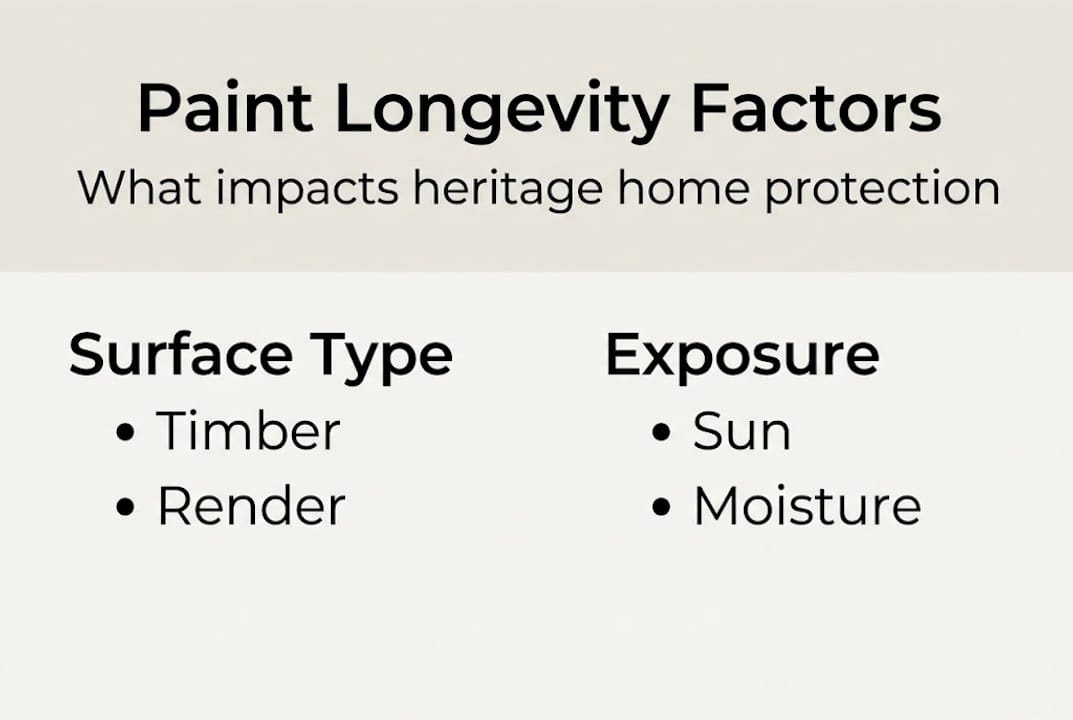
For paint durability factors on heritage homes, the surface material, exposure level, and council requirements all shape the right choice. Powder coatings for heritage assets have their place on specific metal elements, but they are rarely the whole answer.
Pro Tip: For heritage fretwork and decorative timber trims, a high-gloss enamel finish offers the best resistance to UV and rain. It also tends to satisfy council approval requirements more readily than flat or low-sheen finishes.
How council rules and maintenance impact paint longevity
Once you choose your paint, ongoing compliance and maintenance determine how long it serves your asset. In Melbourne’s heritage overlay zones, council rules are not optional. Many properties in suburbs like Kew, Hawthorn, Camberwell, and Brighton sit within overlays that legally require approved colours and finishes. Painting outside those guidelines can result in enforcement orders and costly rectification.
Beyond compliance, maintenance schedules are where most homeowners fall short. Skipping regular repainting does not just affect appearance. It voids manufacturer warranties and allows minor paint failures to become major structural problems. Dulux recommends repainting every 5 to 10 years depending on exposure, with 25-year anti-peeling warranties available when guidelines are followed correctly.
A compliant, long-lasting paint schedule for a heritage home follows these steps:
- Condition assessment: Inspect all surfaces for paint failure, timber damage, render cracks, and corrosion before any work begins.
- Surface preparation: Strip failing paint, repair substrate issues, and prime correctly. This is the most critical step.
- Colour approval: Submit proposed colours to council if required under a heritage overlay.
- Finish selection: Specify the correct paint system for each surface type, matching product to substrate and exposure.
- Scheduled repainting: Book the next repaint before the current coat fails, not after.
Quality modern paint can protect weatherboard for 10 to 15 years and render for 12 or more years when applied correctly and maintained. Routine inspections every 2 to 3 years, combined with prompt touch-ups, are far more cost-effective than full restoration after neglect.
Heritage painting is restoration, not just a repaint job. Using approved products from the Dulux heritage range ensures both compliance and long-term performance. For practical guidance, maintenance tips for heritage homes and advice on paint lasting more than 10 years are worth reviewing before you plan your next project.
Practical steps: Maximising the protection of your heritage home
Understanding maintenance is one thing. Breaking down exactly how to keep your home in top condition is where real value lies. Regular maintenance and the right paint extend property value and asset longevity, but only if the schedule is followed consistently.

Here is a practical maintenance frequency guide by area and material:
| Area or material | Inspection | Cleaning | Touch-up | Full repaint |
|---|---|---|---|---|
| Weatherboard exterior | Every 2 years | Annually | As needed | Every 10 to 12 years |
| Rendered facade | Every 2 years | Annually | As needed | Every 12 to 15 years |
| Decorative fretwork | Every year | Annually | As needed | Every 7 to 10 years |
| Metal gutters and downpipes | Every year | Annually | As needed | Every 8 to 10 years |
| Interior timber trims | Every 3 years | As needed | As needed | Every 10 to 15 years |
Knowing when paint is failing is just as important as knowing when to repaint. Watch for these warning signs:
- Peeling or flaking: Paint is losing adhesion, often due to moisture beneath the film.
- Blistering: Trapped moisture or solvent is pushing the film away from the substrate.
- Fading or chalking: UV degradation has broken down the binder, leaving a powdery surface.
- Timber swelling or cupping: Moisture has already entered the wood, meaning paint failure is advanced.
For preventative painting for heritage homes, early intervention is always less expensive than full restoration. When you spot any of these signs, act quickly rather than waiting for the next scheduled repaint.
Pro Tip: Walk around your home at the start of each season and check the most exposed surfaces, typically the north and west-facing walls. Catching a small area of peeling paint early can save thousands in timber replacement or render repair.
For complex or multi-storey properties, engaging a heritage paint specialist is the right call. They can assess substrate condition, recommend compliant products, and coordinate with council on your behalf. Reviewing exterior painting steps and sustainable painting tips can also help you prepare for the conversation.
A professional perspective: Why most heritage homes miss the mark on paint longevity
With the practical steps clear, it is worth addressing what actually goes wrong most often. In our experience working across Melbourne’s heritage suburbs, the most common failure is not choosing the wrong paint. It is skipping proper surface preparation and rushing the process.
Homeowners are often drawn to quick overcoating, applying a new coat over failing paint to save time and money. The result looks fine for 12 to 18 months, then fails dramatically. The underlying shortcuts undermine longevity in ways that a fresh colour simply cannot hide.
“The most expensive repaint is the one done twice because the first job skipped preparation.”
Heritage restoration painting is fundamentally different from a standard home repaint. It requires stripping back to sound substrate, repairing damaged timber and render, priming correctly, and specifying products that meet both performance and council requirements. Reviewing a master painting workflow makes clear just how many steps are involved before a brush touches the final coat.
The homeowners who get the best long-term results are those who treat painting as part of a broader restoration strategy, not a cosmetic exercise. That mindset shift is where real asset protection begins.
Expert heritage painting services in Melbourne
If you are ready to protect your Victorian or Edwardian home properly, Sol Shine offers the specialist expertise Melbourne homeowners need. From colour selection and council compliance to full surface preparation and premium paint application, every project is handled with care and precision.
Sol Shine’s heritage painting services cover everything from weatherboard repaints to complete facade restorations, all managed under one roof. Browse our exterior painting specialists portfolio to see the quality of work delivered across Melbourne’s inner east, bayside, and surrounding suburbs. If you are also considering interior work, explore why repaint interiors for a complete picture of how painting adds lasting value to your home.
Frequently asked questions
How often should I repaint a Victorian home in Melbourne?
Repainting every 5 to 10 years is generally recommended, though sun and rain exposure, paint quality, and surface type all influence the exact timing for your property.
Do council rules affect which paint I can use on a heritage home?
Yes. Many Melbourne councils require approved colours and finishes for Victorian and Edwardian facades, particularly in designated heritage overlay zones.
What paint lasts longest on heritage timber and render?
Linseed oil paints can last 50 to 100 years with proper care, while premium modern acrylics and elastomerics offer 10 to 15 years of protection and are council-compliant for most heritage surfaces.
Does a warranty cover paint failures on heritage homes?
Brands like Dulux offer up to 25 years anti-peeling warranty, provided the paint is applied correctly, surfaces are properly prepared, and maintenance guidelines are followed throughout the warranty period.


