
TL;DR:
- Correct modern techniques with heritage knowledge prevent costly damage and ensure longevity.
- Permits, documentation, and specialist painters are essential for heritage compliance and preservation.
- Blending traditional and modern materials offers durable, authentic results for Melbourne’s period homes.
The idea that modern painting techniques are somehow at odds with heritage authenticity is one of the most persistent misconceptions in Melbourne’s restoration industry. In reality, the wrong approach, whether that means applying non-breathable acrylics to a lime-rendered façade or skipping proper lead paint containment, causes far more damage than any thoughtfully chosen modern product ever could. For homeowners with Victorian or Edwardian properties, the stakes are high. Your home’s character, its council compliance, and an investment that can easily exceed $50,000 all depend on getting the method right from the start. This guide clarifies which modern techniques genuinely work, how to evaluate them, and what to expect from a major heritage restoration project in Melbourne.
Table of Contents
- Why heritage homes need specialist painting approaches
- How modern painting techniques blend with period authenticity
- Choosing materials and brands for heritage longevity
- Navigating compliance: Permits, colour choices, and overcoming challenges
- Why careful modernisation is the future of Melbourne heritage painting
- How Sol Shine can help with your Melbourne heritage painting project
- Frequently asked questions
Key Takeaways
| Point | Details |
|---|---|
| Specialist knowledge needed | Modern painting techniques must be tailored for heritage homes to avoid damaging period features. |
| Modern paints can be compatible | Breathable modern paint systems often outlast traditional limewash while respecting the home’s character. |
| Materials and prep drive results | Choosing heritage-grade products and investing in preparation ensures the durability of your restoration. |
| Compliance is essential | Council permits and colour documentation are critical for legal and lasting heritage works in Melbourne. |
Why heritage homes need specialist painting approaches
With the big picture in mind, let’s examine why heritage painting can’t be treated like a regular renovation.
Melbourne’s Heritage Overlay places specific obligations on homeowners undertaking painting or restoration works. Depending on your council, you may need a permit before scraping back paint, and you’ll likely need to provide documented evidence of original colours rather than simply choosing what looks period-appropriate. These aren’t bureaucratic hurdles for their own sake. They exist because the wrong intervention on a heritage property can cause irreversible damage to fabric that took craftsmen decades to build.
The materials found in older homes add another layer of complexity. Lead paint is common in properties built before 1970, and its removal must meet legal containment standards. Lime-based renders and tuckpointing are sensitive to moisture-trapping products. Even the timber in Victorian weatherboards and Edwardian sash windows behaves differently from modern-day substrates, expanding and contracting with Melbourne’s variable climate in ways that demand flexible, breathable coatings.
The financial stakes are equally significant. Painter cost Melbourne data shows that full exterior repaints for single-storey Victorian homes typically run $8,000 to $20,000, interior repaints for a three-bedroom period home range from $6,000 to $15,000, and larger restoration projects covering the façade plus structural repairs can reach $20,000 to $120,000. At those figures, a misstep in product selection or preparation isn’t just an aesthetic problem. It’s a costly one.
Engaging specialist heritage painters with a proven portfolio is the most reliable way to avoid those missteps. Generalist painters may be skilled at standard residential work, yet lack the specific knowledge to navigate Heritage Overlay requirements, substrate sensitivity, and lead paint protocols. The heritage repainting requirements for Melbourne properties are detailed and non-negotiable.
Key considerations when engaging a heritage painter include:
- Familiarity with your specific council’s Heritage Overlay conditions
- Experience with lead paint containment and safe removal
- Knowledge of lime-based substrates and compatible coatings
- A portfolio of comparable Victorian or Edwardian projects
- Transparent project scoping and preparation timelines
“The quality of a heritage restoration is determined before a single brush stroke. Preparation is where the real work happens.”
Pro Tip: Budget preparation costs at roughly 40 to 50 per cent of your total project spend on major heritage jobs. Skimping on prep is the single most common reason for premature paint failure on period homes.
How modern painting techniques blend with period authenticity
Understanding the unique stakes and standards, let’s look at what ‘modern techniques’ actually mean in a heritage context.
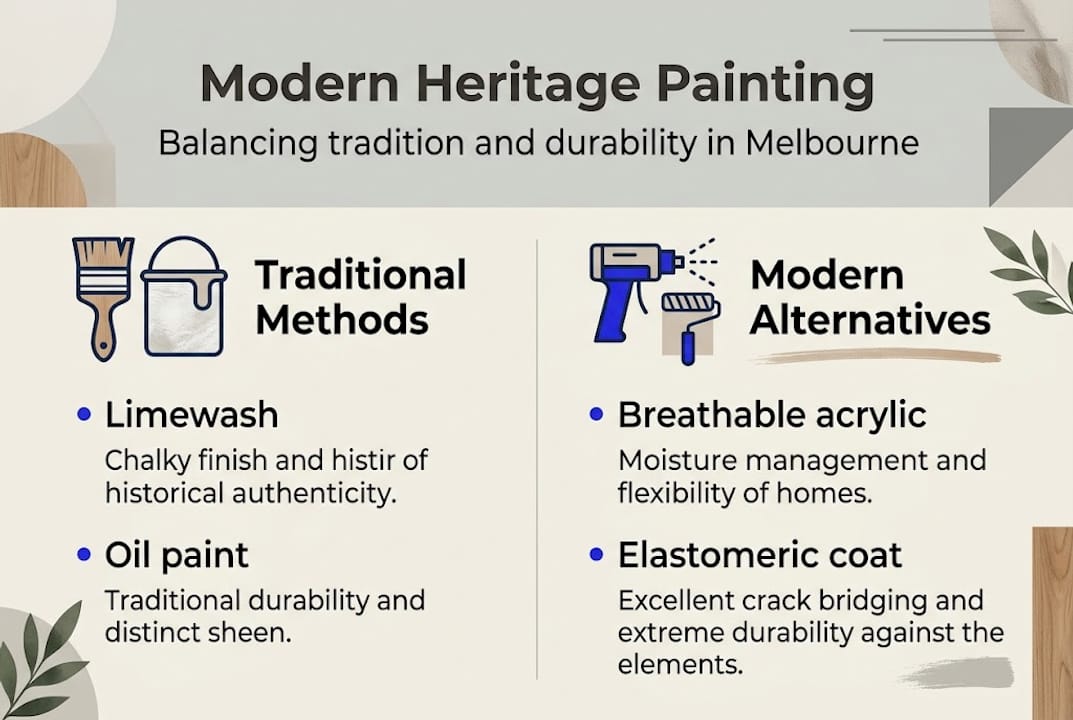
The debate between traditional limewash and modern breathable paint systems is often framed as a choice between authenticity and practicality. The reality is more nuanced. Limewash has genuine merit on certain substrates, particularly unpainted or previously limewashed masonry, because it allows moisture to move freely through the wall. However, modern breathable paints outperform historical limewash in durability on most surfaces, while non-permeable acrylics can cause serious damage to lime-based substrates by trapping moisture and triggering blistering or spalling.
The critical distinction is permeability. Modern microporous paint systems, designed specifically for heritage use, allow walls to breathe while providing significantly better UV resistance and colour retention than traditional limewash. On timber surfaces such as weatherboards and heritage timber trim, water-based alkyd hybrids offer the flexibility of oil-based paints with faster drying times and lower VOC output. These are not compromises. They are genuine improvements.
Common pitfalls to avoid when selecting modern techniques:
- Applying standard acrylic topcoats directly over lime render without a breathable primer
- Using high-sheen finishes on façades where the original finish was flat or low-sheen
- Selecting colours from modern palettes without cross-referencing period-appropriate ranges
- Overlooking the need for flexible coatings on timber that moves seasonally
| Surface type | Traditional approach | Modern alternative | Heritage suitability |
|---|---|---|---|
| Lime render | Limewash | Microporous mineral paint | High |
| Brick | Oil-based paint | Breathable masonry coating | High |
| Timber weatherboards | Lead-based oil paint | Water-based alkyd hybrid | High |
| Timber trim | Enamel | Low-VOC water-based enamel | High |
| Rendered façade | Distemper | Breathable acrylic (heritage grade) | Medium to high |
For homeowners exploring paint choices for Victorian homes, the key is matching the product’s permeability to the substrate’s original composition. Sol Shine’s approach to combining old and new painting methods reflects this principle, using modern formulations where they genuinely outperform originals, and traditional methods where they remain the most appropriate choice.
Choosing materials and brands for heritage longevity
Equipped with the pros and cons of various techniques, it’s time to focus on choosing products fit for heritage conditions.
Not all premium paint brands are equal when it comes to heritage applications. The product needs to suit the specific surface, the original substrate composition, and Melbourne’s climate demands. For projects over $20,000, heritage experience matters and so does the choice of premium brands such as Dulux Heritage and Haymes, both of which offer ranges formulated for period homes. Preparation, however, remains the primary driver of longevity regardless of which brand is applied.
| Brand | Key product range | Best application | Heritage suitability |
|---|---|---|---|
| Dulux Heritage | Heritage Colours collection | Exterior walls, trims | Very high |
| Haymes | Breathe Easy, Ultra Premium | Interior and exterior | Very high |
| Taubmans | Endure Exterior | Weatherboards | High |
| Murobond | Mineral Silicate range | Masonry, render | Very high |
For paints with proven heritage durability, the Murobond Mineral Silicate range is particularly well regarded for masonry and render applications, as it bonds chemically with the substrate rather than sitting on top as a film.
How to confirm paint compatibility with your period home:
- Identify the original substrate: lime render, brick, timber, or a combination.
- Test for lead paint presence before any scraping or surface preparation begins.
- Confirm the existing paint system’s permeability, especially on rendered surfaces.
- Select a primer compatible with both the substrate and the chosen topcoat.
- Cross-reference the topcoat’s flexibility rating against the substrate’s expected movement.
Verifying a painter’s heritage track record is equally important. Ask to see completed projects on comparable Victorian or Edwardian homes, and confirm their understanding of painting safety for heritage homes, including lead containment protocols and Heritage Overlay compliance.
Pro Tip: Most paint failures on heritage homes are traced back to poor surface preparation, not product quality. Even the finest heritage paint will fail within a few years if applied over poorly prepared or contaminated surfaces.
Navigating compliance: Permits, colour choices, and overcoming challenges
Even with the right materials and techniques, compliance can trip up major heritage projects.
If your property sits within a Melbourne Heritage Overlay, the permit process is your first step, not an afterthought. Many homeowners assume that repainting is exempt from council approval, but this is often incorrect for heritage-listed properties. The scope of works, the extent of surface preparation, and the proposed colour scheme can all trigger a permit requirement.
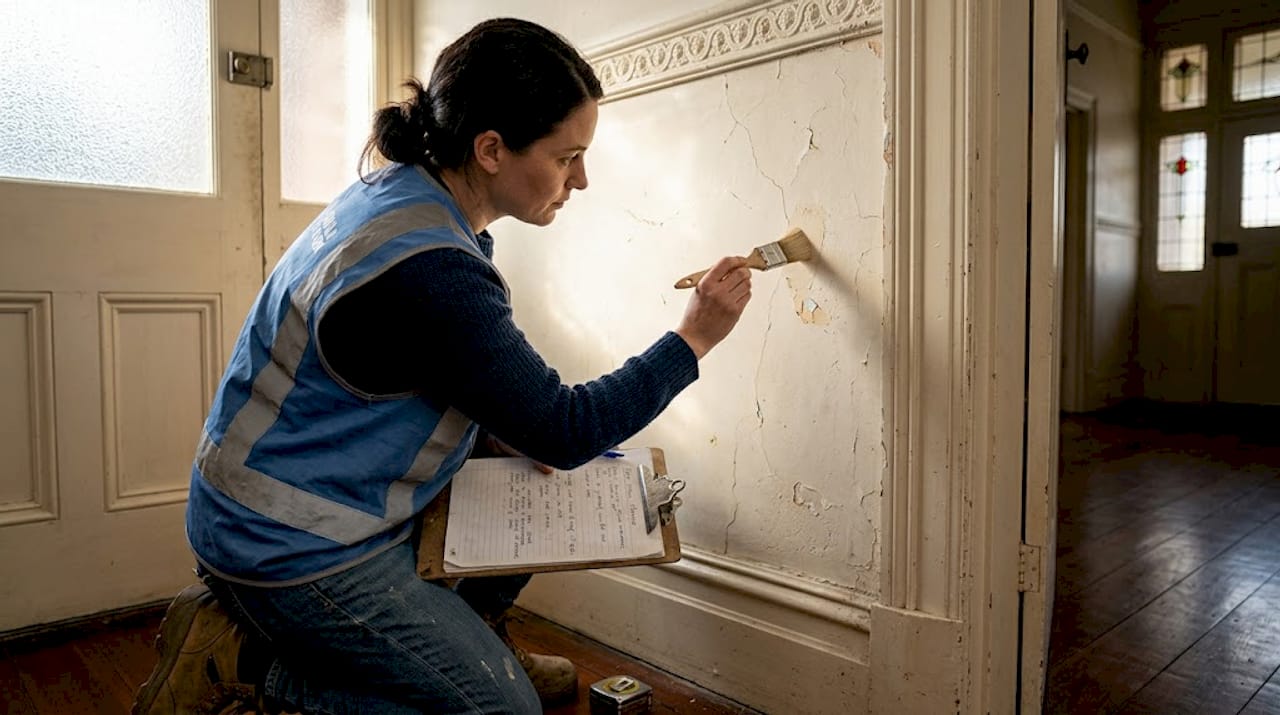
Colour selection is a particularly sensitive area. Councils prefer documented evidence for colour choices over assumptions, and work may require paint scraping and lead containment to uncover original finishes. A heritage consultant or experienced painter can assist with paint scrape analysis, which involves carefully removing layers to identify the original palette. This documented approach carries far more weight with council assessors than a homeowner’s best guess based on period photographs.
Lead paint management is non-negotiable. Properties built before 1970 almost certainly contain lead-based coatings somewhere on the façade or interior. Removal must comply with Safe Work Australia guidelines, including containment sheeting, appropriate respirators, and disposal through licensed channels. Attempting to manage this without proper protocols is both a legal risk and a health hazard.
For information on Melbourne heritage paint permits and the broader compliance process, Sol Shine’s heritage guide provides a detailed overview of what to expect at each stage.
Common compliance mistakes and how to avoid them:
- Assuming repainting is always permit-exempt under the Heritage Overlay
- Selecting colours without conducting a paint scrape analysis
- Failing to notify council before commencing surface preparation
- Overlooking lead paint containment requirements during scraping
- Proceeding with facade repairs without integrating them into the permit scope
Tuckpointing, render repairs, and window restoration are frequently part of a larger heritage painting project. Integrating these into a single permit scope, rather than treating each as a separate job, simplifies the approval process and ensures all works are assessed together. For ongoing guidance on maintaining heritage homes after restoration, a structured maintenance programme keeps your investment protected between major projects.
Why careful modernisation is the future of Melbourne heritage painting
Drawing all these threads together, here’s a candid perspective from years of working on Melbourne’s heritage gems.
Rigid purism in heritage painting, the insistence that only historically identical materials are acceptable, can actually cause more harm than good. When original products are no longer manufactured to the same specification, or when a lime render has been partially replaced with cement over decades of patchwork repairs, replicating the original approach precisely may introduce new incompatibilities. Documented, evidence-based solutions that blend proven modern products with traditional methods consistently outperform guesswork dressed up as authenticity.
The homes that hold their value and their character over the long term are those where the restoration was treated as a technical discipline, not a nostalgic exercise. Modern breathable systems, properly matched to the substrate, reduce maintenance intervals, extend the life of the coating, and protect the underlying fabric more effectively than many period-authentic alternatives. This is not a concession. It is the most respectful thing you can do for a building that has already survived a century or more.
Experienced specialists who understand both the historical context and the modern product landscape are the only professionals equipped to make these calls reliably. For homeowners exploring sustainable painting practices for their heritage property, the most sustainable outcome is a restoration that lasts, rather than one that needs revisiting in five years.
How Sol Shine can help with your Melbourne heritage painting project
If you’re planning a significant restoration or wish to bring your Victorian or Edwardian home back to life, Sol Shine is ready to assist.
Sol Shine works directly with Melbourne homeowners on large-scale heritage restoration and painting projects, typically $20,000 and above. From interior painting services to full heritage exterior painting, every project is handled under one roof by skilled specialists who understand the compliance, material, and craftsmanship demands of period homes. You can browse completed heritage painting projects to see the standard of work firsthand. Reach out today to arrange a project assessment and discuss how Sol Shine’s team can deliver a refined, lasting result for your home.
Frequently asked questions
Can modern paints damage my Victorian or Edwardian home?
Some modern paints, particularly non-permeable acrylics, can trap moisture and cause blistering on lime-based substrates, so always specify breathable, heritage-compatible systems for period homes.
How much should I budget for a major heritage painting project?
For a full restoration including repairs in Melbourne, heritage projects range from $20,000 to $120,000 depending on house size, condition, and the extent of works required.
Do I need a council permit to repaint my heritage-listed property?
If your home falls under a Melbourne Heritage Overlay, council permits are required and documented evidence of original colours may also be necessary before works can commence.
How can I check if a painter understands heritage requirements?
Look for a strong portfolio of comparable period properties, 13 or more years of heritage-specific experience, and confirmed use of premium brands such as Dulux Heritage or Haymes suited to Victorian and Edwardian homes.


