
Melbourne’s heritage homes can deliver extraordinary financial returns that most owners never expect. A heritage home doubles in value after restoration, transforming a $640,000 Victorian terrace into a $1.6 million asset through strategic investment. Yet many high-net-worth homeowners hesitate, assuming restoration costs outweigh potential gains. This guide reveals the real numbers behind heritage restoration ROI, explains compliance requirements for Melbourne’s Victorian properties, and outlines practical steps to maximise your investment while preserving architectural integrity.
Table of Contents
- Key takeaways
- Financial returns from restoring historical homes over $2 million
- Key restoration methods and compliance best practices
- Risks of overcapitalisation and managing restoration budgets
- Practical steps for high-net-worth homeowners to maximise restoration value
- Explore premium heritage restoration services in Melbourne
- Frequently asked questions
Key Takeaways
| Point | Details |
|---|---|
| Strong value uplift | Heritage restorations in Melbourne can double or triple asset values with budgets around $500,000 or more, often delivering ROI above 2:1. |
| Restoration cost range | Typical restoration budgets span about $500,000 to $3 million depending on condition and scope. |
| Compliance and practice | The Burra Charter guides minimal intervention and reversible changes, while Melbourne heritage overlays require permits to protect architectural character. |
| Budget focus first | Prioritise structural integrity and facade work to create a solid foundation and reduce the risk of costly repairs later. |
Financial returns from restoring historical homes over $2 million
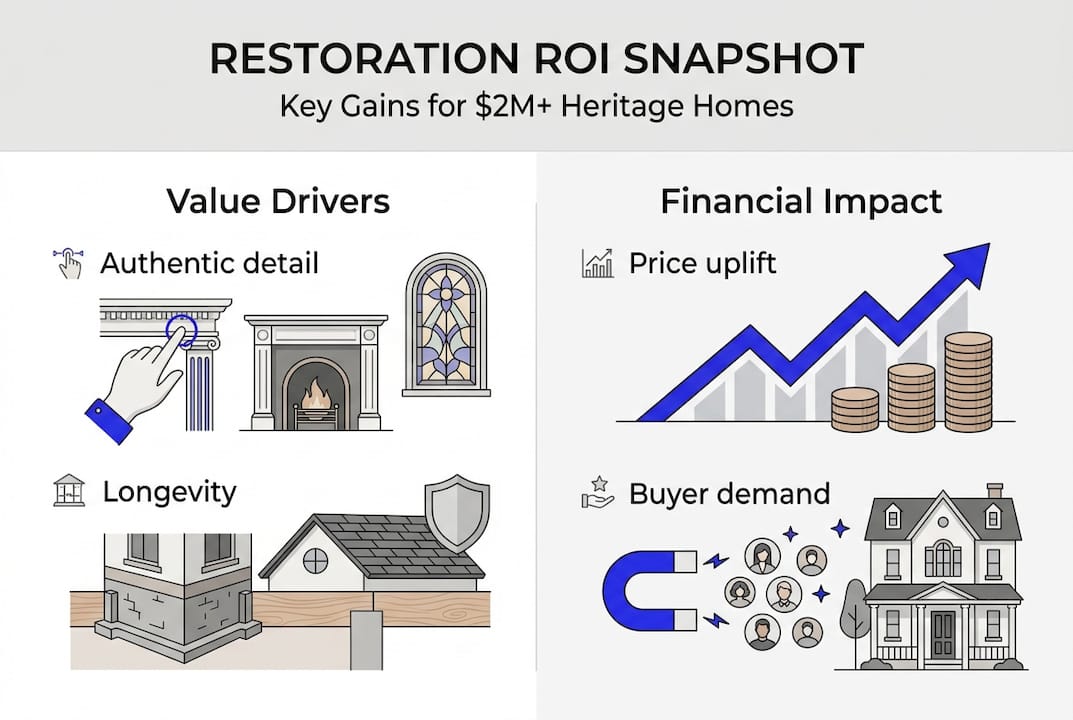
The financial case for heritage restoration often surprises even experienced property investors. Restorations can double or triple value in Melbourne heritage homes with $500,000+ investment, particularly in established suburbs where land value drives growth. A Thornbury Victorian cottage purchased for $640,000 reached $1.6 million after comprehensive restoration, while similar projects in Elsternwick and Camberwell have delivered comparable returns.
These aren’t isolated cases. Heritage properties in Melbourne’s inner east and bayside suburbs consistently demonstrate strong value uplift when restoration follows best practices. The typical restoration investment ranges from $500,000 to $3 million depending on property condition and scope, yet ROI ratios frequently exceed 2:1 for well-executed projects.
Key factors driving heritage property returns:
- Land value appreciation in established Melbourne suburbs accounts for 60-70% of total value growth
- Heritage premium adds 15-25% to property values in designated overlay zones
- Building improvements prevent depreciation that would otherwise erode asset value
- Premium finishes and authentic restoration attract discerning buyers willing to pay top dollar
- Strategic landscaping improvements enhance curb appeal and market positioning
The mathematics become compelling when you examine actual project outcomes. A $2 million heritage home requiring $800,000 in restoration work can realistically achieve $3.5-4 million valuation post-renovation in premium Melbourne locations. This represents a net gain of $700,000-1.2 million after accounting for restoration costs, delivering returns that few other property strategies can match.
Pro Tip: Focus restoration budgets on structural integrity and façade work first, as these elements provide the foundation for all subsequent value gains and prevent costly emergency repairs later.
High-net-worth investors recognise that heritage properties offer something beyond pure financial returns. The prestige factor associated with owning a meticulously restored Victorian or Edwardian home in suburbs like Kew, Brighton, or Malvern creates intangible value that enhances both lifestyle and social capital. Yet the hard numbers demonstrate these properties deliver exceptional financial performance when restoration follows expert guidance.
“The heritage premium in Melbourne’s established suburbs reflects buyer willingness to pay significantly more for authentically restored properties that honour original architectural intent while incorporating modern amenities.”
Key restoration methods and compliance best practices
Successful heritage restoration requires technical expertise that goes far beyond standard renovation practices. The Burra Charter provides the ethical framework for Australian heritage conservation, emphasising minimal intervention and reversible modifications that respect original design intent. Melbourne’s heritage overlays enforce these principles through permit requirements that protect architectural character.
Specialist conservation architects and lime renders prevent damage and meet heritage standards, addressing the hidden crisis affecting Victorian terraces across Melbourne. Traditional cement renders trap moisture in timber frames, causing rot and spalling that can cost hundreds of thousands to repair. Lime-based renders allow timber to breathe naturally, preventing these catastrophic failures while maintaining period authenticity.
Conservation architects experienced in Victorian-era properties understand the nuanced requirements of heritage restoration. They navigate council permit processes, specify appropriate materials, and ensure work complies with heritage overlay restrictions. Their expertise prevents costly mistakes that can derail projects and diminish property values.
Essential restoration methodologies for Melbourne heritage homes:
- Restumping with appropriate pier spacing maintains structural integrity for 100+ years
- Façade repairs using matching bricks and traditional mortar preserve architectural cohesion
- Parapet reconstruction with heritage-compliant materials prevents water ingress
- Window restoration retaining original timber frames and glass where possible
- Roof repairs using period-appropriate tiles or slate maintain authentic appearance
- Render repair with lime-based materials prevents moisture damage to timber structures
Pro Tip: Always obtain heritage permits before commencing work, even for seemingly minor exterior changes, as retrospective approvals can be difficult and expensive to secure.
The technical requirements extend to paint selection and application methods. Specialist painters for heritage homes understand how traditional materials interact with modern coatings, preventing adhesion failures and ensuring long-term durability. They recognise when lead paint abatement requires specialist handling and know which preparation methods suit different substrate conditions.
Heritage window repair represents another critical restoration element. Original timber windows can be restored to full functionality at a fraction of replacement cost while maintaining heritage authenticity. Modern double-glazed units can sometimes be retrofitted into existing frames, providing energy efficiency without compromising appearance.
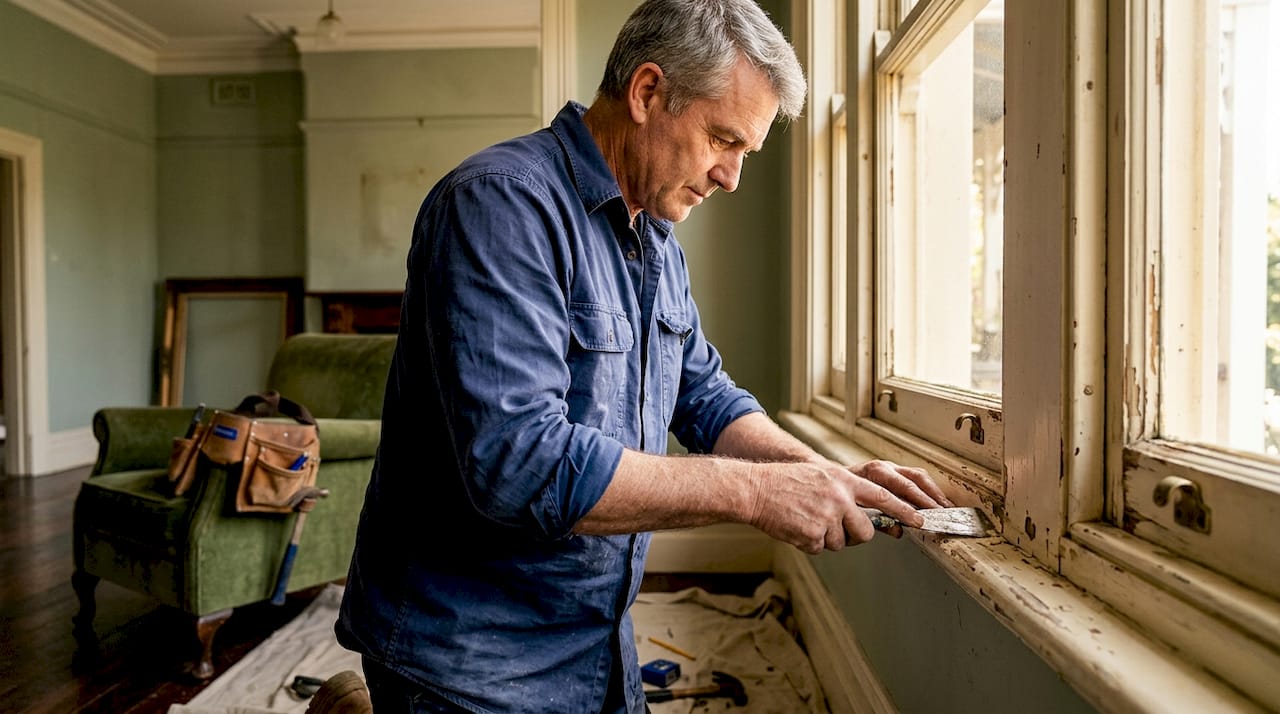
The investment in proper methodology pays dividends through longevity and compliance. Work completed to heritage standards typically requires minimal maintenance for 15-20 years, whereas shortcuts necessitate expensive remediation within 5-7 years. Council enforcement actions for non-compliant work can require complete removal and reconstruction at owner expense, making proper methodology the only financially prudent approach.
Risks of overcapitalisation and managing restoration budgets
Overcapitalisation represents the primary financial risk in heritage restoration, occurring when total investment exceeds the property’s achievable market value. Heritage overlays cause 60% cost overruns in some cases, with unexpected compliance requirements and hidden structural issues pushing budgets beyond initial estimates. The result can be spending $1.5 million on restoration only to achieve $800,000 in value uplift, destroying investment returns.
The complexity of heritage properties creates multiple pathways to budget blowouts. Removing modern additions often reveals concealed damage to original structures. Restumping may uncover termite damage requiring extensive timber replacement. Façade work can expose parapet failures necessitating complete reconstruction. Each discovery adds cost and timeline pressure.
Common budget risks in heritage restoration projects:
- Hidden rot in weatherboards and structural timber discovered during demolition
- Spalling brickwork requiring complete parapet rebuilding rather than patching
- Asbestos removal costs for materials common in pre-1980s renovations
- Heritage permit delays extending project timelines and holding costs
- Specialist trades commanding premium rates for conservation work
- Material sourcing challenges for period-appropriate products
Pro Tip: Engage a heritage-experienced building inspector for comprehensive pre-purchase assessment, identifying potential issues before committing to acquisition and restoration.
Effective budget management starts with realistic cost estimation. Allocate 20% contingency for unforeseen issues, recognising that heritage properties almost always present surprises. Obtain multiple quotes from conservation specialists rather than standard builders, as their expertise prevents mistakes that cost more to rectify than the initial savings.
| Budget element | Typical allocation | Risk factor |
|---|---|---|
| Structural work | 30-40% | High |
| Façade restoration | 25-35% | Medium |
| Interior finishes | 20-25% | Low |
| Contingency | 20% | Essential |
The target ROI benchmark for heritage restoration should exceed 10% annually to justify the investment complexity and risk. This calculation includes both capital appreciation and the avoided depreciation that restoration prevents. Properties requiring $1 million in restoration should realistically achieve $1.5-2 million in value uplift to meet this threshold.
Premium paint selection illustrates the balance between quality investment and overcapitalisation. Top-tier coatings deliver 15-20 year durability and superior appearance, justifying their cost through longevity. Yet specifying ultra-premium products throughout may push spending beyond what the market will recognise in valuation.
The safety standards for heritage painting add compliance costs that cannot be avoided. Lead paint management, scaffolding requirements for multi-storey properties, and proper surface preparation all demand budget allocation. Cutting corners on safety creates liability risks that far exceed any short-term savings.
Monitoring spend against budget milestones prevents runaway costs. Establish clear approval processes for variations, requiring written justification for any changes exceeding $5,000. This discipline maintains financial control while allowing necessary adjustments for genuine unforeseen circumstances.
Practical steps for high-net-worth homeowners to maximise restoration value
Maximising restoration returns requires strategic planning that balances heritage preservation with market appeal. HNWI benefit from balancing prestige features with modern upgrades, focusing investment on elements that deliver both lifestyle enhancement and financial returns. The approach differs fundamentally from standard renovation, requiring specialist expertise at every stage.
Step-by-step restoration planning for optimal returns:
- Engage conservation architects for comprehensive property assessment and restoration strategy development before purchasing or commencing work
- Obtain heritage permits and council approvals early in the planning process to avoid timeline delays and budget impacts
- Assemble specialist trades including heritage painters, plasterers, and carpenters experienced in Victorian-era construction methods
- Prioritise structural integrity and weather protection, addressing restumping, roofing, and façade work before cosmetic improvements
- Specify traditional materials and methods for all heritage-visible elements while incorporating modern systems discretely
- Allocate significant budget to landscaping and outdoor spaces, as these elements strongly influence buyer perception and valuation
- Implement preventative maintenance schedules immediately post-restoration to preserve investment value long-term
The specialist team selection process determines project success. Heritage restoration specialists understand the unique requirements of Victorian and Edwardian properties, from appropriate render systems to traditional joinery techniques. Their experience prevents the common mistakes that plague heritage projects managed by standard builders.
Pro Tip: Visit completed restoration projects by prospective contractors, speaking directly with previous clients about budget management, timeline adherence, and problem-solving approaches during unexpected challenges.
The balance between heritage character and modern amenities requires careful consideration. Kitchens and bathrooms can incorporate contemporary fixtures and appliances while respecting period proportions and detailing. Heating, cooling, and electrical systems integrate discretely without compromising architectural integrity. The goal is creating homes that honour their heritage while meeting luxury lifestyle expectations.
Interior repainting value extends beyond aesthetics to protection and preservation. Premium interior coatings on restored plasterwork and timber prevent moisture damage while enhancing the visual impact of period details. Colour selection following heritage palettes maintains authenticity while creating sophisticated, liveable spaces.
The Camberwell heritage restoration example demonstrates how comprehensive restoration transforms property value and appeal. Attention to authentic details, quality craftsmanship, and strategic modern upgrades created a home that commands premium pricing while preserving historical significance.
Landscaping investment delivers disproportionate returns on heritage properties. Period-appropriate garden design, quality hardscaping, and established plantings create immediate visual impact that influences buyer perception. Allocating 10-15% of total restoration budget to exterior spaces typically returns 150-200% of cost in added valuation.
Preventative maintenance preserves restoration value and prevents expensive emergency repairs. Annual inspections of roofing, gutters, and façade elements catch minor issues before they escalate. Repainting on recommended schedules maintains weather protection and appearance. This ongoing investment protects the substantial capital deployed in restoration while ensuring the property continues appreciating.
Explore premium heritage restoration services in Melbourne
Navigating heritage restoration complexity requires partners who understand both the technical requirements and financial implications of working with Melbourne’s historical properties. The insights shared throughout this guide reflect the real-world experience of managing large-scale Victorian and Edwardian restorations where quality craftsmanship and heritage compliance determine project success.

Heritage painting services specialising in Victorian-era properties bring the expertise needed to execute restoration work that preserves value while meeting council requirements. From façade restoration using traditional materials to heritage window repairs that maintain original character, specialist trades understand the nuanced requirements of these unique homes. Premium interior painting completes the transformation, creating sophisticated spaces that honour heritage while meeting contemporary expectations. When your restoration investment exceeds $500,000, partnering with specialists who understand both the craft and the financial stakes ensures your project delivers the returns these remarkable properties can provide.
Frequently asked questions
How much does restoration of a $2 million+ historical home typically cost?
Restoration investment usually ranges from $500,000 to over $2 million depending on property condition, scope of work, and heritage overlay requirements. Comprehensive Victorian home restorations involving structural repairs, façade work, and premium finishes typically fall in the $800,000 to $1.5 million range for properties in Melbourne’s established suburbs.
What are the risks of spending too much on restoration?
Overcapitalisation occurs when total restoration spend exceeds the property’s achievable market value, resulting in less value gained than money invested. Heritage overlays can cause 60% cost overruns through unexpected compliance requirements and hidden structural issues, making careful budget management and expert guidance essential to protect returns.
Which restoration materials and methods best preserve value?
Lime-based renders instead of cement allow timber to breathe and prevent spalling, while traditional materials for parapets and façades maintain heritage authenticity. Engaging conservation architects experienced in Victorian-era construction ensures work meets council requirements and uses appropriate methods that deliver long-term durability and value preservation.
How can I ensure a good return on my restoration investment?
Hire heritage specialists for planning and execution to avoid overcapitalisation through proper scope definition and budget management. Focus investment on maintaining heritage character in visible elements while upgrading landscaping and interior finishes, target 10%+ annual ROI, and implement preventative maintenance schedules to preserve restoration value long-term.
Recommended
- Premium paint materials for heritage homes in Melbourne
- Hiring specialist painters for heritage homes in Melbourne
- Premium paint vs standard: best for Melbourne heritage homes
- Why preventative painting preserves Melbourne heritage homes
- Finding Hardwood Restoration Near Me: A Parker Homeowner’s Guide


