
TL;DR:
- Many heritage homeowners mistakenly view a new roof coating as a permanent solution, risking costly damage. Regular maintenance, including cleaning and inspections, prolongs coating effectiveness, preserves heritage character, and prevents structural deterioration. Neglecting these practices can lead to water ingress, warranty voids, increased costs, and loss of property value.
Many heritage homeowners treat a freshly applied roof coating as a long-term fix that needs no further attention. That assumption is understandable, but it is also one of the most costly mistakes you can make with a period property. Understanding why maintain roof coatings matters is not simply about ticking a maintenance box. It is about protecting the structural integrity, historical character, and long-term value of a home that cannot be easily replicated. This article walks you through what roof coatings actually do, how to care for them properly, and what you risk by leaving them unattended.
Table of Contents
- Key takeaways
- What roof coatings do and why heritage roofs need them
- Benefits of maintaining roof coatings for heritage properties
- How to maintain roof coatings: practical steps for homeowners
- The cost of neglecting roof coating maintenance
- Choosing the right coating and maintenance plan
- My experience with roof coatings on period homes
- Sol Shine’s heritage roof coating services
- FAQ
Key takeaways
| Point | Details |
|---|---|
| Coatings require active upkeep | Roof coatings degrade over time and need scheduled cleaning, inspection, and recoating to remain effective. |
| Maintenance costs far less than replacement | Restoration costs a fraction of full roof replacement and can extend roof life by up to 20 years. |
| Heritage homes face unique pressures | Older roofing materials are more vulnerable to UV, moisture, and thermal cycling without a well-maintained coating layer. |
| Drainage is as critical as the coating itself | Ponding water degrades coating systems faster than almost any other factor; drainage must be kept clear. |
| Neglect carries financial and legal risks | Allowing coatings to fail can void warranties, breach energy compliance standards, and reduce property value. |
What roof coatings do and why heritage roofs need them
A roof coating is a fluid-applied membrane that bonds to the existing roof surface to form a continuous protective layer. On heritage properties, this is particularly significant because the underlying materials, whether slate, terracotta, corrugated iron, or heritage tile, are often irreplaceable or prohibitively expensive to source.
Roof coatings deliver several overlapping forms of protection:
- UV resistance. Ultraviolet radiation breaks down roofing substrates over time, causing brittleness, cracking, and colour fade. A quality coating absorbs and reflects UV before it reaches the underlying material.
- Waterproofing. Coatings seal porous or aged surfaces to prevent water ingress, which is the leading cause of internal damage and structural deterioration in period homes.
- Thermal cycling protection. Heritage roofs expand and contract significantly across Melbourne’s seasons. Coatings with elastomeric properties accommodate this movement without cracking.
- Reflectivity. Reflective coatings reduce the roof surface temperature, lowering heat transfer into the home and reducing the cooling load on warmer days.
The reflectivity benefit is well documented. Reflective coatings reduce annual air conditioning energy use by 10% to 30% in warm climates by lowering roof surface temperatures by up to 50 to 60 degrees Fahrenheit. For a Victorian or Edwardian home with minimal ceiling insulation, that thermal barrier provided by the coating layer is genuinely meaningful.
Without a maintained coating, each of these protective functions weakens progressively. The roof is not failing dramatically or suddenly. It is deteriorating quietly, season by season, until one major storm or persistent leak reveals just how much protection has been lost.
Benefits of maintaining roof coatings for heritage properties
The benefits of roof coatings are only realised consistently when maintenance is part of the plan. A coating applied once and left alone will still degrade, lose reflectivity, and eventually fail to keep water out.
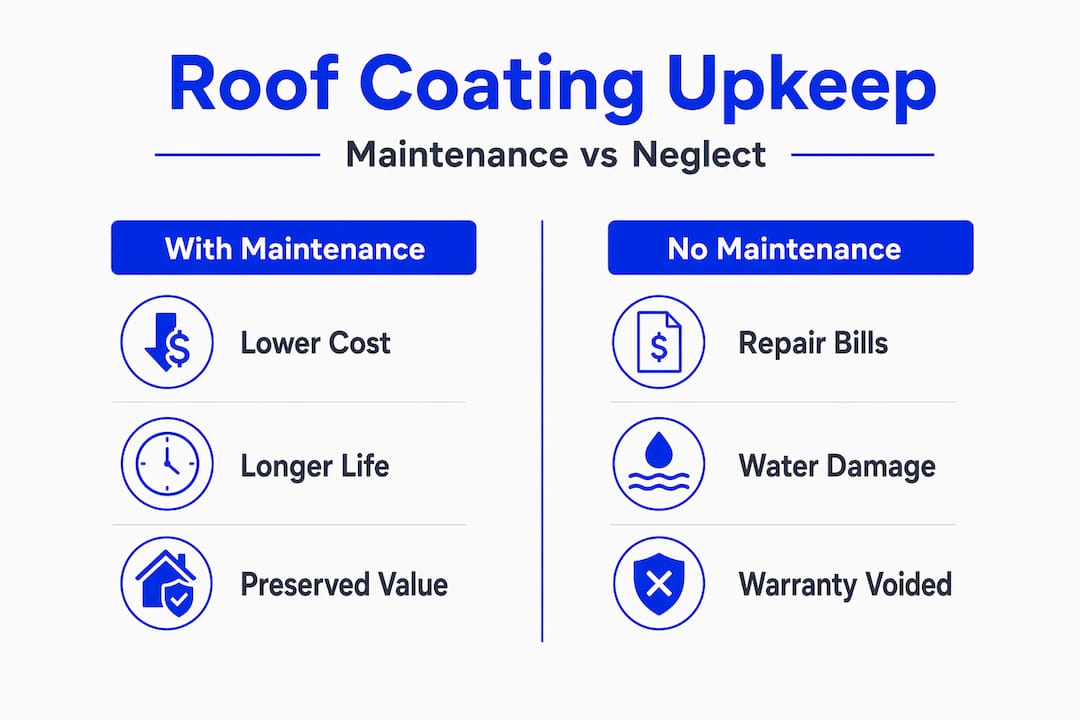
Here is a direct comparison of what regular maintenance delivers versus the cost of neglect:
| Factor | With regular maintenance | Without maintenance |
|---|---|---|
| Energy efficiency | Sustained 10%–30% reduction in cooling costs | Reflectivity drops as dirt and UV degrade the surface |
| Roof lifespan | Extended by 10 to 20 years through timely recoating | Premature substrate failure requiring full replacement |
| Water resistance | Consistent waterproofing, preventing internal damage | Gradual moisture ingress leading to structural deterioration |
| Warranty and compliance | Warranty remains valid; energy code compliance maintained | Warranty voided; potential breach of heritage and energy standards |
| Property value | Heritage character preserved; value protected | Visible deterioration reduces appeal and market value |
Maintaining roof coatings preserves warranty validity, ensures compliance with energy codes, and prevents premature substrate failure, per Roof Coatings Manufacturers Association guidance. For heritage property owners who may already be navigating strict local council requirements, a lapsed warranty or non-compliant roof is a complication worth avoiding entirely.
On the question of cost, roof coating restoration costs between $0.75 and $5.00 per square foot, which is 50% to 70% less than full roof replacement at $4.00 to $30.00 per square foot. Restoration also extends a structurally sound roof by 10 to 20 years, deferring a significant capital expense that most homeowners would prefer not to face.
Pro Tip: If your heritage home was last recoated more than seven years ago, book a professional inspection before the next winter season. Catching early coating wear costs a fraction of what internal water damage repairs will set you back.
How to maintain roof coatings: practical steps for homeowners
Knowing why roof coating maintenance matters is only half the picture. The other half is understanding what that maintenance actually involves and when to act.
-
Clean the roof surface twice a year. Dirt, organic growth such as lichen and moss, and airborne debris accumulate on coating surfaces and degrade reflectivity over time through UV exposure and biological activity. A low-pressure wash using appropriate cleaning solutions removes this buildup and restores the coating’s performance. For heritage roofs, avoid high-pressure washing that can dislodge aged mortar or fragile tiles.
-
Schedule professional inspections twice a year. Professional inspections twice yearly are recommended to detect subtle issues such as mil-thickness loss and flashing stress before they develop into major failure points. Spring and autumn are the most practical times, coinciding with Melbourne’s most demanding weather transitions.
-
Inspect after significant storms. Heavy wind events and sustained rain can cause punctures, debris impact damage, and flashing displacement. A post-storm assessment identifies these before water has an opportunity to work its way into the structure. Professional maintenance programmes costing $200 to $1,000 annually typically include these inspections as standard.
-
Address drainage problems without delay. Ponding water is a silent threat to many coating systems. Blocked scuppers, sagging sections, and poor slope design allow water to sit on the coating surface, accelerating degradation and eventually causing delamination. Clear gutters and downpipes regularly, and have a professional assess any areas where water pools after rain.
-
Plan for recoating at the right interval. Recoating intervals range from 5 to 15 years depending on coating chemistry and site conditions. Do not wait for visible failure. Schedule recoating within the manufacturer’s recommended window, and be aware that recoating aged surfaces requires more intensive preparation, including mechanical cleaning and sometimes scarification, to ensure proper adhesion.
The distinction between what a homeowner can manage and what requires professional attention is worth stating clearly. Basic cleaning and visual checks from ground level are well within a homeowner’s reach. Anything involving access to the roof surface, adhesion assessment, or flashing repairs should be left to qualified professionals with appropriate safety equipment and coating knowledge.
Pro Tip: Keep a simple maintenance log for your roof coating, noting inspection dates, cleaning done, and any areas of concern. This record is valuable evidence for warranty claims and helps any contractor who services your roof understand its history.
The cost of neglecting roof coating maintenance
The financial case for regular maintenance becomes very direct when you look at what deferred upkeep actually costs.
A routine maintenance programme sits at $200 to $1,000 per year. That annual investment covers inspections, cleaning, and minor touch-up repairs. Compare that with the cost of internal water damage repairs, which can run into tens of thousands of dollars when moisture has penetrated ceiling linings, insulation, and structural timbers. For a heritage property with ornate plasterwork ceilings or heritage timber flooring, the restoration costs can be extraordinary.

Beyond the immediate repair bill, neglected roof coatings create cascading problems. Insurance claims for water damage are frequently complicated when assessors determine that the cause was gradual deterioration rather than a sudden event. Many policies distinguish between storm damage and maintenance neglect, and a roof coating in obvious disrepair can be sufficient grounds for a claim to be disputed.
Warranty conditions are another pressure point. Roof coating longevity and manufacturer warranties are both contingent on documented maintenance being carried out at specified intervals. A homeowner who cannot demonstrate that the coating has been properly maintained may find their warranty voided at precisely the moment they need it most.
For heritage homes in Melbourne’s inner east and bayside suburbs, property value is also at stake. A well-presented period home commands a premium. A deteriorating roof, or worse, evidence of water damage inside, is the kind of disclosure that significantly affects what a property achieves at sale.
Choosing the right coating and maintenance plan
Not all roof coatings are suited to every heritage roof, and the wrong product maintained correctly will still underperform. Matching the coating chemistry to the roof design and site conditions is a decision best made with professional input.
The two most common coating chemistries used on residential and heritage roofs are silicone and acrylic. Silicone coatings are better suited to low-slope roofs where ponding water is a risk, because silicone maintains its moisture resistance even under sustained water exposure. Acrylic coatings perform well on roofs with adequate slope and positive drainage but can fail prematurely if water is allowed to pool. Understanding this distinction is particularly relevant for older homes, which often have complex rooflines with varying pitch and drainage characteristics.
Local climate plays a significant role in coating selection and maintenance frequency. Melbourne’s combination of UV intensity, heavy summer rain events, and cooler winter conditions means coatings face a wide range of stressors through the year. A weatherproof coating approach specific to Melbourne’s climate will account for this variability in product selection, application thickness, and recoating interval.
Heritage compliance is another layer to consider. Some local councils apply strict guidelines about what finishes and treatments are permissible on heritage-listed properties. A professional with heritage restoration experience will know how to select and specify coatings that satisfy both performance requirements and compliance obligations, avoiding the cost and frustration of having work rejected or ordered to be redone.
My experience with roof coatings on period homes
I’ve worked on enough Victorian and Edwardian properties in Melbourne to know that roof coatings are almost always the last thing a homeowner thinks about until they’re dealing with a stained ceiling or a rotting fascia. What I’ve found is that the gap between what coatings are sold as and what they actually require is a real problem.
The “set and forget” assumption is not just common. It’s practically universal among first-time heritage property owners. They invest in quality products, get the coating applied properly, and genuinely believe the job is done for a decade. In my experience, what actually happens is that without cleaning and inspection, the coating’s reflectivity drops, biological growth takes hold, and by year five or six the coating is doing maybe half the work it was designed to do.
What I’ve learned is that the maintenance schedule matters more than the product itself for most situations. A mid-tier coating that is cleaned twice a year and inspected regularly will outlast a premium product that is never touched. Proper drainage management, in particular, is where I’ve seen the biggest difference. Blocked scuppers and ponding water destroy coatings faster than UV and foot traffic combined.
My advice is to treat roof coating maintenance the way you treat your heritage home’s broader restoration programme: as a scheduled, deliberate investment rather than a reactive response to visible problems. The properties that hold their character and their value are the ones where owners take that seriously from the start.
— Jarrad
Sol Shine’s heritage roof coating services

Sol Shine specialises in roof painting and coating maintenance for Victorian and Edwardian properties across Melbourne’s inner east and bayside suburbs. The team understands how heritage roof design, local climate, and council compliance requirements intersect, and brings that knowledge to every assessment and maintenance plan. Whether your home needs a first coat inspection, a full heritage roof restoration, or a recoating programme aligned with manufacturer specifications, Sol Shine handles the work with the care these properties deserve. Projects are managed directly, with no subcontracting of skilled trades, and all exterior coating work is carried out by experienced painters with a genuine commitment to heritage preservation. Contact Sol Shine to arrange an assessment for your property.
FAQ
Why do roof coatings need regular maintenance?
Roof coatings degrade over time due to UV exposure, biological growth, and thermal cycling. Without regular cleaning and inspection, coatings lose reflectivity and waterproofing performance, leading to premature roof failure.
How often should heritage roof coatings be inspected?
Professional inspections are recommended twice a year, typically in spring and autumn, plus an additional check after any significant storm event to identify punctures or flashing damage early.
What happens if roof coating maintenance is neglected?
Neglected coatings allow moisture ingress, which causes structural damage and internal water damage. It can also void manufacturer warranties and, in some cases, complicate insurance claims related to gradual deterioration.
When should a heritage roof coating be recoated?
Recoating intervals range from 5 to 15 years depending on the coating chemistry and site conditions. A professional inspection will confirm whether the existing coating has sufficient thickness and adhesion to remain effective.
Is silicone or acrylic coating better for heritage roofs?
Silicone coatings suit low-slope roofs where ponding water is a risk, while acrylic coatings perform well on roofs with positive drainage. A professional assessment of your specific roof design and drainage characteristics will determine the right choice.


