
TL;DR:
- Strata painting involves repainting common property surfaces like external walls, roofs, and shared spaces but excludes individual units. The owners corporation is legally responsible for funding and supervising these projects to maintain building integrity and value. Proper planning, surface preparation, and stakeholder communication are essential to ensure durable, compliant, and cost-effective maintenance.
Strata painting is one of those topics that looks straightforward on the surface, then turns out to involve more responsibility, regulation, and planning than most property owners expect. If you manage or own a lot within a strata scheme, understanding what is strata painting, who is responsible for it, and what it actually protects will save you time, money, and dispute headaches down the track. This guide covers the full picture, from the definition and scope through to legal obligations, practical planning, and the real costs involved in getting the job done properly.
Table of Contents
- Key takeaways
- What is strata painting, exactly?
- Why strata painting matters: benefits and impacts
- How strata painting projects are planned and executed
- Legal and financial responsibilities for strata painting
- Practical tips for planning your strata painting project
- My perspective: what most owners get wrong about strata painting
- Strata painting services from Sol Shine
- FAQ
Key takeaways
| Point | Details |
|---|---|
| Strata painting scope | Covers common and external areas of the building, not individual units or private lots. |
| Owners corporation responsibility | The owners corporation is legally responsible for maintaining and repainting common property. |
| Paint protects more than appearance | Quality exterior paint acts as a barrier against moisture, UV damage, and structural deterioration. |
| Budget beyond paint costs | Surface preparation, scaffolding, and access logistics often exceed the cost of paint itself. |
| Legal quote requirements | In NSW, owners corporations must obtain at least two independent quotes for works over $30,000. |
What is strata painting, exactly?
The strata painting definition is simpler than many property managers expect, but the scope is often underestimated. Strata painting refers to the professional repainting of common property within a strata scheme. It does not include the interior walls of individual apartments or units. Those remain the responsibility of the individual lot owner.
Common property, as defined under Australian strata legislation, includes everything that is shared by all owners. The NSW Government confirms that the owners corporation is responsible for maintaining common property, which typically encompasses external walls, roofs, gutters, balconies, stairwells, lobbies, car parks, and shared corridors. These are the surfaces that strata painting services address.
Typical surfaces included in a strata repaint project are:
- External façades and rendered walls
- Roof structures, gutters, and downpipes
- Common area interiors such as lobbies, lift foyers, and stairwells
- Balconies and shared outdoor spaces
- Boundary fencing and shared structural elements
The key distinction is what counts as common property, managed by the owners corporation or strata committee, versus what belongs to an individual lot. Misunderstanding this boundary is one of the most common sources of conflict in strata communities.
Why strata painting matters: benefits and impacts
Many property owners assume strata painting is primarily a cosmetic exercise. That assumption leads to deferred maintenance cycles that cost far more to correct later. Paint on a building exterior is a protective membrane. When it fails, moisture penetrates the substrate, concrete carbonates, steel reinforcement corrodes, and render begins to delaminate. At that point, you are no longer talking about a painting project. You are talking about structural remediation.
The benefits of strata painting extend well beyond fresh colour. A quality repaint:
- Protects the structure by sealing surfaces against moisture, UV radiation, salt air, and pollution
- Preserves and enhances property value by maintaining strong kerb appeal and presenting the building well to prospective buyers or tenants
- Prevents costly repairs by catching and addressing paint failure, surface cracking, or substrate deterioration before it worsens
- Supports compliance when carried out by licensed professionals who understand height safety, containment, and building codes
- Improves resident experience through clean, well-maintained common areas that reflect the quality of the building’s management
The financial case is straightforward. A strata building repainted on a regular cycle, typically every seven to ten years, retains a higher asset value and avoids the exponentially larger bill that comes with deferred maintenance. Neglected paint leads to mould and substrate degradation that can take far longer and cost far more to remediate than a timely repaint ever would.
Pro Tip: Schedule a condition assessment of your building’s exterior every three to four years, even if a full repaint is not yet due. Catching surface cracks, peeling sections, or moisture staining early is far cheaper than addressing the structural damage that follows.
How strata painting projects are planned and executed
Understanding how to do strata painting at a strata scale is quite different from organising a residential house repaint. The process involves multiple stakeholders, regulatory requirements, and logistical complexity that demands experienced project management.
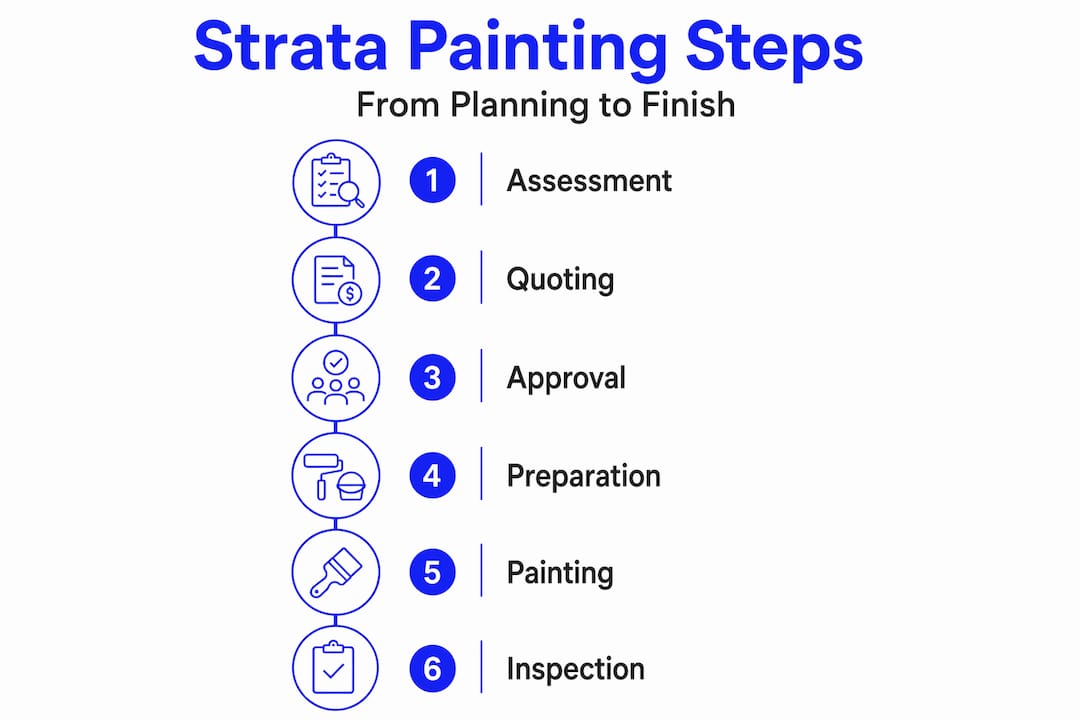
Here is how a well-managed strata painting project typically progresses:
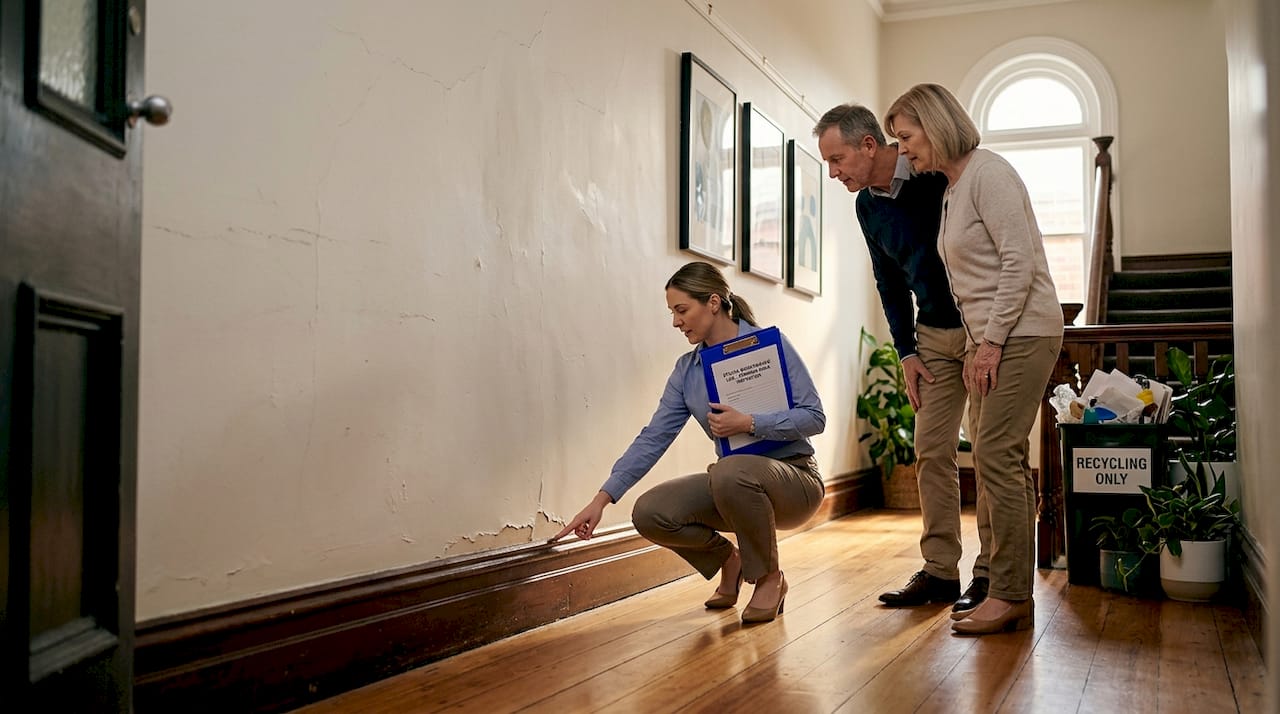
- Condition assessment. A qualified painter or building consultant inspects all surfaces to be repainted, identifies substrate damage, moisture issues, paint failure, and access challenges. This forms the basis of the scope of works.
- Scope preparation and quoting. The strata committee defines the scope, obtains multiple quotes from licensed strata painting specialists, and presents these to the owners corporation for approval.
- Surface preparation. This is where most of the real work occurs. Preparation and access are major cost drivers in any strata project. Cleaning, sanding, patching, render repair, priming, and setting up scaffolding or elevated work platforms consume significant time and budget.
- Resident communication and scheduling. Residents must be informed of access requirements, noise periods, scaffolding placement, and any temporary restrictions. Good communication here prevents disputes and keeps the project on track.
- Paint application. Once surfaces are properly prepared, painting begins in a sequence that minimises disruption to occupied areas. Premium exterior paints, such as those from the Dulux or Taubmans commercial ranges, are typically specified for durability and UV resistance.
- Quality inspection and sign-off. The strata committee or an independent inspector reviews the completed work before final payment is released.
Safety regulations and risk assessments are critical in strata environments. Working at heights on occupied buildings requires strict adherence to safety protocols, which protects residents, workers, and the owners corporation from liability.
Pro Tip: When requesting quotes, ask each painter to break out preparation costs, paint costs, scaffolding, and access equipment separately. A quote that lumps everything together makes it impossible to compare value across tenders or understand where your budget is going.
Legal and financial responsibilities for strata painting
The legal framework around strata painting responsibilities is well defined in Australian legislation, though the specifics vary between states. The core principle is consistent: the owners corporation maintains common property, and repainting external and common areas falls squarely within that obligation.
Key legal and financial considerations include:
- Owners corporation authority. The owners corporation or body corporate holds responsibility for all common property maintenance, including painting. Individual lot owners cannot unilaterally repaint or modify common property.
- Quote requirements. In NSW, owners corporations must obtain two independent quotes for work exceeding $30,000. This protects owners from inflated pricing and promotes competitive, fair tendering.
- Approval process. Major painting works typically require a resolution at a general meeting of the owners corporation, or in some cases a strata committee resolution, depending on the cost threshold and the scheme’s by-laws.
- Funding and levies. Painting works are funded through the administrative or capital works fund, depending on the nature of the expenditure. Owners pay levies into these funds over time to meet anticipated maintenance costs.
- Consequences of deferral. Delaying scheduled painting can constitute a failure to maintain common property, exposing the owners corporation to legal liability if a lot owner suffers loss as a result of that neglect.
The table below summarises typical financial thresholds and approval requirements for strata painting works in NSW:
| Project value | Quote requirement | Approval level |
|---|---|---|
| Under $30,000 | One quote acceptable | Strata committee resolution |
| $30,000 and above | Minimum two independent quotes | Owners corporation resolution |
| Major capital works | Multiple quotes and specifications | Special resolution at general meeting |
Understanding body corporate repainting responsibilities before committing to a project prevents costly procedural errors and ensures that approved works are legally defensible.
Practical tips for planning your strata painting project
Whether you are a property manager coordinating your first major repaint or an experienced strata committee member, a few practical approaches will make the process far smoother.
- Engage the strata committee early. Bring the painting project to the committee’s attention well before the funds are needed. This allows levies to be adjusted in advance and gives time for thorough tendering.
- Choose painters with specific strata experience. Choosing a specialist strata painting company avoids the common pitfalls of residential painters underestimating access complexity, safety requirements, or the pace needed to work around occupied spaces.
- Plan for realistic budgets. Budget estimates must include cleaning, preparation, scaffolding, containment, and access logistics. Paint product cost is a fraction of the total. Schemes that budget only for paint consistently encounter shortfalls mid-project.
- Communicate proactively with residents. Provide residents with a written schedule, expected noise periods, parking impacts, and contact details for queries. Clear communication reduces complaints and keeps the project moving.
- Build in a quality review. Nominate a strata committee member or independent consultant to review progress at key milestones. Checking work before scaffolding is removed is far more efficient than addressing defects after access equipment is gone.
When selecting exterior paint products for common property, prioritise products rated for high UV exposure and moisture resistance, particularly in coastal or high-rainfall areas of Australia.
My perspective: what most owners get wrong about strata painting
I’ve worked on painting projects across a wide range of property types, and strata jobs reveal a consistent pattern. Most owners and committees come to the table thinking about colour choices. What they should be thinking about first is surface condition.
In my experience, the projects that go wrong are almost always the ones where painting began over inadequately prepared surfaces. Moisture trapped behind render, hairline cracks that weren’t sealed, or rust staining on steel elements that wasn’t treated first. These problems don’t disappear under fresh paint. They accelerate. Within two or three years, the paint fails around those problem areas, and the owners corporation is back to the table for remedial work they thought they had already paid to fix.
What I’ve found is that the most cost-effective strata painting projects are the ones where the inspection phase is treated as seriously as the painting itself. A thorough assessment before a single drop of paint is mixed changes the entire scope of works. It turns a cosmetic exercise into a genuine maintenance intervention that protects the building for the next decade.
Managing expectations across multiple stakeholders is also harder than it looks. Committees have differing views on colour, cost, and timing. Residents have differing tolerances for disruption. The painters I’ve seen handle strata work well are the ones who communicate clearly, meet their schedules, and treat the building as if people actually live there, because they do.
Well-managed strata painting adds long-term value that goes well beyond first impressions. It signals that the building is cared for. That matters enormously to the people who live there, and to anyone considering buying in.
— Jarrad
Strata painting services from Sol Shine

Sol Shine brings professional painting expertise to strata properties across Melbourne’s inner east and bayside suburbs, including Kew, Hawthorn, Camberwell, Richmond, Brighton, and Malvern. From lobby and stairwell repaints to full exterior façade programmes, the Sol Shine team understands the planning, stakeholder communication, and surface preparation that strata environments demand. Every project is handled with care for residents and a commitment to durable, quality finishes that protect the building for years. To see completed strata and multi-unit projects, explore Sol Shine’s exterior painting projects or browse the interior painting portfolio to find work that reflects the quality your building deserves. Contact Sol Shine to discuss your next strata repaint.
FAQ
What is the strata painting definition in Australia?
Strata painting refers to the professional repainting of common and external areas within a strata scheme, including external walls, roofs, gutters, balconies, and shared internal spaces such as lobbies and stairwells. Individual units are excluded.
Who is responsible for strata painting costs?
The owners corporation or body corporate is responsible for funding and organising the repainting of common property. Costs are typically drawn from the administrative or capital works fund, collected through owner levies.
How often should strata buildings be repainted?
Most strata buildings require a full external repaint every seven to ten years, depending on climate exposure, paint quality, and surface condition. A condition assessment every three to four years helps identify areas requiring earlier attention.
What affects the cost of strata painting?
The cost of strata painting is influenced by surface preparation requirements, access and scaffolding needs, the area to be painted, substrate condition, and the number of storeys. Paint product costs are typically a smaller proportion of the total budget than preparation and access.
Do you need approval to carry out strata painting?
Yes. Strata painting of common property requires approval from the strata committee or owners corporation, depending on the cost and the scheme’s by-laws. In NSW, works over $30,000 require at least two independent quotes before approval.


