
TL;DR:
- Exterior restoration for Melbourne period homes requires heritage-sensitive materials, thorough substrate assessment, and proper sequencing to ensure long-lasting results.
- Using breathable coatings and integrating modern science without compromising aesthetic character are crucial for preserving structural integrity and heritage value.
Exterior restoration best practices are the essential techniques and methods used to preserve and enhance the structural integrity, appearance, and performance of historic period home façades. For Melbourne homeowners with Victorian or Edwardian properties, this discipline goes well beyond a fresh coat of paint. Successful restoration requires keeping original proportions and heritage details intact while upgrading moisture management, thermal performance, and long-term durability. Getting these fundamentals right from the outset protects both your investment and the irreplaceable character of your home.
1. Start with thorough assessment and substrate integrity testing
Assessment is the foundation of every successful exterior restoration project. Identifying all damage, including issues hidden beneath render or behind weatherboards, determines the true scope of work and prevents superficial fixes that fail within a few years.
Visual inspection alone is not sufficient. Adhesion testing per Dryvit guidelines confirms whether existing substrates can support new coatings or repairs, and reveals delamination, moisture ingress, or structural movement that the eye cannot detect. Skipping this step is one of the most common reasons period home restorations fail prematurely.
A data-driven assessment defines the restoration scope with precision. Key diagnostic steps include:
- Adhesion pull-off testing on render and coating layers to confirm bond strength
- Moisture meter readings across masonry, timber, and render surfaces to map damp zones
- Crack mapping to distinguish cosmetic surface cracks from structural movement
- Substrate probing on timber elements such as fascias, weatherboards, and window frames to identify rot depth
- Photographic documentation of all defects before any work begins
The condition of the substrate directly determines how long any restoration will last. A sound substrate with a quality finish can perform for 10 to 15 years. A compromised substrate with the same finish may fail within two to three years.
Pro Tip: Commission an independent condition report before accepting any contractor quote. This gives you an objective baseline and prevents scope creep mid-project.
2. Clean heritage façades using restorative masonry methods
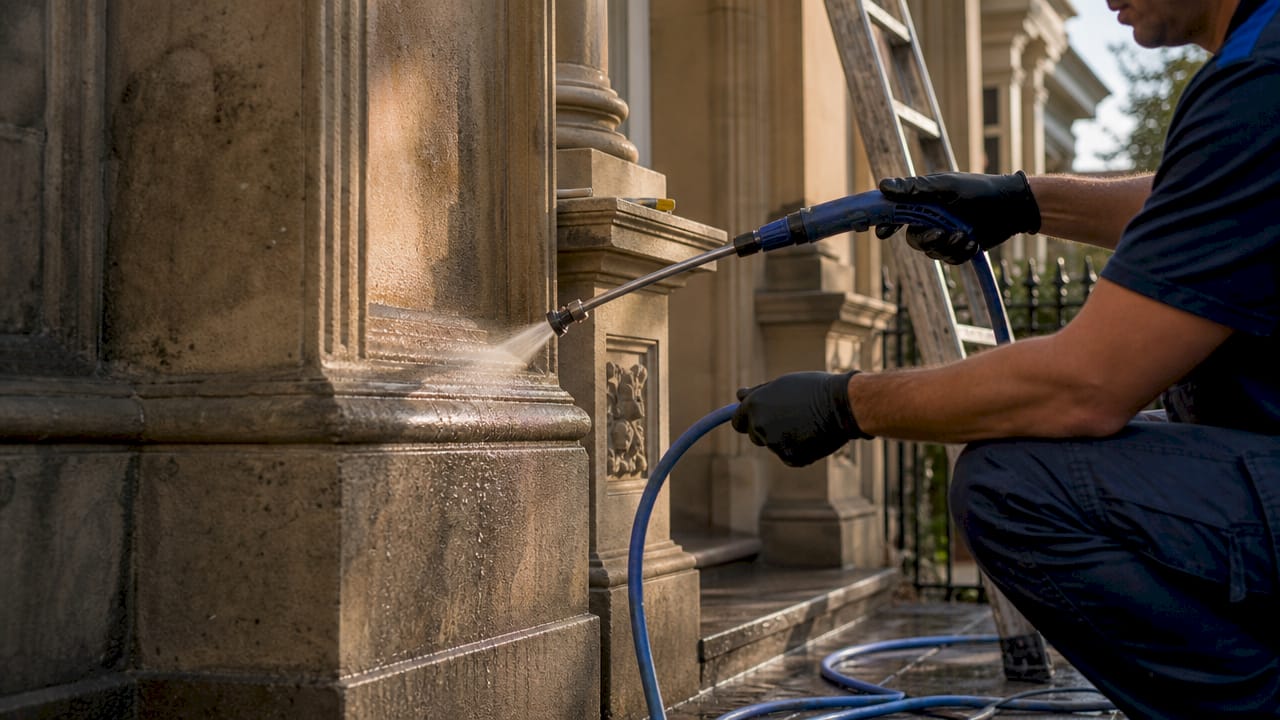
Restorative masonry cleaning is a controlled, specification-level process, not a cosmetic wash-down. Cleaning is often misunderstood as a simple preparatory step, but improper technique causes irreversible damage to historic substrates including colour alteration, surface erosion, and accelerated moisture absorption.
The correct sequence for cleaning a period home façade follows a structured approach:
- Establish test panels on inconspicuous areas to evaluate cleaning method effectiveness and substrate response before full-scale application
- Define success criteria in writing, specifying acceptable appearance outcomes and confirming no substrate damage
- Select the gentlest effective method first, typically low-pressure water washing before progressing to chemical or mechanical options
- Apply chemical cleaners at correct dilutions with adequate dwell time and thorough rinsing to prevent residue that compromises subsequent coatings
- Coordinate cleaning with repair and coating stages so cleaned surfaces are not recontaminated before protective finishes are applied
“Cleaning historic masonry requires specification-level rigour: test panels, success criteria on appearance without substrate damage, and early planning to ensure effective subsequent repairs.” — SWR Institute Technical Meeting, 2025
Improper masonry cleaning through misuse of chemicals, excessive pressure, or inadequate rinsing is a leading cause of accelerated heritage fabric deterioration. For Melbourne bluestone, brick, and render façades, the stakes are particularly high because these materials are often irreplaceable.
Pro Tip: Always request that your contractor documents the cleaning method, dilution ratios, and dwell times used. This record is invaluable if issues arise later.
3. Choose compatible materials: lime renders and breathable coatings
Material selection is where many well-intentioned heritage restorations go wrong. Modern rigid coatings can trap moisture in Victorian-era masonry, causing accelerated decay behind an apparently sound surface. Traditional lime renders allow moisture vapour to escape, which is the defining characteristic that makes them appropriate for period homes.
The distinction between breathable and impermeable systems is not a matter of preference. It is a structural necessity for homes built before the 1940s, when walls were designed to manage moisture through evaporation rather than exclusion.
| Material type | Breathability | Suitability for Victorian homes | Risk profile |
|---|---|---|---|
| Traditional lime render | High vapour permeability | Excellent | Low |
| Mineral silicate paint | High vapour permeability | Excellent | Low |
| Cement-based render | Low vapour permeability | Poor | High moisture entrapment |
| Acrylic/film-forming paint | Impermeable | Poor | High moisture entrapment |
Heritage façades require breathable materials to avoid accelerating decay in Melbourne’s Victorian terraces. Selecting the wrong system does not just cause cosmetic failure. It drives moisture deeper into the masonry, leading to spalling, efflorescence, and in severe cases, structural deterioration that costs significantly more to rectify.
For exterior coatings on heritage properties, mineral silicate paints and limewash finishes are the preferred options. They bond chemically with masonry rather than forming a surface film, which means they cannot peel and they maintain the wall’s natural vapour exchange.
Pro Tip: Ask your supplier for the water vapour transmission rate (sd value) of any coating before specifying it on a heritage façade. An sd value below 0.1 metres is the benchmark for breathable systems.
4. Integrate modern wall science without compromising heritage aesthetics
Balancing heritage character with modern wall science is the defining challenge of period home restoration. The good news is that modern façade systems have advanced to the point where thermal performance and moisture management can be significantly improved without altering the visual character of a Victorian or Edwardian home.
Systems such as StoTherm ci EIFS (exterior insulation and finish systems) and StoCast prefabricated panels replicate historic masonry and render textures with precision. Prefabricated façade systems reduce structural load and improve installation speed while replicating historic textures authentically. This matters for Melbourne homeowners managing multi-storey period properties where scaffolding costs and project duration are significant budget factors.
Key performance improvements available through modern wall science include:
- Continuous insulation layers that eliminate thermal bridging without adding visible bulk to the façade profile
- Air and water-resistive barriers installed behind cladding to manage bulk water intrusion at the wall assembly level
- StoGold Coat® acrylic basecoat systems providing impact resistance and weather protection over insulation substrates
- Vapour-open membrane systems that allow drying to the exterior while blocking liquid water entry
The critical constraint is heritage compliance. Melbourne’s inner east and bayside suburbs contain a high concentration of properties on the Victorian Heritage Register or within heritage overlay zones. Any modification to the external appearance requires council approval, and the use of materials that alter the historic character can result in enforcement action. Engaging a contractor experienced in both heritage compliance and modern wall science is not optional on these projects. It is the difference between a successful outcome and a costly reversal.
5. Plan, budget, and sequence your restoration project correctly
Project planning separates a restoration that delivers lasting results from one that creates ongoing maintenance cycles. Major restoration projects should include contingency budgets of 10 to 15 per cent to cover unforeseen hidden damage such as rot and substrate deterioration. This is not a conservative estimate. On period homes in Melbourne, discovering concealed damage during works is the norm, not the exception.
The correct sequencing of work is equally critical. Applying finishes before fixing moisture problems traps dampness and causes early paint and render failure. The sequence that produces durable results follows a clear hierarchy:
- Stage 1: Structural and moisture repairs, including brickwork repointing, render patching, and timber replacement
- Stage 2: Window and door frame repairs, glazing seal replacement, and flashing corrections
- Stage 3: Restorative cleaning of all surfaces to be coated
- Stage 4: Priming and coating application in appropriate weather conditions
- Stage 5: Architectural detail work including heritage timber trim, decorative mouldings, and joinery finishing
Heritage compliance in Melbourne requires permits for many external works on properties within heritage overlay zones. Councils including Boroondara, Stonnington, and Port Phillip have specific requirements for materials and methods. Engaging a contractor who understands these requirements before work begins avoids stop-work orders and costly rectification.
Selecting qualified tradespeople with demonstrated experience in period home restoration is the single most important decision you will make. Ask for references from comparable projects, request evidence of heritage compliance approvals, and confirm that all trades are working under a single project manager rather than being coordinated separately. For projects above $20,000, a renovation storage plan that protects furniture and fittings during extended exterior works also reduces the risk of incidental damage.
Key takeaways
Exterior restoration best practices for Melbourne period homes require breathable materials, substrate-first sequencing, and heritage-compliant planning to deliver results that last.
| Point | Details |
|---|---|
| Assess before you act | Adhesion testing and moisture mapping define true project scope and prevent premature failure. |
| Clean with specification rigour | Test panels and controlled methods protect irreplaceable heritage masonry from chemical or mechanical damage. |
| Prioritise breathable materials | Lime renders and mineral coatings prevent moisture entrapment that destroys Victorian-era masonry from within. |
| Sequence moisture repairs first | Structural and damp repairs must precede any cosmetic finishes to avoid trapping moisture behind coatings. |
| Budget for the unexpected | A 10 to 15 per cent contingency is standard practice for period home restorations where hidden damage is common. |
What I’ve learned restoring Melbourne’s period homes
The most persistent misconception I encounter is that exterior restoration is primarily a painting project. Homeowners see peeling paint or faded render and assume the solution is a new coat of finish. In reality, the paint is almost always the symptom. The cause is almost always moisture, substrate failure, or an incompatible previous coating system.
I’ve seen beautifully painted Victorian terraces in Hawthorn and Camberwell that were re-coated with acrylic systems five years prior and are now showing spalling render and rising damp. The coating looked fine from the street. Beneath it, the masonry was deteriorating faster than if it had been left unpainted. This is the hidden crisis that breathable lime-based systems exist to prevent.
The other lesson that experience reinforces is the value of early intervention. A hairline crack in render costs a few hundred dollars to repair correctly. Left for two Melbourne winters, it becomes a moisture pathway that saturates the wall cavity and requires full render replacement at ten times the cost. The homeowners who get the best long-term outcomes are those who treat their period home’s exterior as a living system requiring regular assessment, not a fixed asset requiring occasional cosmetic attention.
Modern wall science and heritage values are not in conflict. The best restorations I’ve been involved with use advanced moisture management and thermal performance principles in ways that are completely invisible from the street. The home looks exactly as it should. It just performs far better than it ever did originally.
— Jarrad
Restore your period home with Sol Shine
Sol Shine specialises in heritage painting and exterior restoration for Victorian and Edwardian homes across Melbourne’s inner east, bayside, and surrounding suburbs including Kew, Hawthorn, Camberwell, Brighton, and Malvern.

Every project is managed under one roof, from render repair and brickwork to timber restoration, custom joinery, and heritage painting for period façades. Sol Shine works directly with homeowners on large-scale restoration projects, bringing together skilled tradespeople who understand both heritage compliance and modern performance standards. If your period home needs a thorough assessment and a restoration plan that respects its character, contact Sol Shine to discuss your project. You can also explore the full range of exterior painting services to understand what a complete restoration engagement looks like.
FAQ
What is the first step in exterior restoration for a period home?
The first step is a thorough condition assessment including adhesion testing and moisture mapping. Visual inspection alone is insufficient to define the true scope of work on a heritage property.
Why can’t I use standard acrylic paint on a Victorian terrace?
Standard acrylic and film-forming paints are impermeable and trap moisture vapour inside heritage masonry walls. This accelerates decay in Victorian-era brickwork and render, causing spalling and structural deterioration over time.
How much should I budget for unexpected repairs in a heritage restoration?
A contingency of 10 to 15 per cent of the total project budget is the standard recommendation for period home restorations. Hidden damage such as concealed rot, failed substrate, and moisture ingress is common once works begin.
Do I need council approval for exterior restoration in Melbourne?
Properties within heritage overlay zones, which include many suburbs in Boroondara, Stonnington, and Port Phillip, require council permits for external works that alter the appearance or materials of the building. Confirm heritage overlay status before commencing any works.
What makes lime render better than cement render for heritage homes?
Lime render is vapour-permeable, allowing moisture to escape through the wall surface naturally. Cement render is rigid and impermeable, trapping moisture inside the masonry and accelerating the decay of historic fabric in period homes.


