
TL;DR:
- Modern eco-friendly paints achieved with low-VOC formulas match traditional paints in durability and appearance.
- Certified products like GECA, Green Seal, and GREENGUARD ensure genuine environmental benefits.
- Proper surface preparation and expert application extend the lifespan of heritage paints in Melbourne’s climate.
Eco-friendly paint has long carried an undeserved reputation among heritage homeowners. Many assume that choosing a sustainable option means compromising on durability, colour richness, or the refined finish that a Victorian or Edwardian façade demands. That assumption is outdated. Recent advances in low-VOC formulations and rigorous certification programmes have produced eco-paints that hold up against Melbourne’s unpredictable climate while respecting the architectural character of your home. This guide cuts through the noise, explaining what genuinely makes a paint eco-friendly, which certifications carry real weight, and how to choose the right product for your heritage renovation.
Table of Contents
- What makes paint eco-friendly?
- Certifications and standards that matter
- Eco-friendly paint: performance, durability, and appearance
- Choosing eco-friendly paint for Melbourne heritage renovations
- A Melbourne specialist’s perspective: what most guides miss
- Connect with trusted heritage painting experts
- Frequently asked questions
Key Takeaways
| Point | Details |
|---|---|
| Certifications matter | Look for GECA, Green Seal, GREENGUARD, and Global GreenTag to guarantee genuine eco-friendly paint for heritage homes. |
| No more durability fears | Modern eco-paints match traditional paints for robustness, washability, and UV resistance in heritage environments. |
| Heritage compatibility | Eco-friendly options include period-accurate colours and finishes suitable for Victorian and Edwardian restorations. |
| Lifecycle verification | Choose paints with full lifecycle credentials to avoid greenwashing and ensure sustainability. |
| Practical selection | Consider environmental impact, historic detail, and surface preparation when choosing eco-friendly paint for your renovation. |
What makes paint eco-friendly?
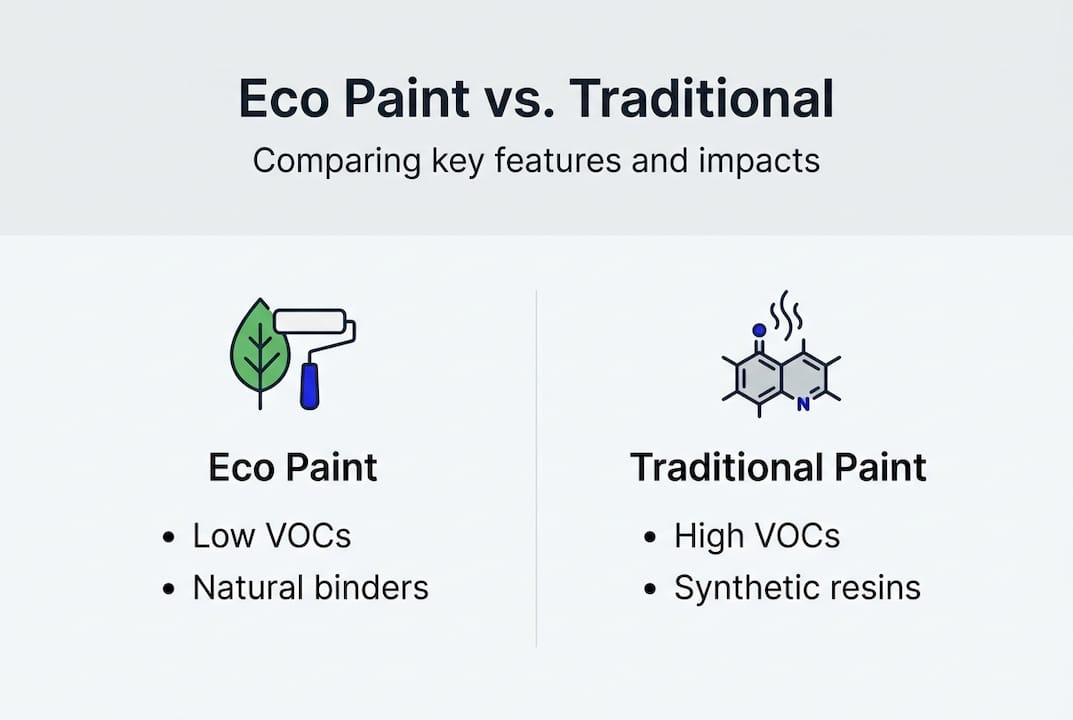
Eco-friendly paint is not simply a marketing label. It refers to products formulated with low or no volatile organic compounds (VOCs), reduced toxic additives, and manufacturing processes that minimise environmental harm. VOCs are chemicals that evaporate as paint dries, contributing to indoor air pollution and broader atmospheric damage. Reducing them is one of the most meaningful steps a paint manufacturer can take.
Beyond VOCs, genuinely eco-friendly paints are assessed across their entire lifecycle. This means examining raw material extraction, production, packaging, application, and disposal. A product that is low-VOC but relies on environmentally destructive ingredients elsewhere in its supply chain is not truly sustainable.
For heritage renovations in particular, the composition of the paint matters beyond environmental reasons. Older homes in Kew, Hawthorn, and Brighton often feature fine timber trims, rendered façades, and ornate joinery that require products with excellent adhesion and flexibility. Eco-paints have evolved to meet these specific demands.
Key attributes that define a genuinely eco-friendly paint include:
- Low or zero VOC content, typically below 5 grams per litre for flat finishes
- No added formaldehyde, heavy metals, or biocides beyond regulated limits
- Water-based formulations that reduce solvent use and simplify clean-up
- Responsibly sourced pigments and binders
- Minimal and recyclable packaging
- Third-party certification from a recognised body
The distinction between traditional and eco paints is worth understanding clearly. Heritage paint certifications provide a reliable framework for comparing products that might otherwise look similar on a shelf.
| Feature | Traditional paint | Eco-friendly paint |
|---|---|---|
| VOC content | Often 150-400 g/L | Below 50 g/L or zero |
| Toxic additives | May include heavy metals | Regulated and minimised |
| Lifecycle assessment | Rarely conducted | Required for certification |
| Indoor air quality impact | Significant during and after application | Minimal |
| Durability on heritage surfaces | Proven over decades | Now comparable with certification |
Green Seal standards cover paints, coatings, stains, and sealers, and key certifications include Green Seal, GREENGUARD, GECA, Global GreenTag GreenRate Level A, and Nordic Swan Ecolabel, each ensuring science-based standards for sustainability.
Certifications and standards that matter
Once you understand what defines eco-friendly paint, the next step is knowing which certifications are worth trusting. The market is crowded with vague claims and self-declared environmental credentials. Genuine third-party verification is what separates a truly sustainable product from clever packaging.
GECA (Good Environmental Choice Australia) is the most relevant certification for Australian homeowners. It assesses products against full lifecycle criteria, covering manufacturing inputs, performance, and end-of-life impact. GECA lifecycle assessment means a product has been independently verified rather than self-assessed. Critically, GECA verification ensures science-based sustainability standards and prevents greenwashing through full lifecycle checks, making it a strong benchmark for local projects.
Green Seal is a US-based programme widely recognised in Australia. Its Green Seal paint criteria address VOC limits, restricted ingredients, and performance requirements. Products carrying this label have met rigorous chemical and environmental tests.
GREENGUARD focuses specifically on indoor air quality. It certifies products with low chemical emissions, which matters enormously when repainting the interior rooms of a heritage home where ventilation may be limited.
Global GreenTag GreenRate Level A is another credible Australian certification, assessing environmental, health, and social impacts across the supply chain.
| Certification | Origin | Focus area | Heritage relevance |
|---|---|---|---|
| GECA | Australia | Full lifecycle | High |
| Green Seal | USA | VOCs, toxins, performance | High |
| GREENGUARD | USA | Indoor air quality | High for interiors |
| Global GreenTag | Australia | Supply chain and health | High |
| Nordic Swan | Scandinavia | Lifecycle, emissions | Moderate |
When evaluating products for your renovation, look for these labels on the tin or the manufacturer’s technical data sheet. Vague terms like “natural,” “green,” or “environmentally responsible” without a certification logo are red flags. Checking paint quality standards against recognised benchmarks before committing to a product can save you significant frustration later.
For heritage work specifically, a certified product also provides documentation that can support council approvals or heritage overlay requirements in councils like Boroondara, Stonnington, and Port Phillip.
Eco-friendly paint: performance, durability, and appearance
The most persistent concern among heritage homeowners is whether eco-friendly paints can truly match conventional options when it comes to performance. On a Victorian weatherboard or an Edwardian rendered façade, paint must resist UV exposure, moisture ingress, and the movement that comes with timber expansion and contraction across Melbourne’s seasonal extremes.
The short answer is yes, modern eco-paints are more than capable. Brands like Dulux and Resene have invested heavily in formulations that meet both environmental standards and demanding performance requirements. Eco-paints now offer comparable washability and durability to traditional paints, with GECA providing the verification framework that confirms these claims.
For heritage timber trims and weatherboards, the key performance metrics are:
- Adhesion to previously painted or primed surfaces
- Flexibility to accommodate timber movement without cracking
- Washability for interior walls subject to daily wear
- UV resistance to prevent fading on sun-exposed northern and western elevations
- Colour retention over multiple years without chalking or discolouration
Review the data for best eco paint brands to compare product specifications side by side before making a decision.
| Performance metric | Traditional paint | Certified eco paint |
|---|---|---|
| UV resistance | High | High (GECA-verified) |
| Washability (interior) | High | Comparable |
| Flexibility on timber | Variable | Good with water-based formulas |
| Colour retention | Strong | Strong |
| Drying time | Variable | Often faster (water-based) |
Understanding durability factors for heritage homes is essential before selecting any product, eco or otherwise. Surface preparation remains the most critical variable in longevity, regardless of which paint you choose.
Pro Tip: When reviewing eco-paint options for a heritage exterior, look specifically for GECA or Green Seal certification alongside the technical data sheet rating. A certified product with a minimum 10-year exterior durability rating is achievable and worth seeking out.
Appearance is equally non-negotiable for a heritage property. Leading eco-paint ranges now include period-appropriate colour palettes with flat, low-sheen, and satin finishes that suit the aesthetic of Victorian and Edwardian homes. Paint durability explained clearly shows that eco formulations no longer require visual compromise.
Choosing eco-friendly paint for Melbourne heritage renovations
With performance established, the practical task of selecting the right paint for your home requires careful thought. Heritage properties have layers of complexity that newer homes simply do not, from existing lead-based paint beneath the surface to the need for period-accurate colour matching and finish profiles.
Here is a structured approach to help you make the right choice:
- Assess the surface condition first. Before selecting any product, understand what you are painting over. Older surfaces may require specific primers compatible with eco-paint formulas. Proper surface preparation is the foundation of any long-lasting result.
- Distinguish between interior and exterior needs. Interior rooms benefit most from GREENGUARD-certified products that minimise emissions. Exterior surfaces require strong UV resistance and flexibility. Select products optimised for each environment rather than a single product for both.
- Prioritise GECA or Green Seal certification. GECA ensures no greenwashing and full lifecycle verification, giving you confidence that environmental claims are substantiated.
- Match colours to the heritage palette. Work with your painter to select shades from certified eco-paint ranges that suit Victorian or Edwardian character. Many manufacturers offer heritage collections with period-accurate tones in low-VOC formulas.
- Factor in finish appropriately. Flat and low-sheen finishes are historically accurate for most exterior and interior heritage surfaces. Higher sheen levels on heritage details like architraves and skirtings should still use certified eco formulations.
- Verify primer compatibility. Eco topcoats perform best when paired with compatible eco primers. Mixing conventional solvent-based primers beneath eco topcoats undermines the environmental benefit.
Heritage paint protection extends well beyond aesthetics. The right paint choice actively preserves the structural integrity of timber and render, reducing the need for costly repair cycles over time. Equally, investing in surface preparation tips will ensure that your eco-paint investment delivers a result measured in decades rather than years.
Pro Tip: Ask your painter for the technical data sheet of any recommended eco product before work begins. Confirm VOC levels, coverage rates, and recommended primer systems in writing. A reputable heritage painter will provide this without hesitation.
A Melbourne specialist’s perspective: what most guides miss
After working on Victorian and Edwardian homes across Camberwell, Malvern, and Brighton, Sol Shine has observed a consistent pattern: homeowners focus heavily on product choice and very little on the preparation that precedes it. Eco-friendly paint applied over a poorly prepared surface will fail faster than a conventional paint applied correctly. The sustainable choice includes the process, not just the product.
Melbourne’s climate adds another layer of complexity. The temperature swings between seasons place genuine stress on heritage timber, and not all eco-formulations respond equally. The products verified through sustainable heritage painting standards consistently outperform those carrying vague environmental claims with no independent backing.
The uncomfortable truth is that some “green” products on the market are not meaningfully better for the environment than their conventional counterparts. Only verified certifications like GECA, Green Seal, and GREENGUARD provide the assurance that what you are applying genuinely delivers on its environmental promise. For a heritage home you intend to preserve for generations, that rigour is not optional.
Connect with trusted heritage painting experts
Choosing the right eco-friendly paint is only part of the equation. Proper application by specialists who understand the demands of heritage surfaces makes the difference between a result that lasts and one that requires attention within a few years.

Sol Shine works with homeowners across Melbourne’s inner east and bayside on heritage painting projects that combine certified eco-paint solutions with skilled preparation and restoration craftsmanship. From interior painting specialists handling Victorian room-by-room repaints to full façade restorations, the team brings the same rigorous standards to every project. Explore completed heritage painting Melbourne projects to see the quality firsthand, or review our approach to premium heritage painting to understand how Sol Shine supports large-scale renovations from start to finish.
Frequently asked questions
What are VOCs and why are they important in eco-friendly paint?
VOCs, or volatile organic compounds, are chemicals that evaporate from paint as it dries and can harm indoor air quality. Eco-friendly paints contain low or no VOCs, and certified standards such as Green Seal and GREENGUARD verify low emissions for a healthier living environment.
How can I check if a paint is genuinely eco-friendly?
Look for certifications like GECA, Green Seal, and GREENGUARD on the product label or technical data sheet. These labels confirm science-based sustainability through full lifecycle verification rather than unsubstantiated marketing claims.
Does eco-friendly paint sacrifice durability compared to traditional paint?
Current eco-paints meet or exceed the durability of conventional paints, particularly when selecting GECA-verified brands. Comprehensive verification through GECA confirms washability and long-term performance standards are met.
Can eco-friendly paints match the historic colours and finishes of Victorian and Edwardian homes?
Yes, leading eco-paint brands including Dulux and Resene offer period-accurate shades and finishes suited to heritage restoration requirements. Eco-paints now rival traditional options for appearance and colour range without compromising environmental performance.
Are eco-friendly paints more expensive?
Eco-friendly paints can carry a modest premium upfront, but they often reduce long-term costs by improving indoor air quality and longevity. Lifecycle certification ensures that both cost and sustainability are assessed together, making the investment well justified for a heritage property.


