
TL;DR:
- Owning a heritage driveway in Melbourne requires careful compliance with council and heritage overlay regulations to preserve the property’s character. Regular inspections, appropriate materials, and professional assessments are essential for maintaining structural integrity and aesthetic authenticity. Proper planning and expert guidance ensure responsible care that respects both history and modern functional standards.
Owning a Victorian or Edwardian home in Melbourne carries a quiet responsibility that extends well beyond the front door. Your driveway is often the first element visitors notice, and for heritage properties, it carries architectural weight that a standard suburban concrete slab simply does not. But maintaining that driveway is rarely straightforward. Heritage overlays, council permits, period-appropriate materials, and Melbourne’s variable climate all create a layered maintenance challenge that most generic guides overlook. This checklist is designed specifically for you, giving you a practical, compliance-aware framework to protect both the character and the structural integrity of your heritage driveway.
Table of Contents
- Understand council and heritage overlay requirements
- Concrete driveway maintenance: what to check and when
- Asphalt driveway checklist: unique inspection points
- Repair or replace? Decision-making for heritage driveways
- A heritage expert’s take: what most lists miss for Melbourne driveways
- Elevate every restoration with Melbourne’s heritage experts
- Frequently asked questions
Key Takeaways
| Point | Details |
|---|---|
| Always check permits | Regulatory and heritage overlays in Melbourne mean extra approvals before driveway works. |
| Tailor maintenance to material | Concrete and asphalt require different cleaning, sealing, and repair methods to stay in top shape. |
| Watch for structural signs | Cracks, pooling water, and edge failures are warning signals for both repair needs and possible replacement. |
| Prevention is better than cure | Simple checklist actions like sealing and edge protection can avoid costly, major repairs later. |
| Keep heritage value intact | Choose methods and materials that respect your home’s historical character while ensuring practicality. |
Understand council and heritage overlay requirements
Now that you understand why driveway care is not business as usual for heritage homes, the next step is clarifying your legal obligations before any physical work begins.
Many homeowners assume that a quick crack fill or a new sealant coat is simply routine upkeep. In a heritage context, that assumption can lead to costly fines or forced reinstatement. Vehicle crossing permits are required for many driveway works in Melbourne, including on heritage properties where visible changes can trigger additional council and sometimes Heritage Victoria involvement.
The regulatory distinction that matters most is the line between maintenance and works. Maintenance versus restoration is treated very differently under Victorian planning rules, and heritage homes sit in a category where even surface material changes can require a planning permit. If your property carries a heritage overlay (designated HO in your council’s planning scheme), you are working under additional scrutiny.
“The practical consequence is this: if your proposed works alter the driveway’s appearance, material, or structure in any visible way, you are likely in permit territory regardless of how minor the job feels.”
Approvals checklist before committing to any works:
- Confirm whether your property has a heritage overlay by searching your council’s planning map
- Determine if the work is genuinely maintenance (cleaning, sealing, minor crack filling) or an alteration (new surface, change of material, widening)
- Contact your council’s planning desk and request a pre-application meeting for anything beyond basic cleaning
- Ask specifically about vehicle crossing permits if edge, kerb, or crossover work is involved
- Check whether Heritage Victoria involvement is required for state-significant listings
- Save all correspondence, photographs of existing conditions, and permit documentation before work starts
Pro Tip: Ring your local council’s planning desk early, even for what seems like a straightforward repair. A five-minute conversation can save weeks of delay and unexpected costs. Councils in Boroondara, Stonnington, and Port Phillip all have dedicated heritage advisors who can clarify your obligations quickly.
Understanding this regulatory landscape also connects to broader preservation of home exteriors for heritage properties, where compliance underpins every decision from paint colour through to driveway surface treatments.
Concrete driveway maintenance: what to check and when
Once you have sorted the approvals, it is time to focus on the physical upkeep of your specific driveway surface, starting with concrete.
Concrete driveways on heritage properties often date back decades and carry characteristics that modern slabs lack, including hand-laid edges, period-appropriate aggregate finishes, and original formwork patterns. These details are worth preserving, but they also present specific failure points. A thorough maintenance checklist for Melbourne concrete driveways covers cleaning, sealing, crack repair, drainage management, and edge protection as the core pillars of ongoing care.
Step-by-step concrete driveway maintenance checklist:
- Sweep and wash the surface. Remove debris, leaf matter, and organic build-up using a stiff broom, then wash with a low-pressure hose. Avoid high-pressure washing on older or unsealed heritage concrete, as it can strip surface finish and damage fine detailing at edges.
- Inspect for cracks. Walk the full length of the driveway and document every crack you find. Hairline cracks under 1 mm are typically cosmetic. Cracks between 1–3 mm need monitoring and sealing. Cracks over 3 mm or those showing vertical displacement require professional assessment before any surface treatment.
- Check the edges and transitions. Heritage concrete driveways often have decorative edging, patterned borders, or curved transitions to garden paths. These areas are structurally weaker and tend to deteriorate first. Look for crumbling, spalling, or lifting at any edge zone.
- Assess drainage. Pour a small amount of water at the centre and edges and watch where it flows. Water pooling near the house foundation is a serious warning sign and warrants urgent attention. Good drainage protects the concrete base from subsoil movement, which is a particular concern in Melbourne’s clay-heavy soils.
- Inspect for staining. Oil, rust, and tannin stains from overhanging trees are common on heritage properties with established gardens. Identify and treat these before sealing, as sealing over stains locks them permanently into the surface.
- Seal the surface. Apply a quality penetrating concrete sealer every two to three years to protect against moisture ingress, staining, and surface degradation. In Melbourne’s climate, the transition from hot, dry summers to wet winters puts significant stress on unsealed concrete.
Pro Tip: Schedule your annual inspection and cleaning in late autumn, after the leaves have fallen but before winter rains arrive. This timing lets you clear organic debris before it decomposes into tannins and catch any drainage issues before they are stressed by wet weather.
For properties where surface condition has deteriorated significantly, epoxy driveway coatings can provide an additional layer of protection, though any coating choice must be assessed for heritage appropriateness first. Similarly, exterior cleaning for heritage homes requires a considered approach that protects original finishes rather than stripping them.
Asphalt driveway checklist: unique inspection points
Not all heritage homes have concrete driveways. The next common material is asphalt, which brings its own unique inspection and care requirements.
Asphalt ages through oxidation and UV exposure, causing the surface to grey and become brittle over time. In Melbourne conditions, the heat-cold cycling is particularly hard on asphalt binders. Protecting asphalt against UV and water through regular sealing is the single most effective maintenance action an owner can take. Without it, surface degradation accelerates rapidly after the first five years.
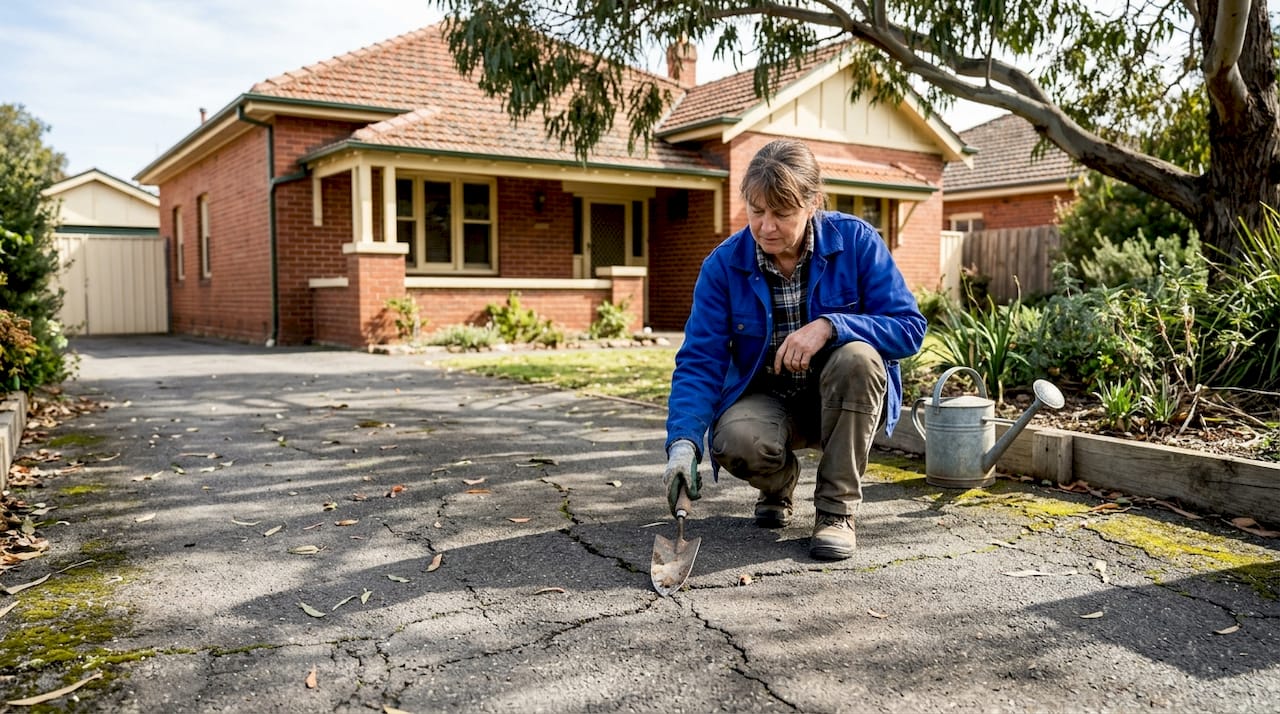
Statistic to note: Cracks wider than 5 mm in an asphalt surface warrant urgent professional repair. Beyond this threshold, water infiltration into the base layer accelerates damage exponentially, especially in Melbourne’s expansive clay soils.
Asphalt driveway inspection checklist:
- Check crack width and pattern. Narrow, isolated cracks are repairable. A network of interconnected cracks resembling crocodile skin (alligator cracking) signals base failure
- Assess surface colour. A healthy asphalt surface is dark grey to black. Significant greyish or faded colouring indicates oxidation and the need for reseal
- Look for potholes or depressions. Any pothole, however small, allows water into the base and must be filled promptly
- Check for edge crumbling. Edges without kerb support deteriorate faster and can compromise the visual character of a heritage frontage
- Monitor drainage after rain. Standing water after rain indicates either poor grading or base settlement, both of which need professional assessment
- Inspect for surface ravelling. Loose aggregate or a rough, gravelly texture means the binder has degraded and the surface needs treatment
Inspecting for these signs early and consistently is what separates a manageable maintenance programme from an expensive emergency replacement. For heritage homes, the added complexity is ensuring that any reseal or surface treatment is compatible with the property’s period character and council heritage guidelines.
| Inspection item | Acceptable condition | Action required |
|---|---|---|
| Crack width | Under 3 mm, isolated | Monitor and seal annually |
| Crack pattern | Linear, non-connected | Fill with crack sealant |
| Surface colour | Dark grey, uniform | Reseal if greying is present |
| Drainage | Water disperses within 2 minutes | Regrade or consult engineer |
| Edge condition | Firm, defined | Repair any crumbling promptly |
| Potholes | None present | Fill and compact immediately |
A simple guide covering outdoor cleaning steps for heritage properties is also worth reviewing, particularly for managing organic growth on asphalt surfaces in gardens with mature trees.
Repair or replace? Decision-making for heritage driveways
After you have identified maintenance needs via checklists, you will reach a point where a clear decision is needed: repair, resurface, or undertake a full replacement?
This decision is more consequential for heritage properties than for standard homes. The driveway contributes to the streetscape authenticity of your Victorian or Edwardian home, and a poorly chosen replacement material can detract from the property’s character and potentially create compliance issues under your heritage overlay.
Alligator cracking and structural failure are reliable indicators that replacement is necessary rather than repair. Isolated surface cracks covering less than 25% of the area, by contrast, are typically suitable for repair without full replacement. The critical variable is the condition of the base layer beneath the surface.
A key insight from experienced restoration professionals: resurfacing over a failing base is money wasted. If the sub-base has failed due to drainage problems, clay movement, or root intrusion, no surface treatment will hold. Address the base first, or the investment in surface repair will be short-lived.
Steps to a confident repair-or-replace decision:
- Complete a full surface inspection using the checklists above and photograph all damage
- Probe any depressions or sinking areas to assess whether the issue is surface-deep or base-related
- Consult a specialist who understands both the technical requirements and the heritage context of your property
- Obtain a written assessment that includes base condition and drainage evaluation
- Check your council’s heritage overlay requirements before committing to any particular replacement material
- Budget for the full scope, including any permit fees, heritage consultant input, and reinstatement of period-appropriate edge details
| Trigger | Concrete: repair | Concrete: replace | Asphalt: repair | Asphalt: replace |
|---|---|---|---|---|
| Surface cracks under 3 mm | Yes | No | Yes | No |
| Alligator cracking | No | Yes | No | Yes |
| Edge crumbling, minor | Yes | No | Yes | No |
| Sinking or settlement | Assess base first | Likely | Assess base first | Likely |
| Drainage failure | Address drainage, then repair | If base failed | Address drainage, then repair | If base failed |
| Over 25% area damaged | No | Yes | No | Yes |
Decisions about replacement materials also connect to broader weatherproofing of heritage exteriors, where material compatibility and period appropriateness matter as much as technical performance.
A heritage expert’s take: what most lists miss for Melbourne driveways
Standard maintenance checklists cover the technical tasks well. What they rarely address is the deeper challenge facing Melbourne heritage homeowners: making maintenance decisions that respect historical integrity while meeting modern functional standards.
The most expensive mistakes Sol Shine encounters on heritage properties are not caused by neglect. They are caused by well-intentioned repairs using the wrong methods or materials. A high-pressure wash that strips original exposed aggregate finish. A modern polymer crack filler that sits visually incongruous against a century-old concrete edge. These mismatches are difficult and costly to reverse, and they can undermine the character that makes your property valuable.
Sealing is often treated as a cure-all, but it is really insurance against surface degradation. It will not stop subsidence caused by clay movement, nor will it compensate for a failed base layer. Owners who seal over problems are simply delaying a more serious reckoning. Address the structural issue first, then protect the repaired surface.
Edge zones and transition areas deserve particular attention. In our experience, the driveway edge where concrete or asphalt meets the garden bed, the footpath, or a heritage gate pier is where deterioration begins and where visual authenticity is most at risk. These zones fail first and define the aesthetic impression of the whole driveway. Prioritise them.
Compliance documentation is another area where owners are often underprepared. Always photograph existing conditions before any works begin. Retain every permit, correspondence, and invoice. If a heritage overlay dispute ever arises, this paperwork is your primary protection.
Pro Tip: Where possible, choose reversible interventions. Surface cleaning, penetrating sealers, and removable surface treatments preserve future conservation options. Irreversible choices, such as grinding off original surface textures or using incompatible infill materials, should be avoided unless professionally assessed.
For a broader view of maintaining your property’s period character, heritage home painting and maintenance tips cover complementary principles that apply across all exterior surfaces.
Elevate every restoration with Melbourne’s heritage experts
Driveway care is just one element of a heritage home’s exterior story, but it connects directly to the kerb appeal, structural health, and long-term value of your property.

Sol Shine specialises in the kind of careful, considered restoration that Victorian and Edwardian homes in Melbourne deserve. From surface assessment and permit navigation through to painting, render repair, and full exterior restoration, our heritage painting projects bring together the skills and historical sensibility your property requires. We understand that every decision on a heritage home carries weight, and we treat your property accordingly.
If you are looking for premium heritage painting or a complete exterior restoration that honours the original character of your home, speak with our team. We work with homeowners across Kew, Hawthorn, Camberwell, Brighton, Malvern, and surrounding suburbs on projects typically valued at $20,000 and above, and we handle every element under one roof. A well-executed restoration genuinely boosts value for heritage homes, and we are here to help you achieve that outcome with confidence.
Frequently asked questions
Do I need council approval to repair my heritage driveway in Melbourne?
Maintenance may not require a permit, but works needing approval include visible changes, new vehicle crossings, and surface material alterations, particularly for heritage overlay properties.
How often should I seal a concrete driveway in Melbourne’s climate?
Resealing every 2 to 3 years is the standard recommendation for Melbourne concrete driveways, helping to protect against moisture ingress, staining, and the effects of the city’s variable climate.
Can surface cracks in a driveway be DIY repaired or should I call a pro?
Small, shallow cracks are often manageable as a DIY task, but structural or widespread cracking should always be professionally assessed before any surface treatment is applied.
What are the danger signs my asphalt driveway needs full replacement?
Alligator cracking, repeated water pooling, persistent sinking, and widespread edge crumbling are all clear signals that resurfacing alone will not resolve the underlying structural failure.
Will epoxy coating help preserve a heritage concrete driveway?
Yes, epoxy coatings add a meaningful layer of protection against staining and moisture, but you should always confirm that the chosen coating is appropriate for your property’s heritage overlay conditions before proceeding.


