
TL;DR:
- Repainting heritage Victorian and Edwardian homes without addressing moisture and salt migration can lead to rapid paint failure and masonry deterioration. Proper assessment, desalination, and breathable restoration materials are essential for long-lasting preservation. Employing specialist heritage painters ensures effective moisture management and the use of appropriate breathable coatings to protect these historic structures.
Repainting the façade of a Victorian or Edwardian home can feel like the obvious answer when paint starts to flake or bubble. But fresh paint applied over untreated moisture is one of the most costly mistakes a heritage homeowner can make. Beneath the surface of Melbourne’s period homes, moisture and salt migration are constantly at work, quietly undermining the very substrate your paint is meant to protect. Understanding what drives this deterioration, and how to address it methodically, is the difference between a paint job that lasts a decade and one that fails within a few years.
Table of Contents
- Understanding moisture issues in heritage homes
- How moisture impacts painting longevity
- Best practices for addressing moisture before painting
- Choosing the right paints and solutions for moisture-prone surfaces
- A heritage specialist’s hard-won lessons on moisture control
- Expert restoration and painting solutions for Melbourne heritage homes
- Frequently asked questions
Key Takeaways
| Point | Details |
|---|---|
| Moisture control is crucial | Managing moisture and salts before painting protects heritage homes from rapid deterioration. |
| Use specialist diagnostics | Professional moisture assessment ensures hidden damage is detected and treated properly. |
| Choose breathable finishes | Selecting limewash or mineral paints allows moisture to escape, reducing risks of peeling and salt damage. |
| Follow evidence-based steps | Desalination, drying, and restoration must precede painting for lasting results. |
| Professional help adds value | Heritage painting specialists deliver proven longevity and preserve property worth in Melbourne’s climate. |
Understanding moisture issues in heritage homes
Victorian and Edwardian homes were built with materials and methods that suited their era: solid brick construction, lime mortar joints, and masonry walls that were never designed to be waterproof in the modern sense. Instead, they were built to breathe. Moisture would enter the wall, migrate through it, and evaporate naturally at the surface. That system worked well when the original lime renders and limewash coatings remained intact. Today, many of these homes have had those breathable finishes replaced with modern cement renders or acrylic paints, which trap moisture inside the wall rather than letting it escape.
The result is a building that absorbs moisture but cannot release it efficiently. This leads to three persistent problems that heritage homeowners across Melbourne encounter regularly:
- Rising damp: Groundwater travels upward through masonry via capillary action, carrying dissolved salts from the soil. It typically appears as a tide mark on lower walls, both internally and externally.
- Salt migration: As moisture moves through the wall, it dissolves and carries soluble salts. When the moisture evaporates at the surface, those salts crystallise within the masonry pores or just behind the paint film.
- Condensation: In Melbourne’s variable climate, cool masonry walls can cause warm interior air to condense, adding to moisture loading from the inside.
Salt and moisture transport in porous materials can significantly affect moisture movement and deterioration in historic masonry, making this a genuine structural and aesthetic concern rather than a superficial one.
The greatest risk for Melbourne’s heritage homes is not the visible paint failure itself, but the ongoing salt crystallisation and moisture cycling that causes progressive masonry decay beneath the surface.
Melbourne’s climate compounds these risks further. The city’s cool, wet winters followed by warm, dry summers create repeated cycles of wetting and drying. Each cycle draws fresh salts to the surface and expands the masonry pores slightly, accelerating long-term deterioration. Our weatherproofing tips for Victorian and Edwardian homes address how this cyclical stress affects heritage façades specifically. For period properties in the inner east, the Camberwell restoration methods we use reflect exactly this kind of climate-sensitive thinking. You can also find useful tips for heritage shutters that complement moisture management on period façades.
How moisture impacts painting longevity
Paint adhesion depends entirely on a clean, dry, stable substrate. When moisture is present beneath or within a masonry wall, it creates pressure that pushes paint away from the surface. Salt crystallisation deposition affects capillary absorption and capillary moisture content, meaning salts actively change how the wall holds and releases water, making the substrate inherently unstable for any coating system.
The failure sequence typically unfolds like this:
- Moisture and salts are present in the masonry wall, often invisible to the eye.
- A new coat of paint is applied over the existing surface without treatment.
- Moisture continues to move through the wall, carrying salts toward the painted surface.
- Salts crystallise behind the paint film, creating micro-pressure points.
- The paint blisters, then flakes, then peels in sheets, often within one to three years.
Paint jobs that skip moisture treatment fail far more quickly than those completed on properly prepared substrates. The table below compares typical outcomes.
| Factor | With moisture control | Without moisture control |
|---|---|---|
| Expected paint lifespan | 8 to 12 years | 1 to 3 years |
| Surface preparation time | Higher investment upfront | Minimal upfront |
| Risk of masonry damage | Low | High |
| Long-term cost | Lower (fewer repaints) | Higher (repeated failure) |
| Substrate stability | Stable, sound | Deteriorating over time |
Pro Tip: Before accepting any quote for repainting a heritage property, ask whether moisture and salt assessment is included. If it is not, you are likely looking at a short-term result with long-term consequences.
Beyond the visible blistering, moisture damage has a hidden side. Salts that crystallise deep within the masonry pores cause spalling (where the surface layer of brick or render breaks away), which no paint system can prevent once established. Understanding moisture detection advice is a useful starting point for identifying the early signs before they escalate. Choosing the right coating also matters enormously. The differences between premium and standard paint for heritage homes can directly influence how well the surface performs when moisture is a factor. Strategies for maximising paint lifespan on Melbourne’s heritage properties begin with getting moisture right before the first coat is applied.
Best practices for addressing moisture before painting
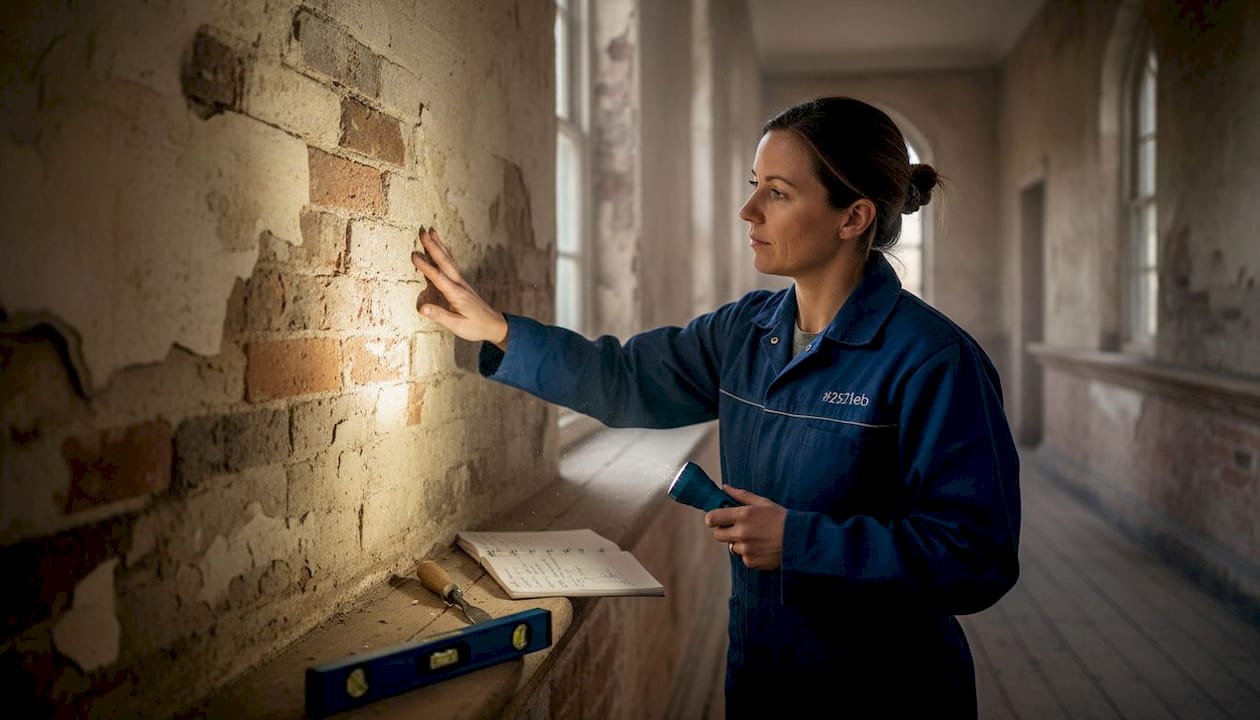
The principle here is simple: diagnose before you treat. Jumping straight to painting, or even to render repair, without understanding the moisture condition of the wall is guesswork. Effective moisture control follows a deliberate sequence.
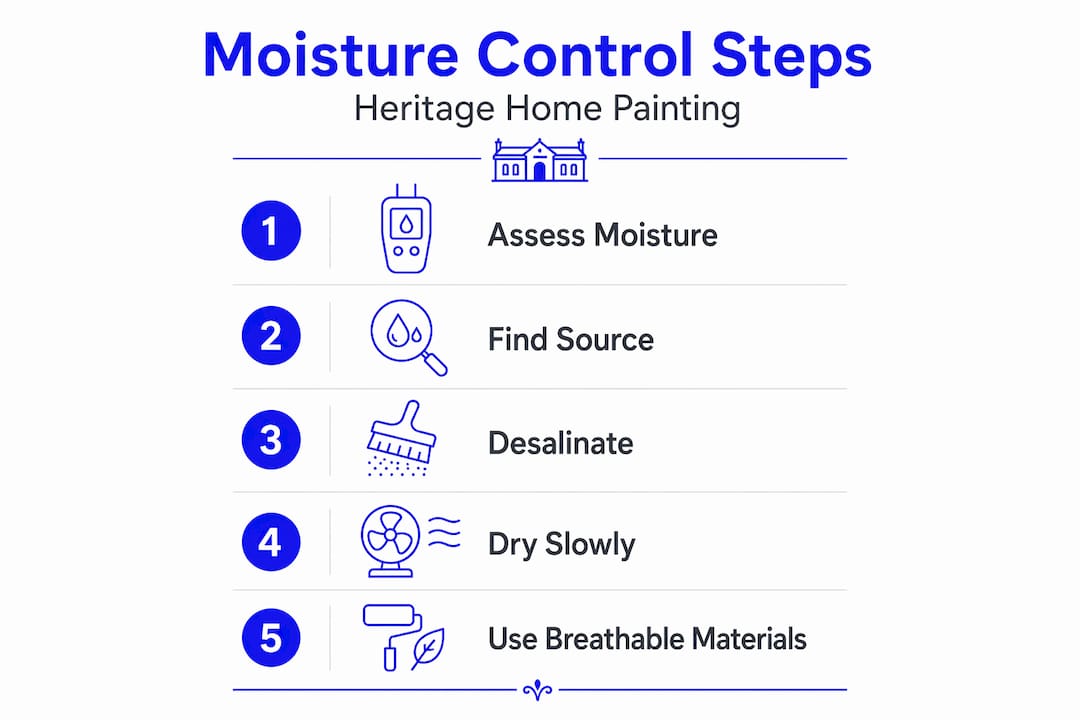
Step 1: Moisture assessment
Use a calibrated moisture meter to map damp areas across the wall surface. Readings above 17% in masonry typically indicate active moisture that needs to be addressed before any coating work begins. Combine meter readings with visual observation: look for efflorescence (white salt deposits), tide marks, spalling, and dark staining. Salt mapping involves testing samples from different wall zones to identify which salts are present and at what concentration.
Step 2: Diagnose the moisture source
Rising damp, penetrating damp, and condensation each require different treatments. Rising damp demands attention at the base of the wall, potentially including chemical damp-proof injection or improved ground drainage. Penetrating damp requires examination of the roof, gutters, flashings, and window surrounds. Condensation issues may point to ventilation deficiencies inside the home.
Step 3: Desalination
Desalination to reduce harmful salts in historic masonry before limewashing or repainting is a well-established conservation technique. It involves applying repeated poultices of clean water or absorptive materials to draw soluble salts out of the wall over a controlled period. This process takes time. Rushing it produces incomplete results and leaves residual salts that will reactivate once moisture returns.
Step 4: Controlled drying
After desalination, the wall must dry slowly and thoroughly. Forced drying with heat can cause micro-cracking. Natural, well-ventilated drying over several weeks is preferable. In Melbourne’s wetter months, this may mean scheduling remediation work during spring or autumn. Mildew detection tips can also help identify secondary biological growth that thrives in persistently damp masonry and needs addressing before painting.
Step 5: Restore with breathable materials
Once dry, any damaged render or mortar is made good using lime-based products that allow the wall to continue breathing. Cement-based fills should be avoided on heritage masonry because they are too rigid and too impermeable, creating new stress points.
Pro Tip: Always allow masonry to reach stable moisture readings for at least two to three weeks after remediation before applying any paint or coating. Patience here directly determines how long your paint job lasts.
The weatherproof painting process used on Melbourne heritage homes incorporates all of these steps as standard practice. Both interior painting and exterior painting on period homes require this level of substrate preparation to achieve results that hold up over time.
As documented in the conservation remediation at Vaucluse House, if a building is already salt-affected or suffering rising damp, simply repainting over existing moisture and salts can fail quickly. The evidence from formal conservation projects reinforces what experienced heritage practitioners know from the field: remediation is not optional.
Choosing the right paints and solutions for moisture-prone surfaces
Once moisture is managed, choosing the right protective coatings is essential for lasting results. The type of paint you select for a heritage masonry surface matters as much as the preparation work that precedes it.
There are three primary categories worth understanding for Melbourne’s period homes:
- Limewash: A traditional, highly breathable coating made from slaked lime. It bonds chemically with masonry, allows moisture to pass through freely, and has excellent compatibility with older brickwork and render. Its natural aesthetic also suits Victorian and Edwardian architecture well.
- Mineral paints (silicate paints): These penetrate the masonry surface and form a permanent chemical bond rather than sitting as a film on top. They are highly breathable, durable, and resistant to UV degradation, making them well-suited to Melbourne’s sun-exposed façades.
- Breathable acrylic paints: A modern option that, when formulated correctly, allows some moisture vapour transmission. Not all acrylics are equal in this regard. Products designed specifically for heritage or masonry applications perform very differently from standard exterior acrylics.
Standard, high-build acrylics can trap moisture within old masonry walls by forming an impermeable film. When moisture cannot escape, the pressure builds behind the paint layer and failure follows the same sequence described earlier. Appropriate breathable restoration approaches are commonly required in conservation practice, and the evidence from heritage projects across Australia supports this consistently.
For Melbourne homes where lime-based renders have been damaged or replaced with cement, restoration to breathable render is often the most valuable investment before any painting begins. A lime-based render coat allows the wall to function as it was designed to, protecting the masonry while permitting controlled moisture movement.
Pro Tip: Breathable finishes are not a compromise on durability. When applied correctly to properly prepared heritage masonry, limewash and mineral paints consistently outlast standard acrylics on period buildings.
Understanding how the right coatings protect and extend the life of heritage homes is central to any long-term maintenance strategy. The choice of paint is not purely aesthetic. It is a structural decision with direct consequences for your home’s longevity. Additional research into options like smoke-resistant paints and painted shutters can also inform a more complete approach to protecting period properties inside and out.
A heritage specialist’s hard-won lessons on moisture control
After working on Victorian and Edwardian homes across Melbourne’s inner east, bayside, and surrounding suburbs, one lesson stands out above all others: moisture control is about prevention, not remediation after the fact.
The most common mistake Sol Shine encounters is a homeowner who has had their home repainted two or three times in quick succession, each time after the previous coat failed within a few years. In almost every case, the root cause is untreated salt-affected masonry or an active moisture source that was never properly investigated. A fresh coat of paint, however premium the product, cannot overcome an unstable substrate.
What truly works is a commitment to evidence-based planning. That means taking the time to map moisture, test for salts, trace the source, remediate systematically, and wait for the wall to stabilise before touching a brush. It means choosing coatings that work with the masonry rather than against it. And it means understanding that salt-affected or damp buildings require desalination and breathable restoration approaches before any paint system will perform as expected.
The uncomfortable truth is that many painting quotes do not include this level of assessment because it requires time, expertise, and specialist knowledge that not every contractor possesses. For heritage homeowners, it is worth asking detailed questions about substrate assessment and moisture treatment before committing to any project. The weatherproof painting guide for Melbourne heritage homes outlines what a thorough approach should look like. Sol Shine’s articles and guides offer further reading for homeowners who want to understand what best practice in heritage painting and restoration actually involves.
Short-term solutions cost more in the long run. Investing in proper diagnostics and restoration at the outset protects both the home’s fabric and its heritage value for decades to come.
Expert restoration and painting solutions for Melbourne heritage homes
For lasting results and genuine peace of mind, partnering with specialist heritage painters can make all the difference. Sol Shine brings together moisture diagnostics, remediation, and tailored paint systems under one roof, handling every stage of a heritage project with the depth of knowledge these homes demand.

Whether you are dealing with salt-affected brickwork in Camberwell, penetrating damp on a weatherboard façade in Hawthorn, or render failure on a double-fronted terrace in Fitzroy, Sol Shine’s team applies the same rigorous approach: assess, remediate, restore, and protect. Browse our heritage painting services to see real projects and the results achieved. Our exterior painting solutions and interior painting solutions are tailored specifically for the unique demands of Victorian and Edwardian properties across Melbourne. We work directly with homeowners on projects typically $20,000 and above, ensuring every detail is handled with care and craftsmanship.
Frequently asked questions
What causes most paint failures in Victorian homes?
Most failures stem from untreated moisture and salt migration through masonry, leading to blistering, flaking, and peeling as salts crystallise behind the paint film.
Are limewash and breathable paints effective in controlling moisture?
Yes, they allow moisture vapour to escape through the masonry surface while reducing salt-related damage, making them the preferred choice for heritage conservation practice on period buildings.
How can I assess moisture before painting?
Use a calibrated moisture meter alongside visual salt mapping to identify damp and salt-affected zones, since salt crystallisation affects capillary absorption and changes how moisture behaves within the wall.
Is it possible to paint over damp walls if I use waterproof paint?
No. Painting over damp or salt-affected walls without proper remediation will almost certainly lead to rapid failure, because repainting over moisture and salts allows continued movement that breaks down the paint film from beneath.
What professional services are available for moisture control in heritage painting?
Specialist teams in Melbourne offer full moisture diagnostics, salt testing, desalination, breathable render restoration, and tailored moisture-tolerant paint systems designed specifically for Victorian and Edwardian properties.


