
TL;DR:
- Paint in heritage homes acts as essential protection against moisture, UV damage, and pests.
- Regular inspection and maintenance extend paint life and prevent costly structural repairs.
- Proactive preservation safeguards the home’s historic details and long-term property value.
Owning a Victorian or Edwardian home in Melbourne carries a particular kind of pride. These properties carry history, character, and architectural details you simply cannot replicate. But there is a common and costly misconception among homeowners: that paint is purely decorative, something to refresh when the colour looks tired or dated. The reality is that paint is your home’s primary armour against Melbourne’s unpredictable climate, persistent moisture, and the slow erosion of time. Ignoring its condition does not just affect how your home looks. It quietly sets the stage for structural damage, irreversible loss of heritage fabric, and repair bills that far exceed what a timely preservation programme would have cost.
Table of Contents
- Understanding heritage home paint preservation
- The real-world risks of neglected painting
- Paint longevity: What happens when you preserve, and when you don’t
- Best practices for paint preservation in Melbourne’s climate
- The overlooked truth: Why paint preservation is the real “heritage insurance”
- Restore and preserve your historic Melbourne home with expert help
- Frequently asked questions
Key Takeaways
| Point | Details |
|---|---|
| Paint is protection | Heritage paintwork shields your home from costly weather and decay, not just surface wear. |
| Neglect leads to loss | Ignoring paint maintenance risks serious timber rot, architectural damage, and expensive restorations. |
| Maintenance saves money | Regular paint inspections and touch-ups prevent major repairs and protect your investment. |
| Authenticity matters | Preserving old paint keeps your home historically accurate and valued within the community. |
Understanding heritage home paint preservation
To grasp why paint preservation matters so deeply, you need to understand the role paint played when your home was first built, and the role it must continue to play today.
Victorian and Edwardian homes were constructed with materials that are highly sensitive to environmental exposure. Softwood and hardwood timbers form the structural framing, decorative fretwork, window sills, fascias, and verandah posts. Unpainted or poorly protected, these timbers absorb moisture readily. In Melbourne’s climate, where wet winters and warm, dry summers cycle year after year, that swelling and contracting creates cracks, splits, and ultimately rot. Paint is what stands between the original fabric of your home and all of that.
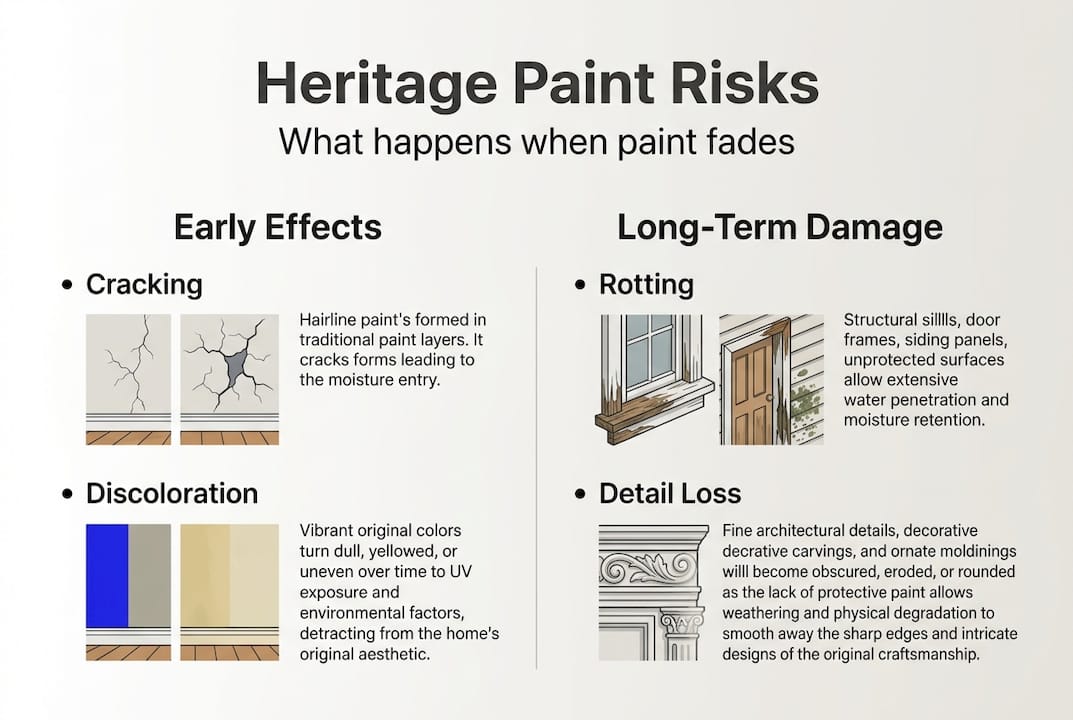
Preserving paint is a critical defence against weather and decay for heritage homes. When that defence weakens, the consequences go far beyond aesthetics. Paint that is chalking, cracking, or peeling is no longer providing a seal. Moisture finds its way in. Insects, particularly termites and borers, are drawn to damp, compromised timber. What began as flaking paint on a verandah post can become a structural repair involving full post replacement within just a few seasons.
Heritage homes in sought-after Melbourne suburbs like Kew, Hawthorn, Camberwell, and Brighton are also subject to council heritage overlays. These overlays govern not just what can be altered, but how properties must be maintained. Paintwork underpins the visual and physical integrity of these controls, which is precisely why preventative painting explained in the context of heritage care is not a luxury, it is a compliance consideration.
Key reasons why heritage paint preservation is foundational:
- Original paintwork creates a moisture barrier across timber, render, and masonry surfaces
- Pigmented coatings block UV radiation that degrades timber fibres over time
- Paint prevents the direct contact between pest species and structural timber
- Consistent colour and finish authenticity satisfies heritage overlay requirements
- Preserving existing paint layers maintains the historical record of your home’s character
“Your home’s paint is not just what people see. It is the reason the timber underneath has survived for over 100 years.”
The real-world risks of neglected painting
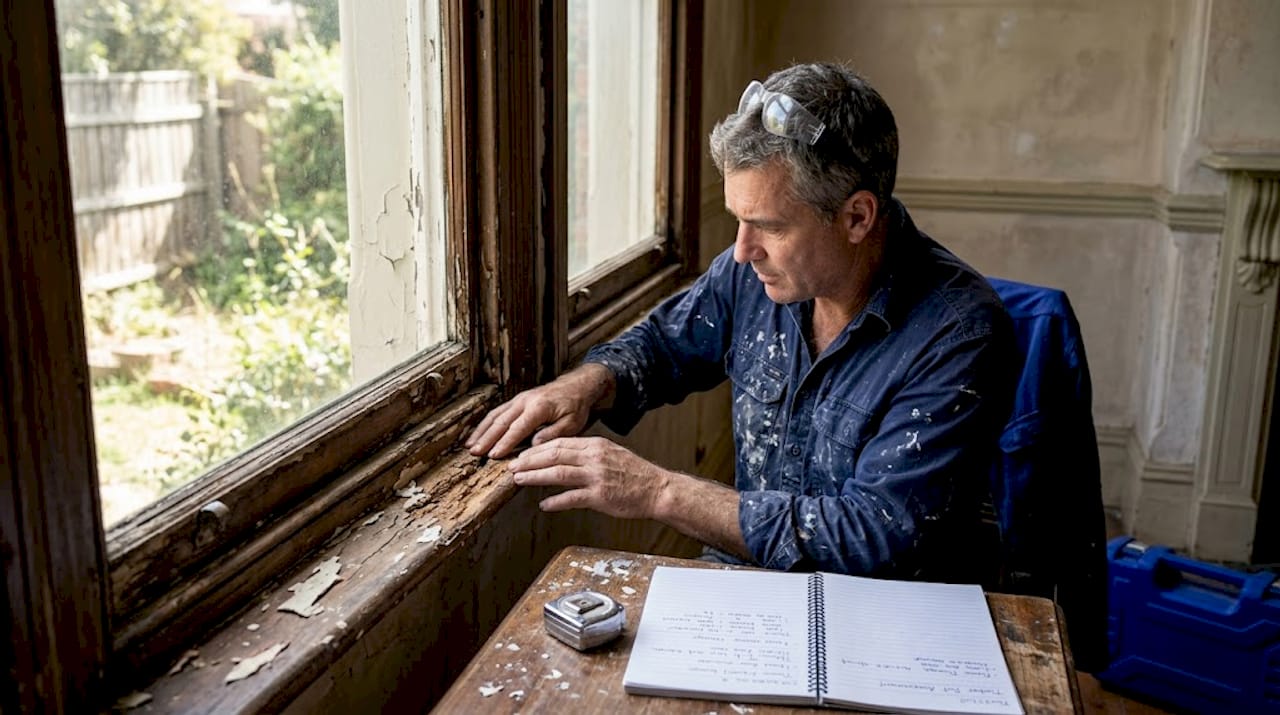
Understanding what is at risk without consistent care is essential. The deterioration process is rarely dramatic at first. It starts with small signs that are easy to dismiss: a little bubbling near a downpipe, some chalking on the south-facing façade, slight cracking along a window sill join. Left unaddressed, these early signals escalate quickly.
Poor maintenance allows weather and damp to compromise structural timbers in ways that cannot always be reversed without major intervention. When moisture penetrates through failed paint, it causes timber to swell. As it dries, the timber contracts. This cycle repeats with every rain event and dry spell, progressively opening cracks wider and driving moisture deeper into the substrate. At a certain point, rot sets in, and rotted structural timber cannot be simply repainted. It must be replaced, often at significant cost.
| Area of concern | Early neglect outcome | Long-term neglect outcome |
|---|---|---|
| Window sills and frames | Cracking, minor moisture ingress | Full sill replacement, frame rot |
| Decorative fretwork and trims | Paint peeling, slight checking | Timber decay, detail loss |
| Verandah posts and fascias | Surface chalking and lifting | Structural instability, replacement |
| Render and masonry surfaces | Hairline cracks, staining | Water ingress, render failure |
| Weatherboard cladding | Paint bubbling, minor swelling | Widespread rot, full replacement |
Well-maintained exteriors can double the service life of woodwork. That is not an overstatement. The difference between a heritage home with a proactive painting schedule and one where work is deferred comes down to whether you are spending money on preservation or on full-scale restoration.
Beyond structural risk, there is also the irreplaceable nature of original heritage details to consider. Victorian fretwork, Edwardian leadlight surrounds, bull-nosed verandah profiles, and ornate cornicing cannot simply be reproduced to the same standard. Once these features deteriorate beyond a certain point, restoration becomes both expensive and imperfect. Genuine preservation maintains these details so they never reach that point.
Pro Tip: If you notice bubbling or blistering paint on external surfaces, do not just scrape and re-coat over the top. Blistering is a sign that moisture is already present beneath the film. Addressing only the surface without investigating the underlying cause will mean the problem returns within months.
Common indicators that your heritage home needs urgent attention:
- Paint flaking or lifting in sheets from timber surfaces
- Brown or rust-coloured staining beneath painted surfaces
- Soft or spongy timber when pressed on sills or posts
- Visible cracking along joins, edges, or render faces
- Paint that is chalky and comes off on your hand when rubbed
- Mould or mildew forming on painted surfaces
Paint longevity: What happens when you preserve, and when you don’t
Seeing the difference preservation makes over time reveals why regular care pays for itself, often several times over.
Proper surface preparation and paint upkeep yield coatings that last over 10 years when done correctly. That figure is significant. It means a well-executed exterior repaint, paired with periodic maintenance, could serve your home for a decade or more before a full repaint is needed again. Contrast that with a poorly prepared or neglected surface, where the new paint coat may fail within two to three years, requiring complete stripping and repainting far sooner than anticipated.
Comparison: Paint preservation versus deferred care
| Factor | Proactive preservation | Deferred or reactive approach |
|---|---|---|
| Repaint frequency | Every 8 to 12 years | Every 3 to 5 years |
| Timber repair requirements | Minimal, surface-level only | Frequent, often structural |
| Cost over 20 years | Moderate, predictable | High, often unpredictable |
| Heritage detail retention | Excellent | Poor to moderate |
| Property value impact | Positive and sustained | Negative, particularly at sale |
Proactive maintenance can save homeowners thousands in restoration costs. These savings accumulate over time but they are also evident at specific moments, particularly when a property is sold or when heritage compliance is assessed.
Here is what the preservation journey looks like when managed properly:
- Annual inspection: Walk the exterior of your property each year and note areas of concern, particularly north and west-facing elevations that receive the most UV and weather exposure.
- Touch-up maintenance: Address minor paint failures immediately. Small cracks filled and spot-painted prevent moisture entry and slow deterioration dramatically.
- Scheduled full repaints: Plan full exterior repaints on a defined schedule, typically every 8 to 12 years depending on surface exposure, paint quality, and preparation standards.
- Professional assessments: Engage a heritage painting specialist every few years to assess surface condition beyond what is visible, including moisture readings and timber soundness.
- Documentation: Keep records of colour specifications, products used, and work completed. This supports heritage overlay compliance and adds to the property’s provenance.
Pro Tip: When scheduling a full exterior repaint, invest in premium-grade coatings with documented UV and moisture resistance ratings. The upfront cost difference between a premium and mid-range product is typically minor compared to the extended service life you gain, particularly on exposed Melbourne façades.
Best practices for paint preservation in Melbourne’s climate
Armed with the facts, the next step is translating them into practical actions that protect your heritage home year after year.
Melbourne’s climate presents a specific challenge for heritage paintwork. The city experiences significant temperature variation between seasons, with warm to hot summers, cool wet winters, and frequent spring and autumn weather events that combine UV exposure, wind, and rain within days of each other. Heritage homes, often oriented with at least one elevation exposed to prevailing westerly winds, bear the brunt of this.
Tailored surface preparation and weatherproofing are crucial for long-lasting results in this climate. A coat of paint applied over inadequately prepared surfaces will fail prematurely regardless of its quality. Preparation includes removing all failing paint, treating bare timber with appropriate primers, sealing joins and cracks with flexible sealants, and allowing adequate drying time between coats.
Routine inspections and touch-ups prevent deterioration and are far less disruptive and costly than emergency repairs. The approach should be systematic rather than reactive.
Recommended practices for Melbourne heritage homeowners:
- Inspect twice yearly, once in autumn before winter rains begin and once in spring to assess any winter damage.
- Match your colour palette to the original or approved heritage scheme. Many councils require colour matching for heritage overlay properties, and deviating without approval can create compliance issues.
- Use appropriate primer systems on any bare timber before applying finish coats. Bare timber primed and painted correctly outlasts timber that receives only a finish coat.
- Seal all penetrations and joins with flexible sealants rated for external use. Rigid fillers will crack with timber movement and invite moisture entry.
- Never paint over wet or damp surfaces. Moisture trapped beneath a new paint film will cause early failure and can accelerate timber rot beneath.
- Engage a heritage painting specialist for any work involving original decorative features, period mouldings, or leadlight surrounds where incorrect technique could cause irreversible damage.
Know when professional help is genuinely necessary. Touch-up work on a small section of sound, stable paintwork is well within the scope of a diligent homeowner. But when paint failure covers large areas, when substrate damage is suspected, or when the work involves heritage-listed or architecturally significant features, professional expertise is not optional. It is the responsible and cost-effective choice.
The overlooked truth: Why paint preservation is the real “heritage insurance”
Having covered the technical detail and the practical steps, it is worth stepping back and addressing something that rarely gets said directly to heritage homeowners.
Sol Shine has worked on Victorian and Edwardian homes across Melbourne for many years. One pattern repeats itself consistently. The homeowners who face the most significant and expensive restoration challenges are not those who made bad decisions. They are those who simply did not know that paint preservation needed to be treated as seriously as any other form of property maintenance.
Paint preservation is, in effect, your heritage home’s insurance policy. Every year that a sound paint film sits on your timber and render, it is actively working. It is blocking moisture. It is preventing UV degradation. It is holding the line against the entropy that affects every unprotected building material. The year you defer that inspection, or delay addressing that bubbling section on the south verandah, you are effectively allowing that insurance to lapse.
Proactive paint care upholds both the beauty and the legacy of Melbourne’s historic homes. But it does something else that is perhaps equally important. It keeps future options open. A well-preserved heritage home can be refreshed, updated, and admired for generations. A neglected one forces your hand, requiring expensive emergency intervention that may still leave your property with replaced details, patched render, or substituted timbers that are not quite right.
Long-term owners who have lived through a significant restoration almost always say the same thing: they wish they had started a consistent preservation programme earlier. Not because the restoration was not ultimately worthwhile, but because the earlier investment in paint care would have meant the restoration never needed to be as extensive or as costly.
Heritage paintwork is less about today’s appearance and more about protecting what cannot be replaced tomorrow. That framing changes how you approach decisions. An annual inspection and a minor touch-up programme stops feeling like an expense and starts feeling like exactly what it is: the most sensible investment you can make in a property of genuine historical significance.
Restore and preserve your historic Melbourne home with expert help
If you have recognised some of the warning signs discussed in this article on your own property, or if you simply want to establish a proper preservation programme for a home you cherish, professional guidance makes all the difference.
Sol Shine specialises in large-scale heritage restoration and painting projects for Victorian and Edwardian homes across Melbourne’s inner east, bayside, and surrounding suburbs. From premium interior painting to full exterior repaints and heritage painting services that respect the original character of your home, every project is handled with the craftsmanship these properties deserve. If you are wondering whether your property’s condition is already affecting its value, explore how restoration boosts value for historical homes in Melbourne’s premium market. Contact Sol Shine to discuss your heritage home and take the first step toward lasting protection and genuine peace of mind.
Frequently asked questions
How often should paint on a Victorian or Edwardian home be checked or maintained?
Inspect paintwork on heritage homes at least annually, ideally ahead of winter to catch any vulnerabilities and keep surfaces in peak condition. Routine inspections and touch-ups prevent deterioration and reduce the need for costly emergency repairs.
Does repainting affect the value of heritage homes in Melbourne?
Well-preserved paintwork enhances both kerb appeal and property value, while neglected finishes can lead to major value loss during sales. Proactive maintenance can save homeowners thousands in restoration costs while protecting long-term marketability.
What are the most common paint preservation mistakes on historic homes?
Skipping thorough surface preparation and ignoring small cracks are the two most damaging mistakes, as both accelerate deterioration and significantly increase long-term repair costs. Proper surface preparation and regular upkeep yield coatings that last over 10 years when done correctly.
Why not just repaint instead of preserving old paint?
Preserving existing heritage paint maintains historical accuracy and prevents disturbing original architectural details that cannot easily be recreated. Preserving paint is a critical defence against weather and decay, making it far more valuable than simply applying a fresh coat over a compromised surface.


