
Many Melbourne homeowners invest heavily in heritage restorations only to watch their paintwork fail within two years. The culprit isn’t always poor workmanship or cheap materials. Melbourne’s unique environmental challenges, from intense UV radiation to reactive clay soils, demand specific paint systems and application techniques that standard approaches simply can’t deliver. Understanding what truly influences paint durability on Victorian and Edwardian homes helps you make informed decisions that protect your investment for decades, not just seasons.
Table of Contents
- Key takeaways
- Melbourne’s environmental challenges affecting paint durability
- Choosing the right paint and coating systems for heritage homes
- Application best practices for maximum paint lifespan
- Strategies to prevent common paint failures on heritage homes
- Get expert help for durable heritage paintwork in Melbourne
- Frequently asked questions
Key Takeaways
| Point | Details |
|---|---|
| UV drives fade | Intense UV causes paint binders to break down, resulting in chalky, discoloured surfaces on north facing facades. |
| Temperature swings stress | Daily twenty degree temperature swings force painted timber and metal to flex, creating micro cracks that allow moisture to penetrate. |
| Coastal salt air | Properties near Port Phillip Bay experience accelerated corrosion on metal elements and moisture ingress due to salt air. |
| Breathable premium paints | Premium breathable paints allow moisture to escape and reduce moisture related damage when used with proper surface preparation and movement accommodating systems. |
| Surface prep matters | Thorough surface preparation helps joints and mortar lines resist soil movement and prevents cracking. |
Melbourne’s environmental challenges affecting paint durability
Melbourne’s climate presents a perfect storm for paint degradation on heritage homes. Australia’s high UV levels cause fading in cheap paints within just 18 months, far faster than most homeowners expect. The sun’s intensity breaks down paint binders, leaving surfaces chalky and discoloured. Victorian and Edwardian homes with north-facing facades suffer most, as these surfaces receive maximum UV exposure throughout the day.
Temperature swings compound the problem. Melbourne can experience 20-degree variations in a single day, forcing painted timber and metal to expand and contract repeatedly. Without flexible paint formulations, this constant movement creates microscopic cracks that widen over time. These cracks allow moisture penetration, accelerating deterioration beneath the surface where you can’t see it until peeling begins.
Humidity combined with coastal salt air creates another layer of complexity. Properties within 10 kilometres of Port Phillip Bay face accelerated corrosion on metal elements like lacework, gutters, and downpipes. Salt particles settle on painted surfaces and draw moisture from the air, creating a corrosive environment that attacks both the paint film and the substrate underneath. This explains why premium paint materials for heritage homes must include corrosion inhibitors and superior moisture resistance.
Reactive clay soils dominate Melbourne’s geology, particularly in suburbs like Kew, Camberwell, and Malvern. These soils expand dramatically when wet and shrink during dry periods, causing ground movement that stresses building foundations and lower walls. Paint systems that can’t flex with this movement crack along mortar lines and timber joints. The damage often appears as stepped cracking following the brick coursing or vertical splits in weatherboards near ground level.
Wind-blown dust and abrasion wear down exposed surfaces faster than protected areas. Ornamental ironwork, verandah posts, and weatherboard corners lose paint thickness gradually through constant particle bombardment. This mechanical wear is especially severe on properties near construction sites or busy roads where airborne particles are abundant.
Moisture management becomes critical for heritage timber. Poor ventilation beneath homes or blocked subfloor vents creates humid conditions perfect for fungal growth. When non-breathable paints trap this moisture against timber surfaces, rot develops beneath seemingly intact paintwork. Preventative painting that preserves Melbourne heritage homes must address these ventilation issues before applying new coatings.
“Melbourne’s combination of intense UV, temperature extremes, humidity, and reactive soils creates the most demanding environment for exterior paint in Australia. Standard paint systems simply aren’t engineered for these conditions.”
Choosing the right paint and coating systems for heritage homes
Traditional limewash offers exceptional breathability that allows moisture to escape from heritage masonry and timber. However, this breathability comes at a cost. Limewash wears quickly under Melbourne’s harsh conditions, requiring reapplication every three to five years. Many heritage purists prefer limewash for its authentic appearance and compatibility with original building materials, but homeowners must accept the ongoing maintenance commitment.
Modern acrylic paints deliver superior weather resistance and colour retention compared to traditional options. Premium acrylics resist UV degradation far better than oil-based alternatives, maintaining their appearance for 10 to 15 years when properly applied. The challenge lies in selecting formulations with adequate breathability. Cheap acrylics create an impermeable film that traps moisture, leading to blistering and peeling on heritage timber that needs to breathe.
Hybrid paint formulas represent the sweet spot for many Melbourne heritage restorations. These products combine acrylic durability with modified breathability, allowing controlled moisture vapour transmission while blocking liquid water. Hybrid systems suit heritage fabric because they protect against Melbourne’s weather without compromising the building’s ability to dry naturally. This balance proves especially important for walls that experience seasonal moisture fluctuations.
| Paint type | Durability | Breathability | Best application | Maintenance cycle |
|---|---|---|---|---|
| Traditional limewash | Low | Excellent | Masonry, render | 3-5 years |
| Modern acrylic | High | Variable | Weatherboards, trim | 10-15 years |
| Hybrid formula | High | Good | All heritage surfaces | 10-12 years |
| Elastomeric | Very high | Moderate | Foundations, lower walls | 12-15 years |
| Powder coating | Excellent | Not applicable | Metal lacework, railings | 15-20 years |
Gloss finishes deserve careful consideration on heritage homes. High-gloss paints can conceal minor surface imperfections common in Victorian-era substrates, but they also highlight any underlying movement or settling. Semi-gloss or satin finishes often provide better results, offering good cleanability without emphasising every substrate irregularity. The key is matching sheen level to surface condition and expected movement.
Powder coatings outperform liquid paints on metal elements exposed to Melbourne’s climate. Powder coating on Victorian lacework creates a tougher, more uniform film that resists chipping, UV damage, and corrosion far better than brush-applied paints. While the initial investment is higher due to specialised application requirements, the extended maintenance intervals make powder coating cost-effective for ornamental ironwork, gates, and railings.
Elastomeric paints accommodate ground movement on homes affected by reactive clay soils. These flexible coatings stretch and contract with the substrate, preventing the stress cracks that plague rigid paint films. Apply elastomeric products to foundations, lower weatherboards, and areas showing historical crack patterns. This targeted approach delivers movement accommodation where needed without the higher cost of treating entire facades.
Pro tip: Test any new paint system on a small, inconspicuous area before committing to full application. This reveals compatibility issues with existing coatings and helps you assess colour accuracy under your home’s specific lighting conditions.
Application best practices for maximum paint lifespan
Environmental conditions during application determine paint performance as much as product quality. Apply paint between 10-32°C with humidity levels from 40% to 70% for optimal curing. Temperatures below 10°C slow drying and prevent proper film formation, while heat above 32°C causes rapid solvent evaporation that weakens the paint film. These aren’t suggestions but chemistry requirements that directly affect adhesion and durability.
Direct sunlight creates surface temperatures far exceeding air temperature, causing paint to dry too quickly on the outside while remaining wet underneath. This differential drying produces lap marks, poor flow, and reduced adhesion. Plan painting schedules to follow the shade around your home, or work on overcast days when possible. Rain within 24 hours of application washes away uncured paint and creates permanent water marks.
Surface preparation makes or breaks paint longevity on heritage homes. Low-pressure washing removes dirt and loose paint without damaging delicate timber mouldings or eroding soft mortar joints. High-pressure equipment tears fibres from weatherboards and blasts mortar from brickwork, creating more problems than it solves. Hand scraping and sanding remain the safest methods for intricate woodwork and ornamental details.
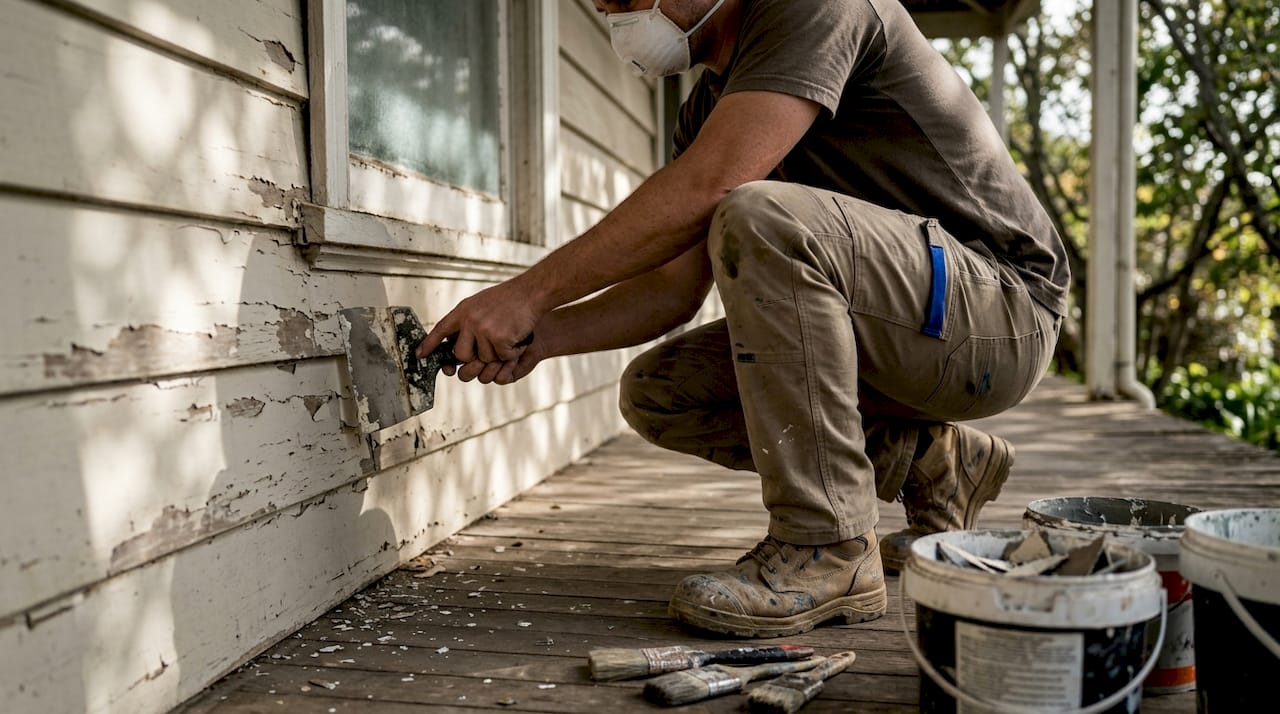
Tool selection affects finish quality and paint consumption. Brush application works best for trims, window frames, and detailed woodwork where precision matters. Quality brushes lay paint smoothly without leaving bristle marks or creating thick edges. Spraying suits large weatherboard expanses and hard-to-reach areas, but requires back-brushing to work paint into the timber grain and ensure proper adhesion. Roller application falls between these extremes, offering reasonable speed on flat surfaces.
Testing small areas before full application prevents costly mistakes. Paint a single weatherboard or small wall section and observe how the product behaves. Does it flow smoothly? Does the colour match your expectations in natural light? Are there any adhesion issues with the existing coating? These trial areas also help you gauge coverage rates and drying times under actual site conditions.
- Check weather forecasts for a stable three-day window with suitable temperatures and no rain predicted
- Clean surfaces thoroughly using low-pressure washing and allow 48 hours drying time
- Scrape and sand loose paint, feathering edges to create smooth transitions
- Apply primer to bare timber and previously unpainted surfaces, following manufacturer specifications
- Paint during optimal temperature and humidity conditions, following the shade
- Apply subsequent coats only after previous layers have fully cured
- Inspect completed work for missed spots, drips, or thin coverage requiring touch-ups
Proper application reduces rework from defects. Studies show poor workmanship generates 35% of construction waste, including failed paint that must be stripped and reapplied. Following step-by-step exterior painting procedures eliminates most common application errors that compromise durability.
Pro tip: Monitor weather forecasts obsessively during painting projects. Conditions can change rapidly in Melbourne, and starting work during a marginal weather window often leads to compromised results. Patience pays dividends in paint longevity.
Strategies to prevent common paint failures on heritage homes
Cracking typically results from soil movement in Melbourne’s clay-rich soils rather than paint quality issues. Properties in suburbs with reactive clay experience seasonal ground movement that stresses rigid paint films beyond their elastic limit. Elastomeric coatings absorb this stress through controlled stretching, preventing the crack propagation that ruins conventional paint systems. Focus elastomeric products on foundations and lower walls where movement is most severe.
Peeling indicates moisture problems or inadequate surface preparation. Non-breathable coatings trap water vapour migrating from inside the home or rising from the ground. This trapped moisture eventually lifts the paint film from the substrate. Check for blocked subfloor vents, leaking gutters, or damaged flashings before repainting. Addressing these moisture sources prevents recurring peeling cycles that waste time and money.
UV degradation manifests as fading, chalking, and loss of gloss on sun-exposed surfaces. Cheap paints use lower-quality pigments and binders that break down rapidly under Melbourne’s intense sunlight. Premium acrylics provide longer protection through superior UV stabilisers and lightfast pigments. The cost difference between economy and premium paint becomes negligible when you factor in labour costs for more frequent repainting.
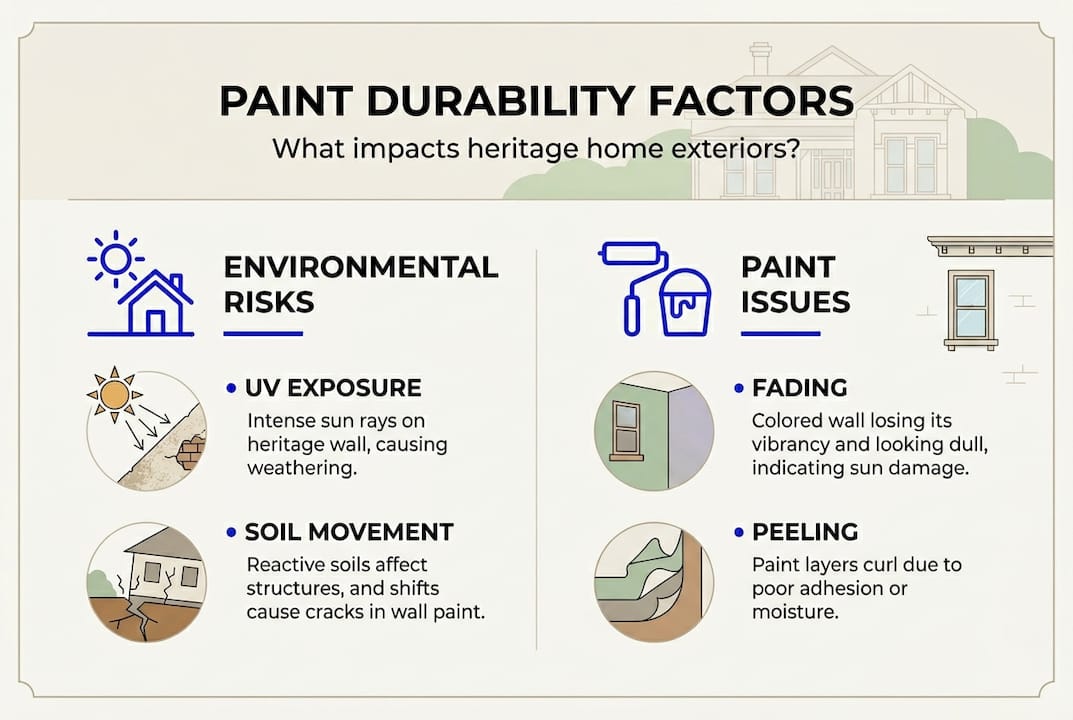
Regular maintenance extends paint lifespan significantly. Annual inspections identify small problems before they become major failures. Clean painted surfaces yearly to remove salt deposits, mould, and accumulated grime. Touch up damaged areas promptly before moisture penetrates to the substrate. This preventative approach costs far less than full repainting every few years.
| Failure mode | Primary cause | Visual symptoms | Prevention strategy |
|---|---|---|---|
| Cracking | Soil movement, substrate flex | Linear cracks following joints | Elastomeric paints on affected areas |
| Peeling | Trapped moisture, poor prep | Paint lifting in sheets | Breathable coatings, fix moisture sources |
| Fading | UV degradation | Colour loss, chalky surface | Premium UV-resistant formulations |
| Blistering | Moisture, rapid heating | Raised bubbles in paint film | Proper drying time, avoid direct sun |
| Mould growth | Poor ventilation, shade | Black/green surface staining | Improve airflow, mould-resistant primers |
| Corrosion | Salt exposure, moisture | Rust staining, metal deterioration | Corrosion-inhibiting primers, powder coating |
Hiring specialist painters experienced with heritage homes reduces failure risk substantially. These professionals understand Melbourne’s environmental challenges and know which products and techniques deliver lasting results on Victorian and Edwardian properties. Their expertise prevents the costly rework that comes from inexperienced application.
Design changes and poor planning also contribute to paint failures. Changing colour schemes mid-project or modifying surface preparations wastes materials and labour. Detailed planning before work begins eliminates these inefficiencies. Specify all products, colours, and procedures in advance, then stick to the plan unless genuine problems emerge.
Get expert help for durable heritage paintwork in Melbourne
Achieving truly durable paintwork on Melbourne heritage homes requires specialised knowledge and premium materials. Professional heritage painters understand how to match paint systems to your home’s specific challenges, from reactive soils to intense UV exposure. They know which products breathe properly for timber substrates while still providing weather protection that lasts.
Sol Shine specialises in heritage painting for Victorian and Edwardian homes across Melbourne’s inner east and bayside suburbs. Our projects typically exceed $20,000 because we take the comprehensive approach needed for lasting results. We handle everything from detailed surface preparation to final protective coatings, ensuring every step meets heritage restoration standards.
Our team brings decades of combined experience working with heritage properties in Kew, Hawthorn, Brighton, Malvern, and surrounding areas. We understand the unique requirements of period homes and use exterior coatings specifically formulated for Melbourne’s demanding climate. This expertise minimises costly rework and extends your paint investment far beyond what standard approaches deliver.
“Investing in professional heritage painting isn’t an expense, it’s insurance against the frustration and cost of premature paint failure. Quality workmanship and appropriate materials pay for themselves through extended maintenance intervals.”
Frequently asked questions
What are the main environmental factors that reduce paint durability on Melbourne heritage homes?
UV radiation, temperature fluctuations, humidity, coastal salt spray, and reactive clay soils all accelerate paint degradation. Melbourne’s intense sunlight breaks down paint binders, while daily temperature swings cause expansion and contraction that cracks rigid films. Proper paint selection and application timing help mitigate these environmental challenges.
How does soil movement affect paint on Victorian and Edwardian homes?
Reactive clay soils expand when wet and shrink during dry periods, causing ground movement that stresses foundations and lower walls. This movement creates cracks in rigid paint films, particularly along mortar joints and timber connections. Elastomeric paints flex with substrate movement, preventing crack formation and extending paint lifespan in affected areas.
What paint types offer the best durability and breathability for heritage restorations?
Hybrid acrylic formulations provide excellent durability with controlled breathability, making them ideal for heritage timber and masonry. These paints resist Melbourne’s UV exposure and weather while allowing moisture vapour to escape. Traditional limewash offers maximum breathability but requires reapplication every three to five years due to lower durability.
Why do some heritage homes experience peeling paint despite using quality products?
Peeling usually indicates trapped moisture rather than paint quality issues. Non-breathable coatings seal water vapour against the substrate, eventually lifting the paint film. Check for blocked subfloor vents, leaking gutters, or rising damp before repainting. Addressing these moisture sources and using breathable paint systems prevents recurring peeling problems.
How long should quality exterior paint last on a Melbourne heritage home?
Properly applied premium paint systems typically last 10 to 15 years on Melbourne heritage homes when maintenance is performed regularly. Factors affecting longevity include surface preparation quality, application conditions, paint breathability, and exposure to UV radiation. Properties with severe soil movement or coastal salt exposure may require more frequent maintenance regardless of paint quality.


